
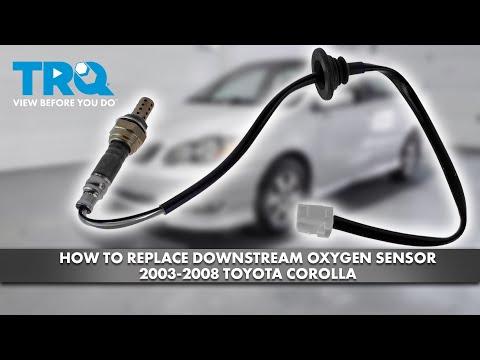







How to Replace Upstream & Downstream O2 Sensors on a 2007 Toyota Corolla
Step-by-step instructions with tools/parts list, OBD2 code tips, and 33 ft-lb (44 Nm) torque spec for 2005, 2006, 2007, 2008
How to Replace Upstream & Downstream O2 Sensors on a 2007 Toyota Corolla
Step-by-step instructions with tools/parts list, OBD2 code tips, and 33 ft-lb (44 Nm) torque spec for 2005, 2006, 2007, 2008


🔧 Corolla - Oxygen (O2) Sensor Replacement
Your Corolla uses oxygen sensors to measure exhaust oxygen so the engine computer can adjust fuel mixture and monitor the catalytic converter. Replacing a failed sensor can fix a check engine light, poor fuel economy, or emissions-test failures.
Difficulty Level: Intermediate | Estimated Time: 0.5-1.5 hours
⚠️ Safety & Precautions
- ⚠️ Exhaust parts get extremely hot—work on a fully cool engine/exhaust.
- ⚠️ Support the car with jack stands before going underneath; never rely on a jack alone.
- ⚠️ Use eye protection—rust and debris fall when loosening sensors.
- ⚠️ Don’t pull on the wiring harness; unplug by the connector only.
- ⚠️ Keep penetrating oil off the sensor tip and connector.
🔧 Required Tools
You'll need the following tools for this repair:
- Safety glasses
- Nitrile gloves
- Floor jack (rated 2-ton minimum)
- Jack stands (rated 2-ton minimum)
- Wheel chocks
- 22mm oxygen sensor socket (specialty)
- 3/8" drive ratchet
- 3/8" drive extension set
- Breaker bar (3/8" or 1/2")
- Torque wrench (10–100 ft-lb range)
- Trim clip tool
- Flathead screwdriver
- Penetrating oil
- OBD2 scan tool (specialty)
🔩 Required Parts
HowToo sells all the parts you need for this repair:
- Upstream air/fuel ratio sensor (Sensor 1) - Qty: 1
- Downstream oxygen sensor (Sensor 2) - Qty: 1
- Anti-seize compound (oxygen-sensor safe) - Qty: 1
📋 Before You Begin
- Park on level ground, shift to neutral, set the parking brake, and chock the rear wheels.
- Let the exhaust cool completely (at least 1 hour after driving).
- Decide which sensor you’re replacing:
- Sensor 1 (Upstream/A/F): on the exhaust manifold at the front of the engine (top side).
- Sensor 2 (Downstream/O2): in the exhaust pipe after the catalytic converter (under the car).
- Tip: Read the code first (P013x/P015x).
🔨 Step-by-Step Instructions
Follow these steps in order:
Step 1: Confirm which sensor the code points to
- Plug in your OBD2 scan tool (specialty) and read stored codes.
- Use this quick map:
- P0130–P0135 usually relates to Sensor 1 (upstream).
- P0136–P0141 usually relates to Sensor 2 (downstream).
- P0420 is often catalyst-related; a sensor can be a cause, but not always.
Step 2: Access the sensor
- If replacing Sensor 1 (Upstream/A/F):
- Open the hood and locate the sensor screwed into the exhaust manifold (front of engine).
- If a plastic cover or clips block access, remove them using a trim clip tool or flathead screwdriver.
- If replacing Sensor 2 (Downstream/O2):
- Lift the front of the car with a floor jack (rated 2-ton minimum) and place it on jack stands (rated 2-ton minimum).
- Keep wheel chocks in place.
- Locate the sensor threaded into the exhaust pipe after the catalytic converter.
Step 3: Unplug the electrical connector
- Spray a small amount of penetrating oil on the sensor threads only (avoid the connector).
- Find the sensor connector and release the lock tab using a flathead screwdriver (gentle pressure).
- Separate the connector by pulling on the plastic housing, not the wires.
Step 4: Remove the old sensor
- Slip the 22mm oxygen sensor socket (specialty) over the sensor (it has a slot for the wire).
- Use a 3/8" drive ratchet with a 3/8" drive extension set as needed to get a straight angle.
- If it’s stuck, use a breaker bar (3/8" or 1/2") to crack it loose, then spin it out.
- Tip: Short, controlled force works best.
Step 5: Install the new sensor
- Compare the old and new sensor (thread size, connector, wire length).
- Check the new sensor’s threads:
- If the new sensor threads already have a coating, do not add anti-seize.
- If threads are bare, apply a tiny amount of anti-seize compound (oxygen-sensor safe) to the threads only (keep it off the tip).
- Start threading the sensor by hand 3–4 turns to avoid cross-threading.
- Tighten with the 22mm oxygen sensor socket (specialty) and torque wrench (10–100 ft-lb range).
- Torque to 44 Nm (33 ft-lb).
Step 6: Reconnect wiring and secure the harness
- Plug the connector back in until it clicks.
- Route the wiring the same way as factory and clip it back into holders (use the trim clip tool if needed).
- Make sure the harness is not touching the exhaust.
Step 7: Lower the car (if you lifted it)
- Raise slightly with the floor jack (rated 2-ton minimum), remove the jack stands (rated 2-ton minimum), then lower the car.
- Remove wheel chocks after the car is fully on the ground.
✅ After Repair
- Use the OBD2 scan tool (specialty) to clear codes.
- Start the engine and listen for exhaust leaks near the sensor (a ticking sound).
- Verify no check engine light returns immediately.
- Take a 10–15 minute drive with mixed city/highway speeds; re-scan for pending codes.
- Tip: Some monitors need 1–3 drive cycles.
💰 DIY vs Shop Cost
Shop Cost: $200-$450 (parts + labor)
DIY Cost: $60-$180 (parts only)
You Save: $140-$270 by doing it yourself!
Shop labor rates vary but typically run $100-$150/hour. This repair takes a shop approximately 0.5-1.5 hours.
🎯 Ready to get started?
HowToo makes it easy: same-day/2-day shipping on every part, plus all the tools and specialty tools you need! Check out the parts and tools sections below to add everything to your cart.