

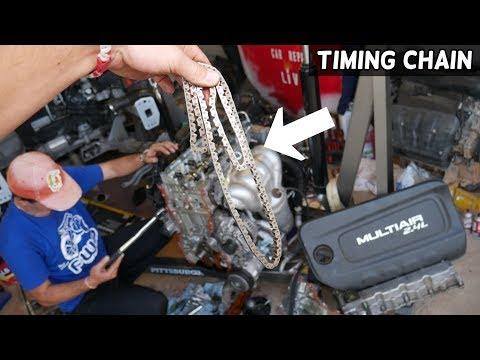







How to Replace the Timing Chain on a 2018 Jeep Renegade 2.4L (Not a Timing Belt)
Step-by-step timing chain replacement with required tools, parts list, TDC timing setup, and reseal tips for 2015, 2016, 2017, 2018, 2019, 2020, 2021
How to Replace the Timing Chain on a 2018 Jeep Renegade 2.4L (Not a Timing Belt)
Step-by-step timing chain replacement with required tools, parts list, TDC timing setup, and reseal tips for 2015, 2016, 2017, 2018, 2019, 2020, 2021


🔧 Renegade - Timing Chain Replacement
Your Renegade’s 2.4L engine uses a timing chain, not a timing belt. The chain is internal (behind the front cover) and replacement is a big job because the engine must be set at exact timing marks and resealed to prevent oil/coolant leaks.
Difficulty Level: Advanced | Estimated Time: 6-10 hours
⚠️ Safety & Precautions
- 🧯 Let the engine cool fully before draining coolant.
- 🧤 Disconnect the negative battery cable to prevent accidental cranking.
- 🧱 Support the vehicle with jack stands; never rely on a floor jack.
- 🪝 The right-side engine mount comes off; support the engine from above before removing it.
- 🔥 Sealant and fluids are messy—wear gloves and safety glasses.
🔧 Required Tools
You'll need the following tools for this repair:
- Safety glasses
- Nitrile gloves
- Floor jack (rated 3-ton minimum)
- Jack stands (rated 3-ton minimum)
- Wheel chocks
- Metric socket set 8mm-21mm
- Metric wrench set 8mm-21mm
- Torx bit set T20-T50
- E-Torx socket set E8-E18
- Breaker bar 1/2"
- Torque wrench 3/8"
- Torque wrench 1/2"
- Harmonic balancer puller kit
- Engine support bar (specialty)
- Timing holding/locking tool set for 2.4L (specialty)
- Trim clip removal tool
- Flat blade screwdriver
- Pry bar
- Drain pan (at least 10-quart)
- Funnel
- Plastic razor scraper
- Brake cleaner spray
- Shop rags
🔩 Required Parts
HowToo sells all the parts you need for this repair:
- Timing chain kit (chain, guides, tensioner) - Qty: 1
- Front timing cover gasket set or RTV sealant (OEM-approved) - Qty: 1
- Crankshaft front seal - Qty: 1
- Valve cover gasket - Qty: 1
- Serpentine drive belt - Qty: 1
- Engine oil (0W-20 full synthetic) - Qty: 5 quarts
- Oil filter - Qty: 1
- Engine coolant (OAT, 50/50 premix) - Qty: 2-3 gallons
📋 Before You Begin
- Park on level ground, set the parking brake, and place wheel chocks behind the rear wheels.
- Disconnect the negative battery cable using a 10mm socket.
- Raise the front safely with a floor jack and support with jack stands.
- Plan for sealing time: the front cover uses RTV sealant (liquid gasket), which must be applied to clean, dry surfaces.
🔨 Step-by-Step Instructions
Follow these steps in order:
Step 1: Remove splash shields and drain coolant
- Remove the lower splash shield using a trim clip removal tool and Torx bit set T20-T30.
- Place a drain pan under the radiator drain, then drain coolant.
Step 2: Remove the right front wheel and access area
- Remove the right front wheel using a 19mm socket.
- Remove the inner fender liner using a trim clip removal tool and Torx bit set T20-T30.
Step 3: Support the engine and remove the right engine mount
- Install the engine support bar (specialty) across the strut towers and tension it to hold engine weight. Support first, unbolt second.
- Remove the right engine mount fasteners using a metric socket set 15mm-18mm and E-Torx socket set as needed.
- Reinstallation note: Torque all engine mount fasteners to factory specification (do not guess—use service info).
Step 4: Remove the serpentine belt and front drive components
- Release belt tension using a breaker bar 1/2" on the belt tensioner, then remove the belt.
- If equipped in the way, unbolt accessory brackets using a metric socket set and E-Torx socket set and move aside without stressing wiring/hoses.
Step 5: Remove the crankshaft pulley (harmonic balancer)
- Remove the crank bolt using a breaker bar 1/2" and correct metric socket.
- Use a harmonic balancer puller kit to pull the pulley off straight.
- Reinstallation note: Torque the crank bolt to factory specification. This is critical for engine safety.
Step 6: Remove the valve cover
- Disconnect any hoses/connectors in the way, then remove valve cover bolts using a metric socket set.
- Lift the cover off carefully; do not gouge sealing surfaces. Use a plastic razor scraper if needed.
- Reinstallation note: Torque valve cover bolts to factory specification.
Step 7: Set cylinder #1 to TDC and lock the timing
- Rotate the engine by hand at the crank using a metric socket and breaker bar 1/2" until timing marks align at TDC (Top Dead Center = piston at the top of its travel).
- Install the timing holding/locking tool set for 2.4L (specialty) to keep the cam/crank from moving.
- Do not rotate the engine once the chain is removed.
Step 8: Remove the front timing cover
- Remove front cover bolts using a metric socket set and E-Torx socket set.
- Gently separate the cover using a pry bar only at designated pry points. Don’t pry on sealing faces.
- Clean all old RTV from both surfaces using a plastic razor scraper, brake cleaner spray, and shop rags.
Step 9: Replace timing chain, guides, and tensioner
- Relieve and remove the chain tensioner using the metric socket set.
- Remove chain guides using the metric socket set or E-Torx socket set.
- Remove the chain and install the new chain aligned to the timing marks per the timing kit instructions.
- Install new guides and tensioner; Torque fasteners to factory specification.
Step 10: Install new front crank seal and reseal the timing cover
- Install the crankshaft front seal squarely (do not deform it) using a suitable driver from the harmonic balancer puller kit or a flat seal driver tool.
- Apply OEM-approved RTV sealant to the timing cover per bead locations in service information.
- Install the cover and tighten bolts evenly using a torque wrench; Torque to factory specification.
Step 11: Reassemble mount, belt drive, and covers
- Reinstall the crank pulley and crank bolt using a torque wrench 1/2"; Torque to factory specification.
- Reinstall accessory brackets using a torque wrench; Torque to factory specification.
- Reinstall the right engine mount using a torque wrench; Torque to factory specification.
- Install the new serpentine belt using a breaker bar 1/2" to rotate the tensioner.
- Reinstall the valve cover with a new gasket using a torque wrench 3/8"; Torque to factory specification.
- Reinstall the fender liner and splash shield using Torx bit set and trim clip removal tool.
- Reinstall the wheel using a 19mm socket; Torque lug nuts to factory specification.
Step 12: Refill fluids and reconnect battery
- Refill coolant using a funnel with the correct OAT 50/50 premix.
- Change oil and filter using a metric socket set, drain pan, and funnel.
- Reconnect the negative battery cable using a 10mm socket.
✅ After Repair
- Start the engine and listen: no rattling, slapping, or squealing.
- Check for oil leaks around the timing cover and crank seal area.
- Bring engine to operating temperature and verify heater output, then recheck coolant level after cool-down.
- If the check engine light comes on, scan for codes (timing correlation codes mean timing is off and the engine should be shut down).
💰 DIY vs Shop Cost
Shop Cost: $1,300-$2,600 (parts + labor)
DIY Cost: $250-$650 (parts only)
You Save: $1,050-$1,950 by doing it yourself!
Shop labor rates vary but typically run $100-$150/hour. This repair takes a shop approximately 6-10 hours.
🎯 Ready to get started?
HowToo makes it easy: same-day/2-day shipping on every part, plus all the tools and specialty tools you need! Check out the parts and tools sections below to add everything to your cart.