

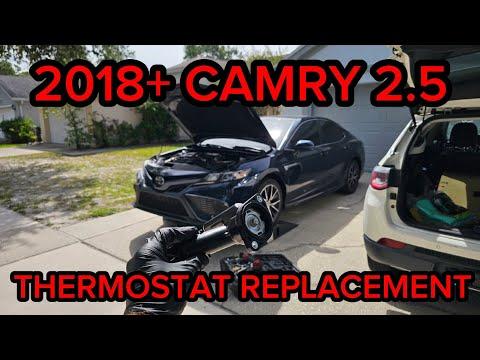






How to Replace the Thermostat on a 2020 Toyota Camry 2.5L
Step-by-step DIY thermostat change with tools, parts list, torque specs, coolant bleeding, and safety tips for 2018, 2019, 2020, 2021, 2022, 2023, 2024
How to Replace the Thermostat on a 2020 Toyota Camry 2.5L
Step-by-step DIY thermostat change with tools, parts list, torque specs, coolant bleeding, and safety tips for 2018, 2019, 2020, 2021, 2022, 2023, 2024


🔧 Camry - Thermostat Replacement
You’ll be removing the thermostat housing, swapping in a new thermostat, and refilling/bleeding the coolant. This helps fix issues like overheating, running too cold, or poor heater performance when the thermostat is sticking.
Difficulty Level: Intermediate | Estimated Time: 2-3 hours
⚠️ Safety & Precautions
- ⚠️ Always work on a completely cool engine; hot coolant can cause serious burns.
- ⚠️ Support the front of your Camry on jack stands, never rely on the jack alone.
- ⚠️ Coolant is toxic to people and animals; avoid skin contact and clean spills immediately.
- ⚠️ Keep coolant away from belts and the alternator; it can cause damage or slipping.
- ⚠️ Disconnect the negative battery cable if your tools might touch the starter or alternator area.
- ⚠️ Dispose of old coolant properly at a recycling center or workshop, not down the drain or on the ground.
🔧 Required Tools
You'll need the following tools for this repair:
- 🔹Floor jack (rated 3-ton minimum)
- 🔹Jack stands (rated 3-ton minimum)
- 🔹Wheel chocks
- 🔹10mm socket
- 🔹12mm socket
- 🔹1/4" drive ratchet
- 🔹3/8" drive ratchet
- 🔹3" socket extension
- 🔹Torque wrench (inch-lb and ft-lb capable)
- 🔹Flathead screwdriver (medium size)
- 🔹Pliers (regular slip-joint)
- 🔹Hose clamp pliers (specialty)
- 🔹Drain pan (at least 10-liter capacity)
- 🔹Plastic trim tool
- 🔹Shop rags or microfiber towels
- 🔹Funnel (medium-size)
- 🔹Coolant filling/burping funnel kit (specialty)
- 🔹Safety glasses
- 🔹Mechanic gloves
🔩 Required Parts
HowToo sells all the parts you need for this repair:
- 🔹Engine thermostat (with jiggle valve, correct temp for Camry 2.5L) - Qty: 1
- 🔹Thermostat housing gasket or O-ring - Qty: 1
- 🔹Toyota Super Long Life coolant (pink, pre-mixed 50/50) - Qty: 2-3 gallons
- 🔹Thermostat housing bolts (optional replacement) - Qty: 2
- 🔹Upper radiator hose clamp (if original is weak or rusty) - Qty: 1
- 🔹Lower engine cover clips or screws (if any are damaged) - Qty: as needed
- 🔹Shop towels or absorbent pads - Qty: 1 pack
📋 Before You Begin
- Park your Camry on level ground, set the parking brake, and place wheel chocks behind the rear wheels.
- Let the engine cool for at least 1–2 hours until the upper radiator hose is cold to the touch.
- Open the hood and locate the coolant reservoir cap and radiator cap; loosen them slightly to release any leftover pressure once the engine is cool.
- If you’re worried about short circuits, disconnect the negative battery terminal using a 10mm socket.
- Lay cardboard or plastic under the front of the car to catch any accidental spills.
🔨 Step-by-Step Instructions
Follow these steps in order:
Step 1: Raise and support the front of the car
- Use the floor jack at the front center jacking point (under the subframe) to lift the front of your Camry.
- Place jack stands under the factory pinch weld points on both sides; lower the car gently onto the stands.
- Leave the floor jack slightly touching (but not lifting) as a backup.
- Give the car a small shake to confirm stability.
Step 2: Remove the lower engine cover (splash shield)
- Slide your drain pan and yourself under the front of your Camry.
- Use a 10mm socket and 1/4" ratchet to remove the bolts holding the front lower engine cover.
- If there are plastic clips, pry them out gently with a plastic trim tool.
- Lower the cover and set it aside.
- Reinstall the bolts later and torque to 7 Nm (62 in-lbs).
Step 3: Drain the coolant
- Position the drain pan under the radiator drain (petcock) at the bottom of the radiator (driver side).
- Use your hand or a flathead screwdriver to turn the drain cock counterclockwise and let the coolant drain.
- Remove the radiator cap at the top using your hand to allow faster draining.
- Once flow slows to a drip, gently close the drain cock by hand; do not overtighten.
- Note how much coolant comes out; you’ll refill slightly more.
Step 4: Locate the thermostat housing
- From the top of the engine bay, follow the lower radiator hose to where it meets the engine block; the metal part it connects to is the thermostat housing.
- On the 2.5L engine, the thermostat is at the front of the engine, low down, attached to the water pump outlet.
- Plan whether you will work mostly from above or below; usually below gives more room.
Step 5: Remove the lower radiator hose from the thermostat housing
- Place the drain pan under the thermostat area to catch remaining coolant.
- Use hose clamp pliers (or regular pliers) to squeeze the spring clamp on the lower radiator hose at the housing and slide the clamp back along the hose.
- Gently twist the hose by hand to break it free, then pull it off the housing nipple. Use a flathead screwdriver carefully at the edge only if it’s stuck.
- Work slowly to avoid tearing the hose.
Step 6: Remove the thermostat housing
- Locate the two housing bolts where the metal thermostat housing attaches to the engine.
- Use a 10mm socket, 3" extension, and 1/4" ratchet to remove both bolts.
- Support the housing with your other hand as you remove the last bolt so it doesn’t fall.
- Pull the housing away from the engine; a little coolant will spill, let it drain into the pan.
- Keep track of the bolts and housing orientation.
Step 7: Remove the old thermostat
- Note the orientation of the thermostat: the spring side faces into the engine, and the small air bleed “jiggle valve” (tiny pin hole) is usually oriented near the top.
- Pull the old thermostat out by hand; if stuck, gently wiggle it with your fingers or carefully use a flathead screwdriver at the edge.
- Remove the old gasket or O-ring from the housing or engine side.
- Wipe both mating surfaces clean using shop rags; surfaces must be clean and smooth.
Step 8: Install the new thermostat
- Lightly coat the new O-ring or gasket with clean coolant using your fingers; this helps sealing and installation.
- Install the new thermostat into the engine side with the spring toward the engine.
- Position the jiggle valve (small pin/hole) near the top, typically within about 10–15 degrees of straight up, to help air bleed.
- Confirm the thermostat sits fully and evenly in its recess.
Step 9: Reinstall the thermostat housing
- Place the cleaned housing back over the thermostat, aligning it with the bolt holes.
- Hand-start both housing bolts to avoid cross-threading.
- Use the 10mm socket and 1/4" ratchet to snug them evenly, alternating between bolts.
- Then use a torque wrench with the 10mm socket to tighten the thermostat housing bolts to 10 Nm (89 in-lbs).
- Do not overtighten; these bolts are small.
Step 10: Reattach the lower radiator hose
- Slide the lower radiator hose fully back onto the housing nipple until it seats against the stop.
- Use hose clamp pliers to move the spring clamp back into its original position over the hose and nipple.
- Make sure the clamp is centered and evenly gripping all around.
Step 11: Reinstall the lower engine cover
- Lift the lower engine cover back into place under your Camry.
- Start all clips and bolts by hand so the cover sits correctly.
- Use a 10mm socket and 1/4" ratchet to tighten the bolts.
- Use a torque wrench and 10mm socket to torque the bolts to 7 Nm (62 in-lbs).
Step 12: Lower the car
- Use the floor jack to lift the front slightly and remove the jack stands.
- Lower your Camry carefully back onto the ground.
Step 13: Refill the cooling system
- Make sure the radiator drain cock is fully closed.
- Place the coolant filling/burping funnel kit in place of the radiator cap at the top of the radiator.
- Pour Toyota pink coolant (or equivalent) slowly into the funnel until the radiator is full and the funnel is about half full.
- Fill the coolant reservoir to the “FULL” line using the funnel.
- Pour slowly to reduce trapped air.
Step 14: Bleed air from the system
- If you disconnected it, reconnect the negative battery terminal with a 10mm socket.
- Start the engine and set the heater to HOT with the fan on low; this opens the heater core.
- Let the engine idle while watching the coolant level in the funnel.
- Squeeze the upper and lower radiator hoses gently by hand (with gloves) to help push out air bubbles.
- As bubbles come out and the level drops, add more coolant into the funnel to keep it at least one-third full.
- Watch the temperature gauge on the dash; it should rise to normal (center) and stay steady.
- Once the radiator fans cycle on and off at least once, most air is out.
Step 15: Final close-up and leak check
- Turn off the engine and let things cool for 20–30 minutes.
- Remove the burping funnel and install the radiator cap using your hand, turning it until fully seated.
- Check the coolant reservoir and adjust level to the “FULL” mark using the funnel if needed.
- Look around the thermostat housing and hose connection for any signs of coolant leaks.
- Wipe up any spilled coolant with shop rags.
✅ After Repair
- Start the engine and let it reach normal operating temperature while parked; watch the temperature gauge for any signs of overheating.
- Check that the cabin heater blows good hot air when set to HOT.
- Inspect under the front of your Camry and around the thermostat housing and lower radiator hose for leaks.
- After your first drive (10–20 km), let the engine cool fully, then recheck coolant level in the reservoir and top up to the “FULL” mark if needed.
- Over the next few days, keep an eye on the coolant level and the temperature gauge.
💰 DIY vs Shop Cost
Shop Cost: $250-$450 (parts + labor)
DIY Cost: $70-$150 (parts only)
You Save: $180-$300 by doing it yourself!
Shop labor rates vary but typically run $100-$150/hour. This repair takes a shop approximately 1.5-2.0 hours.
🎯 Ready to get started?
HowToo makes it easy: same-day/2-day shipping on every part, plus all the tools and specialty tools you need! Check out the parts and tools sections above to add everything to your cart.