

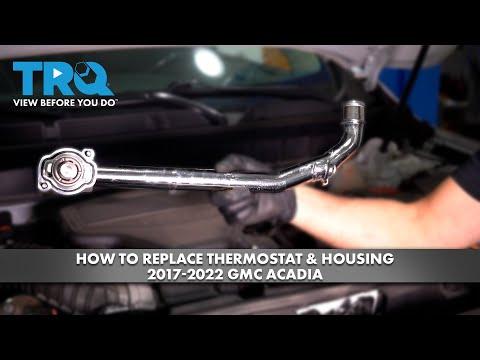







How to Replace the Thermostat Housing Assembly on a 2018 GMC Acadia
Step-by-step thermostat replacement with required tools, parts, torque specs, coolant refill/bleed tips, and P0128 checks for 2017, 2018, 2019, 2020, 2021
How to Replace the Thermostat Housing Assembly on a 2018 GMC Acadia
Step-by-step thermostat replacement with required tools, parts, torque specs, coolant refill/bleed tips, and P0128 checks for 2017, 2018, 2019, 2020, 2021


🔧 Acadia - Thermostat Replacement
On your Acadia, the thermostat controls coolant flow to keep engine temperature stable. A failed thermostat can cause overheating or a “coolant temp below thermostat regulating temp” code (often P0128). This job involves draining some coolant, removing the thermostat housing, then refilling and bleeding air from the cooling system.
Difficulty Level: Intermediate | Estimated Time: 1.5-3.0 hours
⚠️ Safety & Precautions
- ⚠️ Never open the coolant cap on a hot engine; hot coolant can spray and burn you.
- ⚠️ Support the vehicle on jack stands if you raise it; never rely on a jack alone.
- ⚠️ Keep coolant off belts and electrical connectors; wipe spills immediately.
- ⚠️ Dispose of used coolant properly; it’s toxic to people and pets.
🔧 Required Tools
You'll need the following tools for this repair:
- Safety glasses
- Nitrile gloves
- Floor jack (rated 3-ton minimum)
- Jack stands (rated 3-ton minimum)
- Wheel chocks
- Drain pan (at least 3-gallon)
- Funnel
- Trim clip removal tool
- Flathead screwdriver
- Hose clamp pliers
- 1/4" drive ratchet
- 3/8" drive ratchet
- 6" extension (3/8" drive)
- 10mm socket
- 8mm socket
- 7mm socket
- Torque wrench (inch-pound, 20-200 in-lb range)
- Torque wrench (ft-lb, 10-80 ft-lb range)
- Coolant vacuum fill tool (specialty)
- Scan tool with live data (specialty)
🔩 Required Parts
HowToo sells all the parts you need for this repair:
- Engine coolant thermostat assembly (thermostat/housing) - Qty: 1
- Thermostat housing gasket / O-ring - Qty: 1
- DEX-COOL coolant (50/50 premix) - Qty: 2-3 gallons
- Distilled water - Qty: 1 gallon
📋 Before You Begin
- Park on level ground, set the parking brake, and let the engine cool completely.
- Put wheel chocks behind the rear wheels.
- Place a drain pan under the radiator area before opening any drains/hoses.
- If you’re using a coolant vacuum fill tool, it uses shop air to pull vacuum and refill without air pockets (it makes bleeding much easier).
🔨 Step-by-Step Instructions
Follow these steps in order:
Step 1: Depressurize the cooling system
- With the engine fully cold, slowly loosen the coolant surge tank cap by hand to release any leftover pressure, then remove it.
Step 2: Raise the front (optional, but helps access)
- Use a floor jack (rated 3-ton minimum) to lift the front safely.
- Set the vehicle onto jack stands (rated 3-ton minimum) and keep wheel chocks in place.
Step 3: Drain coolant to below thermostat level
- Position a drain pan (at least 3-gallon) under the radiator drain area.
- Use a flathead screwdriver or 7mm socket (varies by drain design) to open the radiator drain and drain coolant until the level is below the thermostat housing.
- If your drain is hard to access, use hose clamp pliers to release the lower radiator hose clamp and carefully crack the hose loose to drain into the pan.
- Tip: Save clean coolant only if new.
Step 4: Remove the engine cover and air intake duct
- Pull up on the engine cover by hand to release it from its grommets.
- Use an 8mm socket to loosen the air intake duct clamps.
- Disconnect any intake duct clips using a trim clip removal tool, then remove the duct to create working room.
Step 5: Locate the thermostat housing and clear access
- The thermostat on your Acadia is part of the thermostat housing/coolant outlet assembly at the front/top area of the engine where the upper radiator hose routes into the engine.
- Use a flashlight (from your phone is fine) and follow the upper radiator hose to the housing.
- If an electrical connector blocks access, release the lock and unplug by hand (do not pull on wires).
Step 6: Disconnect coolant hoses from the thermostat housing
- Use hose clamp pliers to compress the spring clamp(s) and slide them back on the hose.
- Twist the hose gently to break it loose, then pull it off the housing.
- Keep the drain pan underneath—more coolant will come out.
Step 7: Remove the thermostat housing
- Use a 10mm socket, 3/8" drive ratchet, and 6" extension to remove the thermostat housing bolts.
- Remove the housing and thermostat assembly from the engine.
- Clean the sealing surface with a clean rag (do not gouge the metal).
Step 8: Install the new thermostat/housing and gasket
- Install the new thermostat housing gasket / O-ring onto the new housing (or confirm it’s pre-installed correctly).
- Position the new thermostat housing onto the engine.
- Start all bolts by hand to avoid cross-threading.
- Use a torque wrench (inch-pound, 20-200 in-lb range) and 10mm socket to tighten evenly: Torque to 89 in-lb (10 Nm).
Step 9: Reconnect hoses and reinstall intake parts
- Reinstall the coolant hose(s) fully seated, then use hose clamp pliers to move the clamps back into place.
- Reinstall the air intake duct and tighten clamps using an 8mm socket.
- Reinstall the engine cover by pressing it down into the grommets.
Step 10: Refill and bleed the cooling system
- If using a coolant vacuum fill tool (specialty), follow the tool instructions to pull vacuum and refill with DEX-COOL coolant (50/50 premix).
- If filling normally, use a funnel and slowly fill the surge tank with DEX-COOL coolant (50/50 premix) to the “FULL COLD” line.
- Start the engine and set HVAC to hottest temp; let it idle.
- Watch the coolant level and add as needed (do not let it run empty).
- When the radiator fan cycles and you feel steady heat from the vents, shut the engine off and let it cool completely, then recheck level and top off.
Step 11: Verify thermostat operation with live data
- Plug in a scan tool with live data (specialty) and monitor engine coolant temperature while warming up.
- Confirm the temperature rises smoothly and stabilizes normally (no rapid spikes, no overheating).
✅ After Repair
- Check for leaks around the thermostat housing and hose connections with the engine running.
- After your first drive and full cool-down, recheck the surge tank level and top off to “FULL COLD.”
- Clear any stored codes (like P0128) using a scan tool with live data (specialty) and confirm they do not return.
- If it still runs hot or has no cabin heat, you likely have air trapped—re-bleed and recheck coolant level.
💰 DIY vs Shop Cost
Shop Cost: $350-$650 (parts + labor)
DIY Cost: $60-$220 (parts only)
You Save: $130-$590 by doing it yourself!
Shop labor rates vary but typically run $100-$150/hour. This repair takes a shop approximately 1.5-3.0 hours.
🎯 Ready to get started?
HowToo makes it easy: same-day/2-day shipping on every part, plus all the tools and specialty tools you need! Check out the parts and tools sections below to add everything to your cart.