

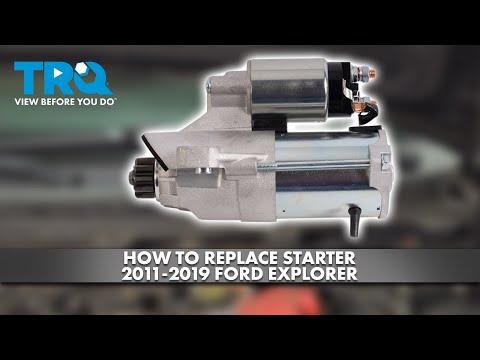




How to Replace the Starter Motor on a 2018 Ford Explorer
Step-by-step instructions with tools, parts, torque specs, and safety tips for 2011, 2012, 2013, 2014, 2015, 2016, 2017, 2018, 2019
How to Replace the Starter Motor on a 2018 Ford Explorer
Step-by-step instructions with tools, parts, torque specs, and safety tips for 2011, 2012, 2013, 2014, 2015, 2016, 2017, 2018, 2019


🔧 Starter Motor - Replacement
The starter on your Explorer sits on the engine-to-transmission area and requires access from underneath and from above. This job is a bit tight, but it is straightforward if you work carefully and keep track of the wiring and bolts.
Difficulty Level: Intermediate | Estimated Time: 2-4 hours
⚠️ Safety & Precautions
- Disconnect the negative battery cable before touching the starter wiring. The starter cable is always hot when the battery is connected.
- Support the Explorer securely with jack stands on level ground. Never work under a vehicle held up only by a jack.
- Keep hands clear of the serpentine belt, exhaust, and the exhaust crossover area. These parts can be hot even after the engine is off.
- If your Explorer has an electronic parking brake, make sure it is fully applied before lifting.
- Wear safety glasses. Dirt and rust will fall when the starter comes out.
🔧 Required Tools
You'll need the following tools for this repair:
- 8mm socket
- 10mm socket
- 13mm socket
- 15mm socket
- Ratchet
- Long extension set
- Swivel socket adapter
- Torque wrench
- Flat-blade screwdriver
- Trim clip tool
- Floor jack (rated 3-ton minimum)
- Jack stands
- Wheel chocks
- Safety glasses
- Nitrile gloves
- Battery terminal wrench
🔩 Required Parts
HowToo sells all the parts you need for this repair:
- Starter motor - Qty: 1
- Starter mounting bolts - Qty: 2
- Battery terminal cover or protective boot - Qty: 1
📋 Before You Begin
- Park on level ground and set the parking brake.
- Move the shift lever to Park and remove the key or keep the key fob away from the vehicle.
- Open the hood and make sure the engine is completely cool.
- Disconnect the negative battery cable first, then isolate it so it cannot touch the battery terminal again.
- Tip: Take a photo of the starter wiring before removing it.
🔨 Step-by-Step Instructions
Follow these steps in order:
Step 1: Disconnect the battery
- Use a 10mm socket or battery terminal wrench to loosen the negative battery cable.
- Remove the negative cable and secure it away from the battery.
- This prevents accidental cranking and protects the starter circuit.
Step 2: Raise and support the Explorer
- Use a floor jack (rated 3-ton minimum) to lift the front of the vehicle at the proper lift point.
- Place jack stands under the approved support points and lower the vehicle onto them.
- Use wheel chocks at the rear wheels.
Step 3: Remove lower access components
- Use a trim clip tool and 8mm socket to remove the lower splash shield or air deflector if it blocks access to the starter.
- Keep the fasteners organized by location.
- Tip: Lay bolts out in the order removed.
Step 4: Locate the starter
- Find the starter on the lower engine area near the transmission bellhousing.
- Identify the large battery cable and the small control wire connected to it.
Step 5: Disconnect starter wiring
- Use a 13mm socket to remove the nut from the main battery cable terminal on the starter.
- Use a flat-blade screwdriver to release any wiring connector lock, then unplug the small control connector.
- Move the wires aside so they do not get pinched.
Step 6: Remove the starter mounting bolts
- Use a 15mm socket, long extension set, and swivel socket adapter to remove the starter mounting bolts.
- Support the starter with one hand as the last bolt comes out.
- Lower the starter out carefully; it is heavier than it looks.
Step 7: Install the new starter
- Position the new starter in place by hand.
- Start both mounting bolts by hand first to avoid cross-threading.
- Use a 15mm socket and torque wrench to tighten the starter bolts to 40 Nm (30 ft-lbs).
Step 8: Reconnect the wiring
- Reconnect the small control wire until it locks in place.
- Install the main battery cable and tighten the retaining nut with a 13mm socket.
- Tighten to 9 Nm (80 in-lbs).
- Make sure the cable boot or cover is back in place.
Step 9: Reinstall lower covers
- Reinstall any splash shields or undertrays using the 8mm socket and trim clip tool.
- Make sure all clips and screws are fully seated.
Step 10: Reconnect the battery and test
- Reconnect the negative battery cable and tighten it with the 10mm socket.
- Start the engine and listen for normal cranking and smooth engagement.
- Check for warning lights and make sure the starter wiring stays cool and secure.
✅ After Repair
- Start the engine 3-4 times to confirm repeatable operation.
- Check underneath for loose parts or tools before lowering fully to the ground.
- If the engine cranks slowly, recheck the battery condition and cable connections.
- Confirm there are no grinding, clicking, or no-crank symptoms.
💰 DIY vs Shop Cost
Shop Cost: ₹18,000-₹35,000 (parts + labor)
DIY Cost: ₹7,000-₹18,000 (parts only)
You Save: ₹10,000-₹17,000 by doing it yourself!
Shop labor rates vary but typically run ₹4,000-₹8,000/hour. This repair takes a shop approximately 2-4 hours.
🎯 Ready to get started?
HowToo makes it easy: same-day/2-day shipping on every part, plus all the tools and specialty tools you need! Check out the parts and tools sections below to add everything to your cart.