

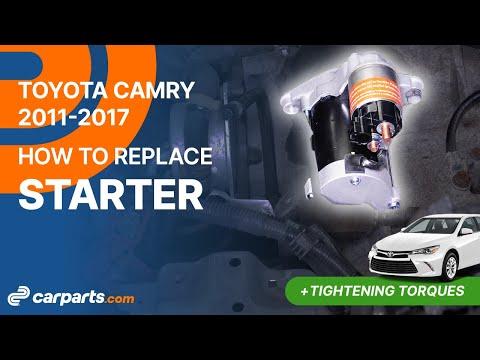





How to Replace the Starter Motor on a 2017 Toyota Camry
Step-by-step instructions with tools, parts, torque specs, and safety tips for 2007, 2008, 2009
How to Replace the Starter Motor on a 2017 Toyota Camry
Step-by-step instructions with tools, parts, torque specs, and safety tips for 2007, 2008, 2009


🔧 Starter Motor - Replacement
The starter on your Camry V6 sits under the intake manifold, so this job takes more teardown than a typical starter swap. You’ll remove the upper intake pieces to reach the starter, then reinstall everything carefully to avoid vacuum leaks and drivability issues.
Difficulty Level: Advanced | Estimated Time: 4-6 hours
⚠️ Safety & Precautions
- Disconnect the negative battery cable before touching the starter. This prevents accidental cranking and short circuits.
- The intake manifold and nearby engine parts may be hot if the vehicle was recently driven.
- Work carefully around fuel and vacuum lines when removing the intake components.
- Keep dirt out of the intake ports. A small dropped bolt or debris can cause engine damage.
- Use jack stands if you raise the front of the vehicle for access, even though most of this job is done from above.
🔧 Required Tools
You'll need the following tools for this repair:
- 10mm socket
- 12mm socket
- 14mm socket
- Ratchet
- 3/8-inch drive extension set
- Torque wrench
- Flat-blade screwdriver
- Pliers
- Trim clip removal tool
- Magnetic pickup tool
- Pick tool
- Shop towels
- Safety glasses
- Mechanic gloves
- Battery terminal wrench 10mm
🔩 Required Parts
HowToo sells all the parts you need for this repair:
- Starter motor - Qty: 1
- Intake manifold gasket set - Qty: 1
- Throttle body gasket - Qty: 1
- Air intake hose clamps - Qty: 2
- Vacuum hose clips - Qty: 1 set
📋 Before You Begin
- Park on level ground and set the parking brake.
- Turn the ignition off and remove the key or keep the fob away from the vehicle.
- Disconnect the negative battery cable first, then isolate it so it cannot spring back.
- Label every hose and connector.
🔨 Step-by-Step Instructions
Follow these steps in order:
Step 1: Disconnect the battery
- Use a 10mm wrench or 10mm socket to remove the negative battery terminal.
- Move the cable aside so it cannot touch the post.
Step 2: Remove the engine cover and air intake duct
- Pull up on the engine cover if equipped.
- Use a flat-blade screwdriver to loosen the air intake hose clamps.
- Disconnect the intake duct and remove the resonator pieces as needed for access.
Step 3: Remove the throttle body and intake connections
- Unplug the throttle body connector and any nearby sensors using your hands or a pick tool if the locks are tight.
- Use a 10mm socket to remove the throttle body fasteners.
- Set the throttle body aside carefully.
- Do not drop dirt into the intake opening.
Step 4: Remove the upper intake manifold
- Disconnect vacuum hoses, electrical connectors, and brackets attached to the intake manifold.
- Use a 10mm socket and 3/8-inch drive extension set to remove the intake manifold bolts in a cross pattern.
- Lift the manifold straight up and remove it from the engine.
- Replace the intake manifold gaskets.
- Tighten intake manifold bolts to 21 Nm (15 ft-lbs) during reassembly.
Step 5: Remove the starter motor
- The starter is now visible on the engine near the transmission bell housing.
- Use a 12mm socket or 14mm socket to remove the electrical terminal nut and battery cable from the starter.
- Use a 14mm socket and ratchet with extensions to remove the starter mounting bolts.
- Support the starter with one hand while removing the last bolt.
- Remove the starter from the engine bay.
- Tighten starter mounting bolts to 37 Nm (27 ft-lbs) on installation.
- Tighten the starter terminal nut to 9 Nm (80 in-lbs).
Step 6: Install the new starter
- Place the new starter in position and start both mounting bolts by hand.
- Use a 14mm socket to tighten the starter bolts evenly.
- Reconnect the starter cable and tighten the terminal nut with a 12mm socket or 14mm socket as equipped.
- Make sure the cable boot is fully seated.
Step 7: Reinstall the intake manifold and throttle body
- Install new intake manifold gaskets and set the manifold back in place.
- Use a 10mm socket to reinstall the manifold bolts in sequence.
- Reinstall the throttle body with a new gasket.
- Tighten throttle body fasteners to 10 Nm (89 in-lbs).
- Reconnect all hoses, connectors, and brackets.
Step 8: Reinstall the intake duct and battery cable
- Reinstall the air intake duct and tighten the hose clamps with a flat-blade screwdriver.
- Reconnect the negative battery cable using a 10mm wrench.
- Reinstall the engine cover if removed.
✅ After Repair
- Start the engine and confirm the starter cranks normally.
- Listen for air leaks around the intake manifold and throttle body.
- Check for warning lights on the dash.
- If the engine idles rough, recheck every hose and connector you removed.
- Drive the vehicle and confirm normal starting after a heat soak.
💰 DIY vs Shop Cost
Shop Cost: $900-$1,500 (parts + labor)
DIY Cost: $180-$450 (parts only)
You Save: $450-$1,050 by doing it yourself!
Shop labor rates vary but typically run $100-$150/hour. This repair takes a shop approximately 4-6 hours.
🎯 Ready to get started?
HowToo makes it easy: same-day/2-day shipping on every part, plus all the tools and specialty tools you need! Check out the parts and tools sections below to add everything to your cart.