

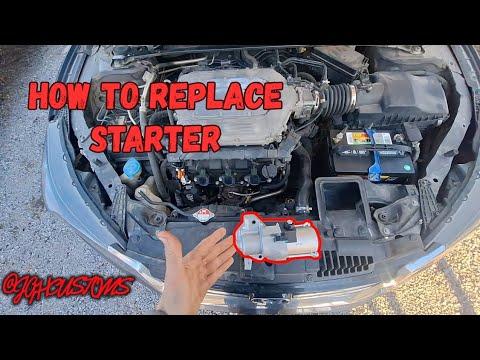







How to Replace the Starter Motor on a 2017 Honda Accord V6
Step-by-step instructions with tools, parts, safety tips, and torque specs for 2008, 2009, 2010, 2011, 2012, 2013, 2014, 2015, 2016, 2017
How to Replace the Starter Motor on a 2017 Honda Accord V6
Step-by-step instructions with tools, parts, safety tips, and torque specs for 2008, 2009, 2010, 2011, 2012, 2013, 2014, 2015, 2016, 2017


🔧 Starter Motor - Replacement
Assumption: This guide covers the starter motor on your Accord V6. On this engine, the starter is mounted low on the engine/transmission area and access is tight, so the intake ducting and related upper components may need to come off first. A failed starter can cause a no-crank condition, clicking, or intermittent starting.
Difficulty Level: Advanced | Estimated Time: 2-4 hours
⚠️ Safety & Precautions
- Disconnect the negative battery cable before starting. The starter cable is always hot and can arc badly.
- Use care around the intake manifold area and electrical connectors. Do not force brittle clips.
- Keep metal tools away from the starter battery cable until the battery is disconnected.
- If you raise the vehicle, support it with jack stands on level ground.
- Do not allow the starter to hang by the wiring.
🔧 Required Tools
You'll need the following tools for this repair:
- Floor jack (rated 3-ton minimum)
- Jack stands (rated 3-ton minimum)
- Wheel chocks
- Safety glasses
- Mechanic gloves
- 10mm socket
- 12mm socket
- 14mm socket
- 3/8-inch ratchet
- Extensions
- Universal joint adapter
- Torque wrench
- Flat-blade trim tool
- Battery terminal wrench
- Pickup magnet
🔩 Required Parts
HowToo sells all the parts you need for this repair:
- Starter motor - Qty: 1
- Starter mounting bolts - Qty: 2
- Intake tube clamp - Qty: 1
- Battery terminal clamp cleaner - Qty: 1
📋 Before You Begin
- Make sure the ignition is off and the key/fob is away from the vehicle.
- Disconnect the negative battery cable first, then the positive if needed.
- If the car is in a tight driveway, open the hood fully and give yourself room at the front and top of the engine bay.
- Take a photo of each connector before unplugging it.
🔨 Step-by-Step Instructions
Follow these steps in order:
Step 1: Disconnect battery power
- Use a 10mm socket or battery terminal wrench to remove the negative battery cable.
- Move the cable aside so it cannot touch the terminal.
- Torque to factory specification when reinstalling the battery terminal.
Step 2: Remove upper intake ducting
- Use a flat-blade trim tool to loosen any clips on the air inlet duct.
- Use a 10mm socket to remove the duct or airbox fasteners if equipped.
- Lift the intake tube out of the way for access.
- Label every hose before removal.
Step 3: Gain access to the starter area
- Depending on access, remove any nearby brackets, covers, or air cleaner parts using a 10mm socket and 12mm socket.
- If needed for lower access, raise the front of the vehicle with a floor jack and support it on jack stands.
- Remove the lower splash shield fasteners with a 10mm socket.
Step 4: Disconnect starter wiring
- Use a 10mm socket to remove the battery cable nut from the starter terminal.
- Remove the small control-wire connector by pressing the lock tab and pulling it straight off.
- Keep the cable from touching metal parts.
Step 5: Remove the starter
- Use a 14mm socket, extensions, and a universal joint adapter to remove the starter mounting bolts.
- Support the starter with one hand while removing the last bolt.
- Lower the starter out carefully. It may need to rotate slightly to clear the housing.
Step 6: Compare the new starter
- Match the mounting ears, electrical terminals, and depth of the old and new starters.
- Check that any heat shield or spacer transfers over if your replacement requires it.
Step 7: Install the new starter
- Position the new starter in place and start the mounting bolts by hand.
- Use the 14mm socket and torque wrench to tighten the bolts evenly.
- Torque to factory specification.
- Reconnect the small control-wire connector first, then install the battery cable nut with a 10mm socket.
- Torque to factory specification.
Step 8: Reassemble removed parts
- Reinstall any brackets, splash shields, intake ducting, and airbox parts with a 10mm socket and 12mm socket.
- Make sure all hose clamps and connectors are fully seated.
Step 9: Restore battery power and test
- Reconnect the negative battery cable with a 10mm socket.
- Start the engine and confirm normal cranking.
- Listen for smooth engagement and check for warning lights.
✅ After Repair
- Verify the engine starts consistently several times in a row.
- Check that no loose parts rattle near the intake or starter area.
- If the battery was weak, have it load-tested.
- If the no-crank condition remains, check battery voltage, main fuse, and starter relay.
💰 DIY vs Shop Cost
Shop Cost: $550-$1,050 (parts + labor)
DIY Cost: $150-$400 (parts only)
You Save: $400-$650 by doing it yourself!
Shop labor rates vary but typically run $100-$150/hour. This repair takes a shop approximately 2-4 hours.
🎯 Ready to get started?
HowToo makes it easy: same-day/2-day shipping on every part, plus all the tools and specialty tools you need! Check out the parts and tools sections below to add everything to your cart.