

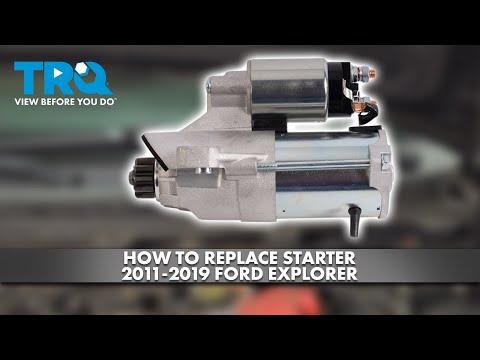





How to Replace the Starter Motor on a 2017 Ford Explorer
Step-by-step instructions with tools, parts, safety tips, and torque specs for 2011, 2012, 2013, 2014, 2015, 2016, 2017, 2018, 2019
How to Replace the Starter Motor on a 2017 Ford Explorer
Step-by-step instructions with tools, parts, safety tips, and torque specs for 2011, 2012, 2013, 2014, 2015, 2016, 2017, 2018, 2019


🔧 Starter Motor - Replacement
On your Explorer, the starter motor sits low on the engine/transaxle area and access is tight. This job usually requires removing the intake air ducting and upper intake manifold for clear access, then disconnecting the starter electrical connections and mounting bolts.
Difficulty Level: Advanced | Estimated Time: 3-5 hours
⚠️ Safety & Precautions
- Disconnect the negative battery cable before starting. The starter has direct battery power.
- Make sure the ignition is off and the key/fob is away from the vehicle.
- The intake manifold and nearby engine parts may be hot. Let the engine cool fully.
- Use jack stands if you raise the vehicle. Never work under a vehicle supported only by a jack.
- Keep tools away from the battery positive terminal. A short circuit can cause burns or fire.
🔧 Required Tools
You'll need the following tools for this repair:
- 10mm socket
- 8mm socket
- 13mm socket
- Ratchet
- Long extension set
- Swivel joint adapter
- Torque wrench
- Flat-blade trim tool
- Pliers
- Shop light
- Safety glasses
- Mechanic gloves
- Jack stands
- Floor jack (rated 3-ton minimum)
🔩 Required Parts
HowToo sells all the parts you need for this repair:
- Starter motor - Qty: 1
- Starter mounting bolts - Qty: 2
- Intake manifold gasket set - Qty: 1
- Throttle body gasket - Qty: 1
📋 Before You Begin
- Park on level ground and set the parking brake.
- Open the hood and remove the key/fob from the vehicle area.
- Disconnect the negative battery cable first, then isolate it so it cannot spring back.
- Tip: Take photos before unplugging anything.
🔨 Step-by-Step Instructions
Follow these steps in order:
Step 1: Disconnect power
- Use a 10mm socket to remove the negative battery cable.
- Move the cable aside so it cannot touch the battery terminal.
Step 2: Remove air intake components
- Use an 8mm socket and flat-blade trim tool to remove the air intake ducting and air box pieces that block access.
- Loosen clamps and disconnect any small hoses attached to the intake tube.
- Tip: Label hoses if they look similar.
Step 3: Remove the throttle body and upper intake manifold
- Use an 8mm socket to remove the throttle body fasteners.
- Disconnect the electrical connector from the throttle body.
- Use a 10mm socket with a ratchet and extension to remove the upper intake manifold bolts.
- Lift the intake manifold off carefully and remove the old gasket set.
- Torque during reassembly: 10-12 Nm (89-106 ft-lbs) for small intake fasteners unless the service label on the manifold states otherwise.
Step 4: Access the starter motor
- Locate the starter on the engine/transaxle area.
- Use a shop light to find the battery cable and solenoid wire on the starter.
Step 5: Disconnect starter wiring
- Use a 13mm socket to remove the main battery cable nut from the starter.
- Pull off the smaller solenoid trigger connector by hand or with pliers if needed.
- Keep track of any washers or insulators.
Step 6: Remove the starter motor
- Use a 13mm socket, long extension, and swivel joint adapter to remove the starter mounting bolts.
- Support the starter with one hand while removing the last bolt.
- Lower the starter out of the vehicle.
- Torque during reassembly: 45-55 Nm (33-41 ft-lbs) for the starter mounting bolts.
Step 7: Install the new starter motor
- Position the new starter in place by hand.
- Install the mounting bolts finger-tight first.
- Use the torque wrench and 13mm socket to tighten the bolts to spec.
- Reconnect the solenoid wire and main battery cable.
- Torque the battery cable nut to 9-12 Nm (80-106 in-lbs).
Step 8: Reinstall intake parts
- Install the new intake manifold gasket set.
- Set the upper intake manifold back in place.
- Use a 10mm socket to tighten the manifold bolts evenly in stages.
- Reinstall the throttle body with the new gasket and reconnect the electrical connector.
- Reinstall the air intake ducting and clamp everything securely.
- Torque the throttle body fasteners to 8-10 Nm (71-89 in-lbs).
Step 9: Restore battery power
- Reconnect the negative battery cable with a 10mm socket.
- Make sure the cable is tight and cannot move.
✅ After Repair
- Start the engine and confirm the starter cranks normally.
- Listen for grinding, clicking, or slow cranking.
- Check for vacuum leaks around the intake manifold.
- Verify the air intake ducting is sealed and all connectors are back in place.
- If the engine runs rough, recheck the intake manifold and throttle body installation.
💰 DIY vs Shop Cost
Shop Cost: $650-$1,050 (parts + labor)
DIY Cost: $180-$350 (parts only)
You Save: $470-$700 by doing it yourself!
Shop labor rates vary but typically run $100-$150/hour. This repair takes a shop approximately 3-5 hours.
🎯 Ready to get started?
HowToo makes it easy: same-day/2-day shipping on every part, plus all the tools and specialty tools you need! Check out the parts and tools sections below to add everything to your cart.