







How to Replace the Starter Motor on a 2016 Jeep Wrangler (Step-by-Step Guide)
Tools, parts list, safety tips, and torque specs to fix click/no-crank starting issues for 2012, 2013, 2014, 2015, 2016, 2017, 2020, 2021, 2022, 2023
How to Replace the Starter Motor on a 2016 Jeep Wrangler (Step-by-Step Guide)
Tools, parts list, safety tips, and torque specs to fix click/no-crank starting issues for 2012, 2013, 2014, 2015, 2016, 2017, 2020, 2021, 2022, 2023


🔧 Wrangler - Starter Motor Replacement
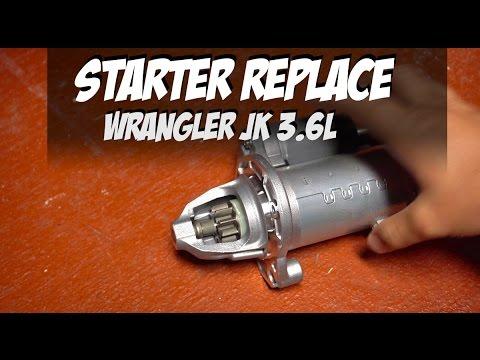
The starter motor cranks your engine when you turn the key. If it’s failing, you may get a single click, slow cranking, or no crank at all. On your Wrangler, the starter is mounted low on the passenger side of the engine/transmission bellhousing area.
Difficulty Level: Intermediate | Estimated Time: 1.0-2.0 hours
Assumption: Fastener heads vary; tools below cover both common types.
⚠️ Safety & Precautions
- 🛑 Disconnect the negative battery cable first to prevent a short.
- 🧯 Keep metal tools away from the starter’s power stud (it’s direct battery power).
- 🧱 Support the Jeep with jack stands on a solid, level surface; never rely on a jack.
- 🔥 Let the exhaust cool before working underneath.
🔧 Required Tools
You'll need the following tools for this repair:
- Floor jack (rated 3-ton minimum)
- Jack stands (rated 3-ton minimum)
- Wheel chocks
- Safety glasses
- Mechanic gloves
- Ratchet (3/8")
- Ratchet (1/2")
- Socket set 8mm-18mm
- 13mm socket
- 15mm socket
- External Torx E12 socket
- External Torx E14 socket
- Extension set (3", 6", 12")
- Universal joint adapter (3/8")
- Torque wrench (10-100 ft-lbs)
- Trim clip tool
- Flathead screwdriver
- Needle-nose pliers
- Work light
- Battery terminal wrench 10mm
🔩 Required Parts
HowToo sells all the parts you need for this repair:
- Starter motor - Qty: 1
- Starter solenoid terminal nut (if damaged) - Qty: 1
- Dielectric grease - Qty: 1
- Cable terminal cleaning brush - Qty: 1
📋 Before You Begin
- Park on level ground, shift to neutral, and set the parking brake.
- Chock the rear wheels with wheel chocks.
- Disconnect the battery: use a 10mm battery terminal wrench to remove the negative cable first, then position it so it can’t spring back. Negative off first prevents sparks.
- If your Wrangler has an aftermarket skid plate, plan to remove it for access.
🔨 Step-by-Step Instructions
Follow these steps in order:
Step 1: Safely raise and support the Wrangler
- Use a floor jack (rated 3-ton minimum) to lift the front of the Jeep at a safe jacking point.
- Set it down on jack stands (rated 3-ton minimum) and gently shake the Jeep to confirm it’s stable.
Step 2: Remove any skid plate blocking access (if equipped)
- Use a socket set 8mm-18mm (commonly 13mm socket or 15mm socket) with a ratchet (1/2") to remove skid plate bolts.
- Set the skid plate and hardware aside in order.
Step 3: Locate the starter
- From underneath on the passenger side, look where the engine meets the transmission (bellhousing).
- You’ll see the starter (a small motor) with a smaller cylinder on it (the solenoid).
Step 4: Disconnect the starter wiring
- Remove the small signal-wire connector (usually a push-on or clip) using needle-nose pliers or your fingers.
- Remove the main battery cable nut from the starter’s large power stud using a 13mm socket with a ratchet (3/8") and extension set (3", 6", 12").
- Move the cables aside so they can’t touch metal.
- Clean the cable ends with a cable terminal cleaning brush and apply a thin film of dielectric grease. (Dielectric grease helps prevent corrosion.)
- Torque to 10 Nm (89 in-lbs / 7 ft-lbs) for the starter power stud nut when reinstalling.
Step 5: Remove the starter mounting bolts
- Support the starter with one hand while loosening the bolts with the other.
- Use either a 15mm socket or External Torx E12 socket (some starters use E-Torx bolt heads) on a ratchet (3/8") with extension set (3", 6", 12").
- If access is tight, use a universal joint adapter (3/8").
- Remove the bolts fully, then lower the starter out.
- Torque to 54 Nm (40 ft-lbs) for starter mounting bolts during installation.
Step 6: Install the new starter
- Position the new starter into place by hand.
- Start the mounting bolts by hand first to avoid cross-threading.
- Tighten with a torque wrench (10-100 ft-lbs) to Torque to 54 Nm (40 ft-lbs).
Step 7: Reconnect the wiring
- Install the main battery cable onto the large starter stud and tighten with a 13mm socket.
- Use a torque wrench (10-100 ft-lbs) to set the stud nut to Torque to 10 Nm (89 in-lbs / 7 ft-lbs).
- Reconnect the small signal-wire connector until it fully seats/clicks.
- Loose wiring causes no-crank.
Step 8: Reinstall skid plate (if removed) and lower the Jeep
- Reinstall the skid plate using the same 13mm socket or 15mm socket you removed it with.
- Snug bolts evenly, then lower the Jeep using the floor jack (rated 3-ton minimum).
Step 9: Reconnect the battery
- Reconnect the negative battery cable using a 10mm battery terminal wrench.
- Ensure the terminal is tight and doesn’t rotate by hand.
✅ After Repair
- Start the engine and verify it cranks strongly and starts normally.
- Listen for grinding or “whirring” after start; if heard, shut off and recheck starter seating/bolts.
- Check that the main starter cable is not touching the exhaust or any sharp edge.
- Take a short drive and recheck for any loose hardware or new noises.
💰 DIY vs Shop Cost
Shop Cost: $450-$900 (parts + labor)
DIY Cost: $120-$350 (parts only)
You Save: $330-$550 by doing it yourself!
Shop labor rates vary but typically run $100-$150/hour. This repair takes a shop approximately 1.0-2.0 hours.
🎯 Ready to get started?
HowToo makes it easy: same-day/2-day shipping on every part, plus all the tools and specialty tools you need! Check out the parts and tools sections below to add everything to your cart.