

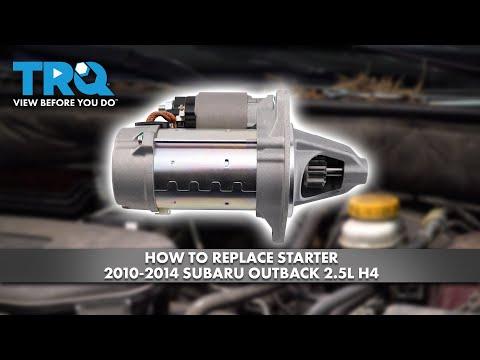





How to Replace the Starter Motor on a 2010-2013 Subaru Outback
Step-by-step DIY guide with tools, parts, torque specs, and safety tips for 2010, 2011, 2012, 2013
How to Replace the Starter Motor on a 2010-2013 Subaru Outback
Step-by-step DIY guide with tools, parts, torque specs, and safety tips for 2010, 2011, 2012, 2013


🔧 Outback - Starter Motor Replacement
Replacing the starter motor on your Outback means disconnecting the battery, accessing the starter on the engine/transmission area, removing the electrical connections, and swapping the starter assembly. The starter is the electric motor that cranks the engine when you turn the key.
Difficulty Level: Intermediate | Estimated Time: 1.5-2.5 hours
⚠️ Safety & Precautions
- ⚠️ Disconnect the negative battery cable before touching the starter wiring. The starter cable is high-current and can spark hard if shorted.
- ⚠️ Let the engine cool before working near the exhaust and engine block.
- ⚠️ Support the Outback securely with jack stands if you raise it. Never rely on a floor jack alone.
- ⚠️ Keep the key out of the ignition while the starter wiring is disconnected.
- ⚠️ The starter is heavy for its size. Support it with one hand when removing the final bolt.
🔧 Required Tools
You'll need the following tools for this repair:
- 10mm socket
- 12mm socket
- 14mm socket
- 3/8-inch ratchet
- 3/8-inch 6-inch extension
- 3/8-inch universal joint adapter
- 14mm box-end wrench
- Flat-blade screwdriver
- Trim clip removal tool
- Torque wrench 10-80 ft-lb
- Floor jack rated 2-ton minimum
- Jack stands rated 2-ton minimum
- Wheel chocks
- Battery terminal brush
- Work gloves
- Safety glasses
🔩 Required Parts
HowToo sells all the parts you need for this repair:
- Starter motor - Qty: 1
- Battery terminal protector spray - Qty: 1
- Dielectric grease - Qty: 1
📋 Before You Begin
- 🅿️ Park your Outback on level ground, shift to Park, and set the parking brake.
- 🧱 Place wheel chocks behind the rear wheels.
- 🔋 Open the hood and disconnect the negative battery cable first. Negative is the black cable marked “–”.
- 🧊 Let the engine cool completely if it was recently driven.
- 📱 If the radio or clock loses settings after battery disconnect, reset them after the repair.
🔨 Step-by-Step Instructions
Follow these steps in order:
Step 1: Disconnect the Battery
- Use a 10mm socket and 3/8-inch ratchet to loosen the negative battery terminal clamp.
- Lift the negative cable off the battery post and move it aside so it cannot spring back.
- Use a battery terminal brush to clean corrosion from the cable end if needed.
- Always remove negative first.
Step 2: Raise and Support the Front
- Use a floor jack rated 2-ton minimum at the front center jacking point to raise the front of your Outback.
- Place jack stands rated 2-ton minimum under the approved front support points.
- Gently lower the vehicle onto the jack stands and leave the floor jack lightly touching as a backup.
- Put on safety glasses and work gloves.
Step 3: Remove the Lower Engine Cover
- Use a trim clip removal tool to remove the plastic push clips from the lower splash shield.
- Use a 12mm socket and 3/8-inch ratchet if your shield has small bolts installed.
- Lower the splash shield and set it aside.
- A splash shield is the plastic under-cover that keeps dirt and water away from the engine bay.
Step 4: Locate the Starter Motor
- Look at the engine-to-transmission area on the upper side of the bellhousing, near the rear of the engine.
- The bellhousing is the large metal case where the engine and transmission meet.
- The starter is a small cylindrical motor with a thick battery cable attached to it.
- Use a flat-blade screwdriver only to gently move wiring retainers if they block access.
Step 5: Disconnect the Starter Electrical Connectors
- Use a 12mm socket and 3/8-inch ratchet to remove the nut from the large starter battery cable terminal.
- Pull the large cable straight off the starter stud and move it aside.
- Use your fingers or a flat-blade screwdriver to release the small solenoid connector tab, then unplug it.
- The solenoid is the small switch on the starter that engages the starter gear.
- Do not pull on wires.
Step 6: Remove the Starter Mounting Bolts
- Use a 14mm socket, 3/8-inch ratchet, and 3/8-inch 6-inch extension to loosen the accessible starter mounting bolt.
- Use a 14mm box-end wrench or 3/8-inch universal joint adapter if the upper bolt angle is tight.
- Support the starter with one hand while removing the final bolt.
- Remove the starter from the bellhousing.
Step 7: Compare the Old and New Starter
- Place both starters side by side on a clean surface.
- Check that the mounting ears, electrical terminals, and gear nose match.
- Use a flat-blade screwdriver only to move any small protective shipping cap from the new starter terminal if installed.
- Match before installing.
Step 8: Install the New Starter
- Position the new starter into the bellhousing opening by hand.
- Start both mounting bolts by hand first to prevent cross-threading.
- Use a 14mm socket, 3/8-inch ratchet, and 3/8-inch 6-inch extension to snug both mounting bolts evenly.
- Use a torque wrench 10-80 ft-lb and 14mm socket to tighten the starter mounting bolts to Torque to 50 Nm (37 ft-lbs).
Step 9: Reconnect the Starter Wiring
- Push the small solenoid connector onto the starter until it clicks.
- Install the large battery cable onto the starter stud.
- Use a 12mm socket and torque wrench 10-80 ft-lb to tighten the starter terminal nut to Torque to 9 Nm (80 in-lbs).
- Apply a small amount of dielectric grease around the terminal boot area after tightening. Dielectric grease helps keep moisture out of electrical connections.
Step 10: Reinstall the Lower Engine Cover
- Lift the splash shield into position.
- Use a trim clip removal tool to reinstall the plastic push clips.
- Use a 12mm socket and 3/8-inch ratchet to reinstall any splash shield bolts.
- Tighten small splash shield bolts snug only; do not overtighten plastic panels.
Step 11: Lower the Vehicle
- Use the floor jack rated 2-ton minimum to lift the Outback slightly off the jack stands.
- Remove the jack stands rated 2-ton minimum.
- Lower the vehicle slowly to the ground.
- Remove the wheel chocks after the vehicle is fully lowered.
Step 12: Reconnect the Battery
- Place the negative battery cable back onto the negative battery post.
- Use a 10mm socket and 3/8-inch ratchet to tighten the clamp until secure.
- Spray the terminal lightly with battery terminal protector spray.
- Do not overtighten the battery clamp; it can crack.
✅ After Repair
- ✅ Start your Outback. It should crank strongly and start normally.
- 👂 Listen for grinding, clicking, or a starter that keeps running after the engine starts. Shut it off immediately if that happens.
- 🔎 Check that the battery cable and starter wiring are secure.
- 🕒 Reset the clock and radio presets if they were lost after battery disconnect.
- 🚗 Take a short test drive, then restart the engine once more to confirm reliable operation.
💰 DIY vs Shop Cost
Shop Cost: $450-$750 (parts + labor)
DIY Cost: $180-$380 (parts only)
You Save: $270-$370 by doing it yourself!
Shop labor rates vary but typically run $100-$150/hour. This repair takes a shop approximately 1.0-1.7 hours.
🎯 Ready to get started?
HowToo makes it easy: same-day/2-day shipping on every part, plus all the tools and specialty tools you need! Check out the parts and tools sections below to add everything to your cart.