

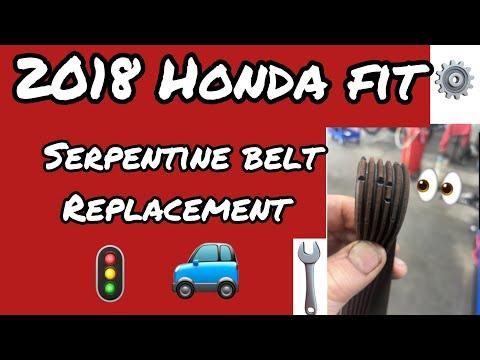







How to Replace the Serpentine Belt on a 2018 Honda Fit (Accessory Drive Belt)
Step-by-step belt routing and tensioner release instructions, required tools/parts, and safety checks for 2015, 2016, 2017, 2018, 2019, 2020
How to Replace the Serpentine Belt on a 2018 Honda Fit (Accessory Drive Belt)
Step-by-step belt routing and tensioner release instructions, required tools/parts, and safety checks for 2015, 2016, 2017, 2018, 2019, 2020


🔧 Fit - Serpentine Belt Replacement
On your Fit, the serpentine (accessory) belt drives components like the alternator and A/C. Replacing it is mostly about safely unloading the automatic belt tensioner, routing the new belt correctly, and confirming alignment on every pulley.
Difficulty Level: Intermediate | Estimated Time: 0.5-1.5 hours
⚠️ Safety & Precautions
- ⚠️ Keep hands clear of the tensioner; it snaps back hard.
- ⚠️ Work on a cool engine; the exhaust and radiator area can burn you.
- ⚠️ Support the car with jack stands if you lift it; never rely on a jack alone.
- ⚠️ Battery disconnect is not required, but keep tools away from the alternator power cable.
🔧 Required Tools
You'll need the following tools for this repair:
- Floor jack (rated 2-ton minimum)
- Jack stands (rated 2-ton minimum)
- Wheel chocks
- 19mm lug nut socket
- 1/2" drive breaker bar
- 1/2" drive ratchet
- 14mm socket
- 10mm socket
- Trim clip removal tool
- Flashlight
- Work gloves
- Safety glasses
🔩 Required Parts
HowToo sells all the parts you need for this repair:
- Serpentine belt (accessory drive belt) - Qty: 1
- Plastic fender liner clips (as needed) - Qty: 5
📋 Before You Begin
- Park on level ground, set the parking brake, and place wheel chocks behind the rear wheels.
- Open the hood and use a flashlight to locate the belt routing diagram (usually a sticker under the hood). If you don’t see it, take a clear photo of the current belt routing before removal.
- If you lift the front-left corner for access, loosen the lug nuts slightly first using a 19mm lug nut socket and breaker bar.
🔨 Step-by-Step Instructions
Follow these steps in order:
Step 1: Raise the front-left corner (optional but recommended)
- Use a 19mm lug nut socket and breaker bar to loosen the front-left lug nuts about 1/2 turn.
- Lift the front-left corner with a floor jack and support it with jack stands.
- Remove the wheel using a 19mm lug nut socket and 1/2" drive ratchet.
Step 2: Remove the lower splash shield/fender liner access
- Use a trim clip removal tool to pop out plastic clips.
- Use a 10mm socket to remove any small bolts holding the splash shield/fender liner section.
- Pull the shield/liner back enough to clearly see the belt and tensioner.
Step 3: Locate the belt tensioner
- Find the spring-loaded tensioner pulley (it’s the pulley on an arm).
- The tensioner has a hex/bolt head used to rotate it and release belt tension.
- Tip: Take a picture before touching anything.
Step 4: Release tension and remove the old belt
- Install a 14mm socket on the tensioner bolt and attach a 1/2" drive breaker bar.
- Rotate the tensioner to unload the belt (you’ll feel spring resistance). A “tensioner” is a spring-loaded arm that keeps the belt tight automatically.
- While holding the tensioner rotated, slide the belt off one easy-to-reach pulley.
- Slowly let the tensioner return to its stop (do not let it snap back).
- Remove the belt fully and compare its length and rib count to the new belt.
Step 5: Route the new belt
- Route the new belt around the pulleys following the under-hood diagram or your photo.
- Make sure the ribbed side sits in ribbed pulleys and the smooth side rides on smooth pulleys.
- Leave one pulley for last (typically the easiest to reach) so you can slip it on after releasing tension.
Step 6: Apply tension and seat the belt
- Use the 14mm socket and 1/2" drive breaker bar to rotate the tensioner again.
- Slip the belt onto the last pulley, then slowly release the tensioner.
- Visually check every pulley: the belt ribs must sit fully in the grooves, not hanging off an edge.
- Tip: Misalignment can shred a new belt fast.
Step 7: Reinstall splash shield and wheel
- Reposition the liner/shield and reinstall bolts using a 10mm socket.
- Reinstall any clips using a trim clip removal tool as needed to align them.
- Install the wheel and snug the lug nuts using a 19mm lug nut socket and 1/2" drive ratchet.
- Lower the car using a floor jack, then tighten lug nuts in a star pattern with a 19mm lug nut socket and breaker bar.
- Torque to 108 Nm (80 ft-lbs).
✅ After Repair
- Start the engine and let it idle while you watch the belt for 30-60 seconds (keep hands and clothing away).
- Listen for squealing, chirping, or slapping sounds; shut off immediately if you hear them.
- Recheck belt seating on all pulleys with the engine off and a flashlight.
- If the belt walks off-center, a pulley or tensioner may be worn and should be inspected.
💰 DIY vs Shop Cost
Shop Cost: $150-$300 (parts + labor)
DIY Cost: $25-$70 (parts only)
You Save: $125-$230 by doing it yourself!
Shop labor rates vary but typically run $100-$150/hour. This repair takes a shop approximately 0.7-1.2 hours.
🎯 Ready to get started?
HowToo makes it easy: same-day/2-day shipping on every part, plus all the tools and specialty tools you need! Check out the parts and tools sections below to add everything to your cart.