

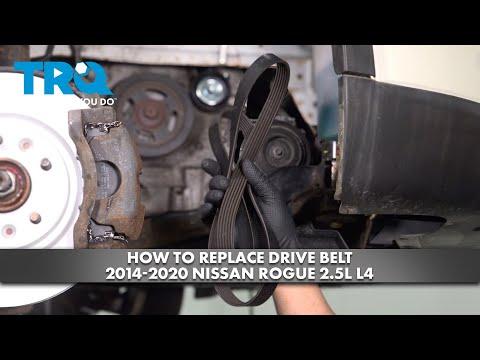






How to Replace the Serpentine Belt on a 2015 Nissan Rogue 2.5L
Step-by-step DIY guide with tools, parts list, torque specs, safety tips, and money-saving advice for 2014, 2015, 2016, 2017, 2018, 2019
How to Replace the Serpentine Belt on a 2015 Nissan Rogue 2.5L
Step-by-step DIY guide with tools, parts list, torque specs, safety tips, and money-saving advice for 2014, 2015, 2016, 2017, 2018, 2019


🔧 Rogue - Serpentine Belt Replacement
The serpentine belt (drive belt) on your Rogue runs the alternator, A/C compressor, and other accessories. You’ll remove the right front wheel and inner splash shield, unload the belt tensioner, swap the belt, and then re-tension it using the automatic tensioner.
Difficulty Level: Intermediate | Estimated Time: 1–2 hours
⚠️ Safety & Precautions
- ⚠️ Always work on a cold engine; moving belts and pulleys can catch clothing and hands.
- ⚠️ Park on level ground, apply the parking brake, and chock the rear wheels so the car cannot roll.
- ⚠️ Support the front of the Rogue with jack stands; never rely only on a floor jack.
- ⚠️ Disconnect the negative battery cable with a 10mm wrench to prevent accidental starting.
- ⚠️ Keep fingers and tools clear of pulleys when releasing the belt tensioner; it is spring-loaded.
🔧 Required Tools
You'll need the following tools for this repair:
- 🛠️ Floor jack (rated 3-ton minimum)
- 🛠️ Jack stands (2-ton or higher, pair)
- 🛠️ Wheel chocks
- 🛠️ 10mm socket
- 🛠️ 12mm socket
- 🛠️ 14mm socket
- 🛠️ 3/8" drive ratchet
- 🛠️ 3/8" drive torque wrench (5–80 ft-lbs range)
- 🛠️ Breaker bar 3/8" or 1/2" drive (18–24")
- 🛠️ Serpentine belt tool (slim profile) (specialty)
- 🛠️ Flathead screwdriver (medium)
- 🛠️ Trim clip removal tool (or plastic pry tool)
- 🛠️ Lug wrench or 21mm socket
- 🛠️ Work light or headlamp
- 🛠️ Mechanic’s gloves
- 🛠️ Safety glasses
- 🛠️ Paint marker or chalk
🔩 Required Parts
HowToo sells all the parts you need for this repair:
- 🔩 Serpentine (drive) belt – 2.5L with A/C - Qty: 1
- 🔩 Automatic belt tensioner assembly - Qty: 1 (optional but recommended if old/noisy)
- 🔩 Idler pulley - Qty: 1 (optional, replace if rough/noisy)
- 🔩 Plastic push clips for right front inner fender liner - Qty: 4–6 (in case any break)
- 🔩 Anti-seize compound - Qty: small tube
📋 Before You Begin
- 📝 Park the Rogue on a flat surface, shift to Park, apply the parking brake, and chock the rear wheels.
- 📝 Open the hood and locate the belt routing sticker on the radiator support or underside of the hood; if missing, you’ll draw your own diagram.
- 📝 Disconnect the negative battery terminal using a 10mm socket and set the cable aside so it cannot spring back.
- 📝 Loosen the front right wheel lug nuts one turn with a lug wrench before lifting the vehicle.
🔨 Step-by-Step Instructions
Follow these steps in order:
Step 1: Lift and support the front right side
- Position the floor jack under the front right pinch weld or front crossmember (consult your owner’s manual diagram).
- Raise the right front of the Rogue until the tire is off the ground.
- Place jack stands under the pinch weld or frame point and gently lower the vehicle onto the stands.
- Remove the right front wheel using a lug wrench or 21mm socket.
- Give the car a shake to confirm it’s stable.
Step 2: Remove the right inner fender liner access
- Turn your work light toward the engine side of the right wheel well.
- Use a trim clip removal tool or flathead screwdriver to remove the plastic push clips holding the front part of the inner fender liner.
- Carefully pull back or partially remove the inner fender liner to expose the crankshaft pulley and belt area.
- Set the clips aside; note their positions for reinstallation.
Step 3: Make or confirm a belt routing diagram
- From the wheel well and top of the engine bay, look at how the belt routes around each pulley.
- If no sticker is present, use a paint marker or chalk on cardboard or paper to draw the routing: label crankshaft, alternator, A/C compressor, idler, and tensioner.
- Take a clear photo with your phone as backup.
Step 4: Release tension from the belt
- Identify the belt tensioner; it is a spring-loaded arm with a smooth pulley on it.
- The QR25 engine uses a tensioner with a hex head (usually 14mm) or a square hole for a tool.
- Place a 14mm socket on the tensioner bolt and attach a breaker bar or serpentine belt tool.
- Rotate the tensioner in the direction that loosens the belt (usually clockwise when viewed from the wheel well) to relieve tension.
- While holding the tensioner, slip the belt off the smoothest, easiest-to-reach pulley (usually the idler or alternator) using your free hand.
- Slowly let the tensioner return to its resting position under control; do not let it snap back.
Step 5: Remove the old belt
- From the wheel well and top, slide the belt off the remaining pulleys and remove it entirely from the engine bay.
- Lay the old belt next to the new one to check length and rib count; they should match closely.
- If lengths differ a lot, stop and verify part.
Step 6: Inspect tensioner and pulleys
- Spin the idler pulley and tensioner pulley by hand; they should turn smoothly and quietly.
- Check for wobble or grinding; if present, plan to replace that pulley or tensioner now.
- Inspect the other accessory pulleys (alternator, A/C compressor) for roughness or damage.
Step 7: (Optional) Replace the belt tensioner
- If you are replacing the tensioner, remove its mounting bolts from the engine using a 12mm or 14mm socket and ratchet (bolt sizes can vary).
- Remove the old tensioner from the engine.
- Position the new tensioner and hand-thread the bolts.
- Tighten the mounting bolts using a torque wrench and correct socket to Torque to 54 Nm (40 ft-lbs).
- Always start bolts by hand to avoid cross-threading.
Step 8: Route the new belt (except over one pulley)
- Using your diagram, route the new belt around the crankshaft pulley first, ensuring the ribs sit properly in the grooves.
- Continue routing around the other grooved pulleys (alternator, A/C compressor, water pump if driven by this belt) matching the old path.
- Route the back (smooth) side of the belt over any smooth idler or tensioner pulleys per your diagram.
- Leave the belt off one easily accessible smooth pulley (often the idler) so you can slip it on once tension is released again.
Step 9: Apply tension and seat the belt
- Again, place a 14mm socket and breaker bar or belt tool on the tensioner.
- Rotate the tensioner to create slack in the belt.
- With your other hand, slip the belt over the last pulley you left free.
- Make sure all belt ribs are centered in the pulley grooves, both from the wheel well and from the top.
- Slowly release the tensioner so it takes up the slack and tensions the belt.
- Double-check each pulley; misalignment will cause squeal.
Step 10: Final visual inspection
- Check again from multiple angles that the belt is fully seated on every pulley and not twisted.
- Confirm the routing matches your diagram exactly.
- Look for any tools or rags left in the engine bay.
Step 11: Reinstall the inner fender liner and wheel
- Position the inner fender liner back in place.
- Install the plastic push clips by hand; if any are damaged, replace them with new ones.
- Reinstall the right front wheel and hand-thread all lug nuts.
- Use the floor jack to raise the vehicle slightly, remove the jack stands, then lower the Rogue to the ground.
- Tighten the lug nuts in a star pattern using a torque wrench and 21mm socket to Torque to 108 Nm (80 ft-lbs).
Step 12: Reconnect battery and test
- Reconnect the negative battery terminal with a 10mm socket and tighten to Torque to 5–7 Nm (4–5 ft-lbs) (snug, not overtight).
- Start the engine and watch the belt from the top; make sure it runs smoothly with no wobble or jumping.
- Listen for squealing or grinding; if you hear any, shut off the engine and recheck belt seating and pulleys.
✅ After Repair
- ✅ Let the engine idle for a few minutes while you watch the belt; verify it tracks in the center of each pulley.
- ✅ Turn on the A/C, lights, and steering (while stationary) to load the belt system slightly and listen for any noise.
- ✅ After a short test drive, recheck belt alignment and inspect the area for any new rubber dust or frayed edges.
- ✅ Over the next few days, listen for squeaks on cold startup; if present, recheck routing and pulley condition.
💰 DIY vs Shop Cost
Shop Cost: $220–$350 (parts + labor)
DIY Cost: $35–$90 (belt only) or $90–$180 (belt + tensioner + idler)
You Save: $130–$260 by doing it yourself!
Shop labor rates vary but typically run $100–$150/hour. This repair takes a shop approximately 1.0–1.5 hours.
🎯 Ready to get started?
HowToo makes it easy: same-day/2-day shipping on every part, plus all the tools and specialty tools you need! Check out the parts and tools sections below to add everything to your cart.