

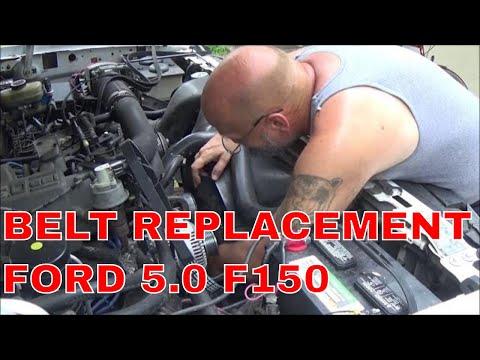




How to Replace the Serpentine Belt on a 2015 Ford F-150 5.0L
Step-by-step 2015 F-150 5.0L serpentine belt replacement with tools, routing diagram tips, safety steps, and torque specs for 2015, 2016, 2017, 2018, 2019, 2020, 2021, 2022, 2023, 2024, 2025
How to Replace the Serpentine Belt on a 2015 Ford F-150 5.0L
Step-by-step 2015 F-150 5.0L serpentine belt replacement with tools, routing diagram tips, safety steps, and torque specs for 2015, 2016, 2017, 2018, 2019, 2020, 2021, 2022, 2023, 2024, 2025


F-150 - Serpentine Belt Replacement 🔧
Good news: on your 5.0L, the serpentine belt is one long belt on the front of the engine, and Ford uses a spring-loaded tensioner, so no adjustment is needed—just route and release.
Quick Questions ❓
Before we start, reply with:
- ✅ Do you have basic tools (socket set and ratchet) and a safe, flat place to work?
- ✅ Is the belt just worn/cracked, or did it break and come off completely?
I’ll tailor the steps slightly based on your answers, but here is the full Ford-specific procedure so you can see what’s involved.
Parts & Specs 📦
- 🔧 Serpentine drive belt (main accessory drive belt)
- Ford OE example: FL3Z-8620-A (5.0L with standard accessories)
- Length and part number can vary with options (like heavy-duty alternator). Match by engine and A/C at the parts counter or catalog.
- 🔧 Optional: Belt tensioner assembly (if the tensioner is noisy or doesn’t move smoothly)
- 🔧 Optional: Idler pulleys (if they feel rough or make noise when spun)
Tools You’ll Need 🧰
- 🔧 3/8" drive ratchet (common hand tool for sockets)
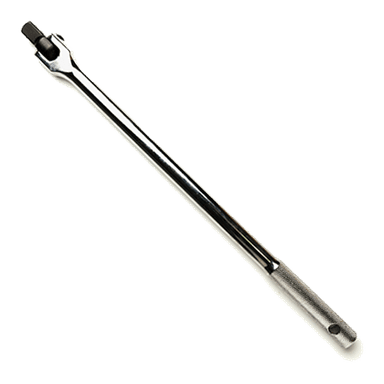
- 🔧 3/8" drive breaker bar or long-handled ratchet (gives more leverage)
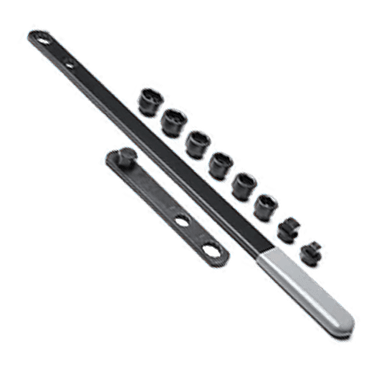
- 🔧 Serpentine belt tool (a thin, long bar with a 3/8" or 1/2" drive head; helps in tight spaces) – very helpful but not absolutely required
- 🔧 Socket set (metric, 8–15 mm will cover most fasteners)
- 🔧 Flat-blade screwdriver or trim tool (to pop off any plastic covers if needed)
- 🔧 Flashlight or work light
- 🔧 Gloves and safety glasses
Safety First ⚠️
- 🔧 Engine off and cool – never work around the belt with the engine running.
- 🔧 Battery: Not strictly required, but for a beginner I recommend disconnecting the negative battery cable (10 mm) so the engine can’t be started accidentally.
- 🔧 Keys out of ignition and keep the truck in PARK with the parking brake set.
- 🔧 Keep fingers and tools clear of pulleys when you release the tensioner; it’s spring-loaded.
Understanding the Belt Layout 🧠
Your 5.0L uses one main belt that drives:
- 🔧 Crankshaft pulley (bottom center – main drive)
- 🔧 Alternator
- 🔧 Power steering pump
- 🔧 A/C compressor
- 🔧 Water pump
- 🔧 Idler pulleys and a tensioner pulley
Ford places a belt routing diagram under the hood, usually on the radiator support or fan shroud. Find this sticker first if you can.
Step 1 – Prepare the Truck 🧱
- 🔧 Park on a flat surface, set the parking brake, and open the hood.
- 🔧 If you want extra safety, disconnect the negative battery cable:
- Use a 10 mm wrench or socket.
- Loosen the clamp and move the cable end away from the battery post.
- 🔧 Remove any plastic engine cover if it blocks access (usually pulls up off rubber grommets).
Step 2 – Locate the Tensioner 🔍
The belt tensioner is a spring-loaded arm with a pulley on the end. On the 5.0L, it’s typically on the front of the engine, slightly toward the passenger side.
- 🔧 Look for a pulley that:
- Is on a small arm, not a big accessory.
- Has a square hole (usually 3/8") or a bolt head in the center for a tool.
- 🔧 This is where you’ll put your ratchet or belt tool to relieve tension.
Step 3 – Record the Belt Routing 📝
- 🔧 Find the factory belt routing sticker under the hood. If it’s there, take a clear photo with your phone.
- 🔧 If there’s no sticker, draw a simple diagram:
- Which pulleys are smooth vs. ribbed.
- How the belt snakes around each one.
- 🔧 This step saves a lot of frustration when installing the new belt.
Step 4 – Release Tension and Remove the Old Belt 🧵
- 🔧 Place your 3/8" ratchet or belt tool into the square hole on the tensioner arm, or onto the center bolt of the tensioner pulley (depending on design).
- 🔧 Rotate the tensioner in the direction that loosens the belt (on the 5.0L, this is usually clockwise when viewed from the front, but follow how the belt slackens).
- 🔧 While holding the tensioner, slide the belt off one easy-to-reach smooth pulley (often an idler or alternator).
- 🔧 Slowly let the tensioner return to its rest position. Don’t let it snap back hard.
- 🔧 Now remove the belt completely from all pulleys and pull it out of the engine bay.
Step 5 – Inspect Pulleys and Tensioner 👀
- 🔧 Spin each idler pulley and the tensioner pulley by hand:
- They should spin smoothly and quietly.
- No grinding, wobbling, or rough spots.
- 🔧 Move the tensioner arm with your tool:
- It should move smoothly and spring back firmly.
- If it’s jerky, weak, or noisy, plan to replace the tensioner.
Step 6 – Compare Old and New Belt 📏
- 🔧 Lay the old belt and new belt side by side on the ground.
- 🔧 They should be very close in length and have the same number of ribs.
- 🔧 A tiny difference in length is normal, but not inches.
Step 7 – Route the New Belt (Except One Pulley) 🪢
- 🔧 Using your diagram or sticker, route the new belt around:
- Crankshaft pulley first (bottom).
- Then around the A/C compressor, power steering, water pump, and alternator as shown.
- 🔧 Make sure the belt ribs sit fully in the grooves on every ribbed pulley.
- 🔧 Leave the belt off one easy-to-reach smooth pulley (often an idler near the top). This will be your last connection after you pull the tensioner.
Step 8 – Apply Tension and Seat the Belt 💪
- 🔧 Put your ratchet or belt tool back on the tensioner.
- 🔧 Rotate the tensioner again to create slack in the belt.
- 🔧 With your other hand, slip the belt over the last smooth pulley.
- 🔧 Slowly release the tensioner so it tightens the belt.
- 🔧 Double-check:
- Belt ribs are centered in all grooved pulleys.
- Belt is not riding on the edge of any pulley.
- Routing matches the diagram exactly.
Step 9 – Final Checks and Start-Up 🚀
- 🔧 Reconnect the negative battery cable if you removed it (tighten the 10 mm nut snugly).
- 🔧 Make sure no tools or rags are left in the engine bay.
- 🔧 Start the engine and watch the belt for 20–30 seconds:
- It should run smoothly with no wobble.
- No squealing or slapping noises.
- 🔧 Shut the engine off and recheck belt alignment once more.
Torque Specs (If You Replace Tensioner/Idlers) 📐
- 🔧 Belt tensioner mounting bolts: typically around 35–40 lb-ft (47–54 N·m).
- 🔧 Idler pulley bolts: typically around 30–35 lb-ft (41–47 N·m).
These are typical Ford 5.0L values; if you end up changing the tensioner or idlers, tell me and I’ll give you the exact spec for your setup.
Tips & Tricks 💡
- 🔧 If access is tight, turning the steering wheel fully to one side and removing the front wheel and inner fender liner can give more room from the side—but usually not needed on your truck.
- 🔧 A serpentine belt tool is thin and long, which really helps clear the fan shroud and gives leverage.
- 🔧 If the belt squeals after install, recheck routing and pulley condition; a new belt on a bad pulley will still make noise.
Want Parts & Tools? 🛒
I’ll show you the correct serpentine belt, optional tensioner, idler pulleys, and a serpentine belt tool from HowToo below this answer. You can add what you need to your cart from the tools and parts section.
Reply with: whether your old belt is still on the truck or has already broken off, and if you want help confirming the exact belt part number for your specific 5.0L setup.
HowToo makes it easy: same-day/2-day shipping on every part, plus all the tools and specialty tools you need! 🚚