

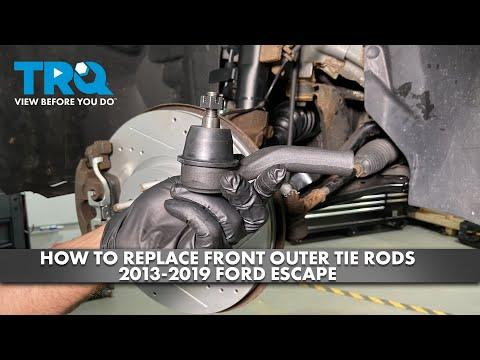







How to Replace the Outer Tie Rod End on a 2019 Ford Escape
Step-by-step DIY guide with tools, parts, torque specs, safety tips, and alignment advice for 2013, 2014, 2015, 2016, 2017, 2018, 2019
How to Replace the Outer Tie Rod End on a 2019 Ford Escape
Step-by-step DIY guide with tools, parts, torque specs, safety tips, and alignment advice for 2013, 2014, 2015, 2016, 2017, 2018, 2019


🔧 Escape - Outer Tie Rod End Replacement
This repair replaces the outer tie rod end, which connects the steering rack to the front wheel knuckle and helps steer your Escape. A worn tie rod end can cause looseness, clunking, uneven tire wear, or poor steering feel.
Difficulty Level: Intermediate | Estimated Time: 1-2 hours per side
Assumption: This procedure covers the front outer tie rod end on one side.
⚠️ Safety & Precautions
- ⚠️ Work on a flat, solid surface and never rely on a jack alone.
- ⚠️ Always support your Escape with jack stands before working near the wheel or suspension.
- ⚠️ Do not hammer directly on the steering knuckle threads or tie rod stud.
- ⚠️ The vehicle will need a professional wheel alignment after replacing a tie rod end.
- ⚠️ If the tie rod end is loose enough to affect steering, avoid driving except directly to an alignment shop.
🔧 Required Tools
You'll need the following tools for this repair:
- Floor jack (rated 2-ton minimum)
- Jack stands (rated 2-ton minimum)
- Wheel chocks
- 19mm lug nut socket
- 1/2-inch drive breaker bar
- 1/2-inch drive torque wrench
- Metric open-end wrench set 18mm-24mm
- Metric socket set 15mm-21mm
- Ratchet 3/8-inch drive
- Tie rod end puller (specialty)
- Needle-nose pliers
- Paint marker
- Tape measure
- Penetrating oil
- Wire brush
- Safety glasses
- Mechanic gloves
🔩 Required Parts
HowToo sells all the parts you need for this repair:
- Front outer tie rod end - Qty: 1 per side
- New tie rod end castle nut or flange nut - Qty: 1
- New cotter pin - Qty: 1 if equipped
📋 Before You Begin
- Park your Escape on level ground with the steering wheel straight.
- Set the parking brake and place wheel chocks behind the rear wheels.
- Loosen the front wheel lug nuts slightly before lifting the vehicle.
- A tie rod end puller is a small press tool that safely separates the tapered tie rod stud from the steering knuckle.
- A jam nut is the locknut on the inner tie rod that holds the outer tie rod end in place.
- Measure carefully before removal. This helps keep the alignment close enough to drive to an alignment shop.
🔨 Step-by-Step Instructions
Follow these steps in order:
Step 1: Loosen the Wheel
- Use the 19mm lug nut socket and 1/2-inch drive breaker bar to loosen the front wheel lug nuts about 1/2 turn.
- Do not remove the lug nuts yet.
- Loosen before lifting for safety.
Step 2: Raise and Support the Front
- Use the floor jack to lift the front corner of your Escape at the proper front jacking point.
- Place a jack stand under the reinforced front support point.
- Lower the vehicle gently onto the jack stand.
- Use safety glasses and mechanic gloves before working underneath or near suspension parts.
Step 3: Remove the Wheel
- Use the 19mm lug nut socket and ratchet 3/8-inch drive to remove the loosened lug nuts.
- Remove the wheel and set it flat under the side of the vehicle as an extra safety backup.
Step 4: Clean and Mark the Tie Rod Position
- Use the wire brush to clean the exposed threads where the outer tie rod end meets the inner tie rod.
- Spray penetrating oil on the jam nut and tie rod threads.
- Use the paint marker to mark the tie rod threads at the rear edge of the outer tie rod end.
- Use the tape measure to measure from the jam nut to a fixed point on the outer tie rod end and write it down.
- This preserves basic toe alignment.
Step 5: Loosen the Jam Nut
- Use the correct metric open-end wrench, typically in the 18mm-24mm range, to hold the outer tie rod end steady.
- Use another metric open-end wrench to loosen the jam nut about 1 turn.
- Do not spin the outer tie rod end yet.
- If it is rusty, apply more penetrating oil and work slowly.
Step 6: Remove the Tie Rod Nut
- If your replacement style uses a cotter pin, use needle-nose pliers to straighten and remove the cotter pin from the tie rod stud.
- Use the correct metric socket, typically in the 15mm-21mm range, with the ratchet 3/8-inch drive to loosen the tie rod end nut at the steering knuckle.
- Remove the nut and discard it if the new part includes a replacement nut.
Step 7: Separate the Tie Rod End from the Knuckle
- Install the tie rod end puller over the tie rod end stud and steering knuckle.
- Tighten the puller with the correct metric socket and ratchet 3/8-inch drive until the stud pops free.
- This pop can be loud. Keep your hands clear of the joint.
- Do not pry on the rubber boot if you plan to inspect the old part.
Step 8: Count Turns and Remove the Old Tie Rod End
- Turn the outer tie rod end counterclockwise by hand to remove it from the inner tie rod.
- Count every full turn as it comes off.
- Write down the exact number of turns.
- Use a metric open-end wrench if the tie rod end is too tight to turn by hand.
- Turn count helps alignment accuracy.
Step 9: Install the New Tie Rod End
- Thread the new outer tie rod end onto the inner tie rod by hand.
- Use the same number of turns counted during removal.
- Stop when it reaches your paint marker reference mark and original measurement.
- Make sure the tie rod end points down into the steering knuckle without twisting the inner tie rod boot.
Step 10: Attach the Tie Rod End to the Steering Knuckle
- Insert the new tie rod stud into the steering knuckle by hand.
- Install the new nut by hand first to avoid cross-threading.
- Use the correct metric socket and 1/2-inch drive torque wrench to tighten the tie rod end nut.
- Torque to 80 Nm (59 ft-lbs)
- If equipped with a castle nut and cotter pin, tighten only enough to align the slot with the hole, then install a new cotter pin using needle-nose pliers.
Step 11: Tighten the Jam Nut
- Use the correct metric open-end wrench to hold the outer tie rod end steady.
- Use another metric open-end wrench to tighten the jam nut against the outer tie rod end.
- Torque to 70 Nm (52 ft-lbs)
- Make sure the tie rod boot is not twisted.
Step 12: Reinstall the Wheel
- Place the wheel back onto the hub.
- Install the lug nuts by hand first.
- Use the 19mm lug nut socket and ratchet 3/8-inch drive to snug the lug nuts in a star pattern.
Step 13: Lower and Torque the Wheel
- Use the floor jack to lift the vehicle slightly off the jack stand.
- Remove the jack stand.
- Lower your Escape fully to the ground.
- Use the 19mm lug nut socket and 1/2-inch drive torque wrench to tighten the lug nuts in a star pattern.
- Torque to 135 Nm (100 ft-lbs)
✅ After Repair
- ✅ Start your Escape and slowly turn the steering wheel left and right while parked.
- ✅ Listen for clunks and check that the steering feels smooth.
- ✅ Test drive slowly at first. If the steering wheel is off-center or the vehicle pulls, stop driving except to the alignment shop.
- ✅ Schedule a professional front wheel alignment immediately after replacing the tie rod end.
- ✅ Recheck the lug nut torque after 25-50 miles: 135 Nm (100 ft-lbs).
💰 DIY vs Shop Cost
Shop Cost: $220-$420 per side (parts + labor, alignment not always included)
DIY Cost: $35-$100 per side (parts only)
You Save: $185-$320 by doing it yourself!
Shop labor rates vary but typically run $100-$150/hour. This repair takes a shop approximately 0.8-1.3 hours, plus alignment time.
🎯 Ready to get started?
HowToo makes it easy: same-day/2-day shipping on every part, plus all the tools and specialty tools you need! Check out the parts and tools sections below to add everything to your cart.