









Howtoo Logo
2014 Ford Escape
2013 - 2019 Ford Escape
Bryan specialist avatar

Ask a Mechanic

Get expert help before you buy

Here is everything needed for this repair

See what I can do

Make Money

With HowToo

OnOff

Here is just the beginning of what I can do!

Select one to see me in action

Vehicle Features

Image Vehicle Features

How do I connect my phone to my stereo?

Vehicle Information

Image Vehicle Information

What is my horsepower and torque

Image Recognition

Image Image Recognition

What is this warning light on my dash?

Troubleshooting

Image Troubleshooting

I have a P0300 engine code

Vehicle Recognition

Image Vehicle Recognition

What vehicle is this?

Find shops near you

Image Find shops near you

Find a shop to do this repair

Vehicle Talk

Image Vehicle Talk

What’s your favorite vehicle of all time?

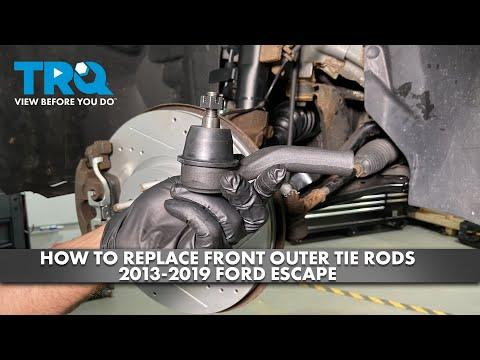
How to Replace Front Outer Tie Rods 2013-2019 Ford Escape

How to Replace Front Outer Tie Rods 2013-2019 Ford Escape

Suggested Parts

See all parts background
See All Parts

Tools & Fluids

2 Ton
2 Ton
Floor Jack
2 Ton
2 Ton
Jack Stands
Wheel Chocks
Wheel Chocks
19mm
19mm
Socket
or (23/32")
1/2
1/2
Breaker Bar
See all parts background
See All Tools

How to Replace the Outer Tie Rod End on a 2014 Ford Escape

Step-by-step steering repair guide with tools, parts, torque specs, and alignment tips for 2013, 2014, 2015, 2016, 2017, 2018, 2019

How to Replace the Outer Tie Rod End on a 2014 Ford Escape

Step-by-step steering repair guide with tools, parts, torque specs, and alignment tips for 2013, 2014, 2015, 2016, 2017, 2018, 2019

Orion
Orion

🔧 Escape - Outer Tie Rod End Replacement

This repair replaces the outer tie rod end, which connects the steering rack to the front wheel knuckle and helps control steering direction. A worn tie rod end can cause clunking, loose steering, uneven tire wear, or poor alignment.

Difficulty Level: Intermediate | Estimated Time: 1-2 hours per side


⚠️ Safety & Precautions

  • ⚠️ Always support your Escape with jack stands before working under or beside the front suspension.
  • ⚠️ Do not rely on a floor jack alone. A floor jack lifts the vehicle; jack stands safely hold it up.
  • ⚠️ Replace tie rod ends in pairs if both sides show wear, and always get a wheel alignment after this repair.
  • ⚠️ Do not hammer directly on the threaded stud. Damaged threads can prevent proper tightening.
  • ⚠️ Battery disconnect is not required for this repair.

🔧 Required Tools

You'll need the following tools for this repair:

  • Floor jack (rated 2-ton minimum)
  • Jack stands (rated 2-ton minimum)
  • Wheel chocks
  • 19mm lug nut socket
  • 1/2-inch drive breaker bar
  • 1/2-inch drive ratchet
  • Torque wrench (10-150 ft-lbs)
  • Adjustable wrench
  • 21mm open-end wrench
  • 18mm socket
  • Needle-nose pliers
  • Tie rod end puller (specialty)
  • Paint marker
  • Tape measure
  • Wire brush
  • Penetrating oil
  • Safety glasses
  • Mechanic gloves

🔩 Required Parts

HowToo sells all the parts you need for this repair:

  • Outer tie rod end - Qty: 1 per side
  • Outer tie rod end castle nut - Qty: 1 per side
  • Cotter pin - Qty: 1 per side
  • Anti-seize compound - Qty: 1 small packet

📋 Before You Begin

  • Park your Escape on level ground and set the parking brake.
  • Place wheel chocks behind the rear wheels.
  • Make sure the steering wheel is centered before starting.
  • Spray penetrating oil on the tie rod jam nut and the tie rod stud nut. Let it soak for 5-10 minutes.
  • A jam nut is the locking nut on the inner tie rod that keeps the outer tie rod end from turning out of adjustment.
  • This repair disturbs steering alignment. The measurement steps help you drive safely to an alignment shop, but they do not replace a professional alignment.

🔨 Step-by-Step Instructions

Follow these steps in order:

Step 1: Loosen the Front Wheel Lug Nuts

  • Use a 19mm lug nut socket and 1/2-inch drive breaker bar to loosen the front wheel lug nuts about 1/2 turn.
  • Do this while the tire is still on the ground so it does not spin.
  • Tip: Loosen only; do not remove yet.

Step 2: Lift and Support the Front of the Vehicle

  • Use a floor jack at the front lift point to raise the side you are repairing.
  • Place a jack stand under the proper front pinch weld or subframe support point.
  • Lower the vehicle gently onto the jack stand using the floor jack.
  • Shake the vehicle lightly by hand to confirm it is stable before working.

Step 3: Remove the Front Wheel

  • Use the 19mm lug nut socket and 1/2-inch drive ratchet to remove the loosened lug nuts.
  • Remove the wheel and place it flat under the side of the vehicle as an added safety backup.

Step 4: Measure and Mark the Old Tie Rod Position

  • Use a paint marker to mark the exposed threads where the outer tie rod end meets the jam nut.
  • Use a tape measure to measure from the center of the tie rod stud to a fixed point on the inner tie rod.
  • Write down the measurement before removal.
  • This helps install the new tie rod close to the old position so your Escape can be driven carefully to an alignment shop.

Step 5: Loosen the Jam Nut

  • Use a 21mm open-end wrench on the jam nut.
  • Use an adjustable wrench on the flat section of the inner tie rod to hold it still.
  • Turn the jam nut loose about 1/4 turn only.
  • Do not spin the jam nut far down the threads. Leave it as a position reference.

Step 6: Remove the Cotter Pin and Retaining Nut

  • Use needle-nose pliers to straighten and pull out the cotter pin from the tie rod stud.
  • A cotter pin is a small bent safety pin that keeps the nut from backing off.
  • Use an 18mm socket and 1/2-inch drive ratchet to remove the tie rod end nut from the steering knuckle.

Step 7: Separate the Tie Rod End from the Steering Knuckle

  • Install the tie rod end puller over the tie rod end stud and steering knuckle.
  • A tie rod end puller is a small press tool that pushes the tapered stud out without damaging the steering knuckle.
  • Tighten the puller with the correct wrench or ratchet until the stud pops free.
  • Keep your face and hands clear because it may release suddenly.

Step 8: Unscrew the Old Outer Tie Rod End

  • Turn the old outer tie rod end counterclockwise by hand to remove it from the inner tie rod.
  • Count the exact number of turns as it comes off.
  • Write down the number of turns.
  • Tip: Counting turns helps preserve rough alignment.

Step 9: Install the New Outer Tie Rod End

  • Use a wire brush to clean the inner tie rod threads.
  • Apply a light coat of anti-seize compound to the inner tie rod threads.
  • Thread the new outer tie rod end onto the inner tie rod by hand.
  • Install it the same number of turns you counted during removal.
  • Line it up with the steering knuckle hole.

Step 10: Seat the Tie Rod Stud in the Steering Knuckle

  • Insert the new tie rod end stud into the steering knuckle by hand.
  • Install the new castle nut by hand first to avoid cross-threading.
  • Use an 18mm socket and torque wrench to tighten the tie rod end nut to Torque to 48 Nm (35 ft-lbs).
  • If the cotter pin hole does not line up, tighten the nut slightly more until it lines up. Do not loosen the nut to line it up.
  • Use needle-nose pliers to install and bend the new cotter pin.

Step 11: Tighten the Jam Nut

  • Hold the inner tie rod steady with an adjustable wrench.
  • Use a 21mm open-end wrench to tighten the jam nut against the new outer tie rod end.
  • Tighten the jam nut firmly to lock the adjustment in place.
  • If using a crowfoot adapter with a torque wrench, tighten the jam nut to Torque to 55 Nm (41 ft-lbs).

Step 12: Reinstall the Wheel

  • Place the wheel back onto the hub by hand.
  • Install the lug nuts by hand first.
  • Use the 19mm lug nut socket and 1/2-inch drive ratchet to snug the lug nuts in a star pattern.

Step 13: Lower the Vehicle and Torque the Lug Nuts

  • Use the floor jack to lift the vehicle slightly off the jack stand.
  • Remove the jack stand.
  • Lower the vehicle fully to the ground with the floor jack.
  • Use the 19mm lug nut socket and torque wrench to tighten the lug nuts in a star pattern to Torque to 135 Nm (100 ft-lbs).

✅ After Repair

  • ✅ Turn the steering wheel left and right while parked. Listen for binding, clicking, or rubbing.
  • ✅ Test drive slowly at first. Make sure the steering wheel returns normally and the vehicle does not pull hard.
  • ✅ Schedule a professional front-end alignment as soon as possible. This is required after tie rod replacement.
  • ✅ Recheck the tie rod jam nut and lug nut torque after the first short drive.
  • ✅ Avoid highway driving until alignment is completed if the steering wheel is off-center or the vehicle pulls.

💰 DIY vs Shop Cost

Shop Cost: $220-$420 per side including parts, labor, and basic alignment adjustment

DIY Cost: $35-$95 per side for parts only

You Save: $185-$325 by doing it yourself!

Shop labor rates vary but typically run $100-$150/hour. This repair takes a shop approximately 0.8-1.5 hours per side, plus alignment time.


🎯 Ready to get started?

HowToo makes it easy: same-day/2-day shipping on every part, plus all the tools and specialty tools you need! Check out the parts and tools sections below to add everything to your cart.

Orion
Orion

🔧 Escape - Outer Tie Rod End Replacement

This repair replaces the outer tie rod end, the steering joint that connects the inner tie rod to the front steering knuckle. A worn tie rod end can cause clunking, loose steering, wandering, or uneven front tire wear.

Difficulty Level: Intermediate | Estimated Time: 1-2 hours per side


⚠️ Safety & Precautions

  • ⚠️ Support your Escape with jack stands before removing the wheel.
  • ⚠️ Never work under or beside a vehicle held only by a floor jack.
  • ⚠️ A wheel alignment is required after replacing a tie rod end.
  • ⚠️ Do not drive at highway speed before alignment if the steering wheel is crooked or the vehicle pulls.
  • ⚠️ Battery disconnect is not required for this repair.

🔧 Required Tools

You'll need the following tools for this repair:

  • Floor jack (rated 2-ton minimum)
  • Jack stands (rated 2-ton minimum)
  • Wheel chocks
  • 19mm lug nut socket
  • 1/2-inch drive breaker bar
  • 1/2-inch drive ratchet
  • Torque wrench (10-150 ft-lbs)
  • 18mm socket
  • 21mm open-end wrench
  • Adjustable wrench
  • Needle-nose pliers
  • Tie rod end puller (specialty)
  • Paint marker
  • Tape measure
  • Wire brush
  • Penetrating oil
  • Safety glasses
  • Mechanic gloves

🔩 Required Parts

HowToo sells all the parts you need for this repair:

  • Outer tie rod end - Qty: 1 per side
  • Outer tie rod end castle nut - Qty: 1 per side
  • Cotter pin - Qty: 1 per side
  • Anti-seize compound - Qty: 1 small packet

📋 Before You Begin

  • Park your Escape on level ground and set the parking brake.
  • Place wheel chocks behind the rear wheels.
  • Center the steering wheel before lifting the vehicle.
  • Spray penetrating oil on the tie rod jam nut and tie rod stud nut. Let it soak for 5-10 minutes.
  • A jam nut is the locking nut on the threaded rod that keeps the tie rod end from moving.
  • Measure carefully before removal. This gets alignment close enough for a short, careful drive to the alignment shop.

🔨 Step-by-Step Instructions

Follow these steps in order:

Step 1: Loosen the Wheel Lug Nuts

  • Use a 19mm lug nut socket and 1/2-inch drive breaker bar to loosen the front wheel lug nuts about 1/2 turn.
  • Do this while the tire is still on the ground so it does not spin.
  • Loosen only; do not remove yet.

Step 2: Lift and Support the Vehicle

  • Use a floor jack to raise the front corner you are repairing.
  • Place a jack stand under a solid front support point.
  • Lower your Escape gently onto the jack stand with the floor jack.
  • Give the vehicle a light shake by hand to confirm it is stable.

Step 3: Remove the Wheel

  • Use the 19mm lug nut socket and 1/2-inch drive ratchet to remove the lug nuts.
  • Remove the wheel and set it flat under the side of the vehicle as a safety backup.

Step 4: Mark and Measure the Old Tie Rod Position

  • Use a paint marker to mark where the outer tie rod end meets the jam nut.
  • Use a tape measure to measure from the center of the tie rod stud to a fixed point on the inner tie rod.
  • Write the measurement down before removing anything.
  • This helps keep the alignment close.

Step 5: Loosen the Jam Nut

  • Use a 21mm open-end wrench on the jam nut.
  • Use an adjustable wrench to hold the inner tie rod steady.
  • Turn the jam nut loose about 1/4 turn.
  • Do not move it far down the threads. It is your reference point.

Step 6: Remove the Cotter Pin and Nut

  • Use needle-nose pliers to straighten and remove the cotter pin from the tie rod stud.
  • A cotter pin is a small bent safety pin that prevents the nut from loosening.
  • Use an 18mm socket and 1/2-inch drive ratchet to remove the tie rod end nut.

Step 7: Separate the Tie Rod End

  • Install the tie rod end puller over the tie rod stud and steering knuckle.
  • A tie rod end puller is a press tool that safely pushes the joint apart.
  • Tighten the puller with the 1/2-inch drive ratchet until the stud pops free.
  • Keep your hands clear because it may release suddenly.

Step 8: Remove the Old Tie Rod End

  • Turn the old outer tie rod end counterclockwise by hand to unscrew it from the inner tie rod.
  • Count the exact number of turns during removal.
  • Write that number down.
  • Install the new one the same turns.

Step 9: Install the New Tie Rod End

  • Use a wire brush to clean the exposed inner tie rod threads.
  • Apply a light coat of anti-seize compound to the threads.
  • Thread the new outer tie rod end onto the inner tie rod by hand.
  • Turn it on the same number of turns counted during removal.
  • Line the stud up with the steering knuckle hole.

Step 10: Tighten the Tie Rod End Nut

  • Insert the new tie rod stud into the steering knuckle by hand.
  • Start the new castle nut by hand to avoid cross-threading.
  • Use an 18mm socket and torque wrench to tighten the nut to Torque to 48 Nm (35 ft-lbs).
  • If the cotter pin hole does not line up, tighten the nut slightly more until it lines up.
  • Use needle-nose pliers to install and bend the new cotter pin.

Step 11: Tighten the Jam Nut

  • Hold the inner tie rod steady with an adjustable wrench.
  • Use a 21mm open-end wrench to tighten the jam nut against the new outer tie rod end.
  • If using a torque wrench with the correct adapter, tighten the jam nut to Torque to 55 Nm (41 ft-lbs).

Step 12: Reinstall the Wheel

  • Place the wheel back on the hub by hand.
  • Start all lug nuts by hand first.
  • Use the 19mm lug nut socket and 1/2-inch drive ratchet to snug the lug nuts in a star pattern.

Step 13: Lower and Torque the Wheel

  • Use the floor jack to raise the vehicle slightly.
  • Remove the jack stand.
  • Lower the vehicle fully with the floor jack.
  • Use the 19mm lug nut socket and torque wrench to tighten the lug nuts in a star pattern to Torque to 135 Nm (100 ft-lbs).

✅ After Repair

  • ✅ Turn the steering wheel fully left and right while parked. Check for binding or rubbing.
  • ✅ Take a short, slow test drive. Listen for clunks and check that steering feels normal.
  • ✅ Get a professional wheel alignment as soon as possible.
  • ✅ Recheck the lug nut torque after the first short drive.
  • ✅ If the steering wheel is off-center or your Escape pulls, drive only carefully to the alignment shop.

💰 DIY vs Shop Cost

Shop Cost: $220-$420 per side including parts and labor, alignment extra if needed

DIY Cost: $35-$95 per side for parts only

You Save: $185-$325 by doing it yourself!

Shop labor rates vary but typically run $100-$150/hour. This repair takes a shop approximately 0.8-1.5 hours per side.


🎯 Ready to get started?

HowToo makes it easy: same-day/2-day shipping on every part, plus all the tools and specialty tools you need! Check out the parts and tools sections below to add everything to your cart.

Parts
Tools
2014 Ford Escape
Menu
Videos
Earn