

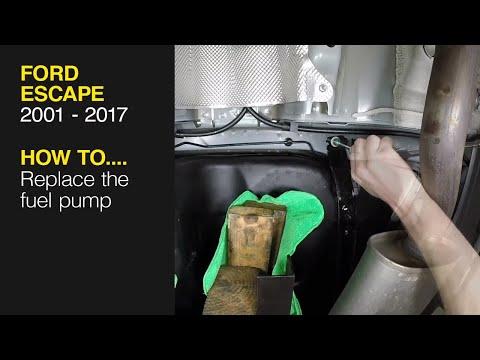




How to Replace the Fuel Pump on a 2017 Ford Escape
Step-by-step in-tank pump guide with tools, parts, torque specs, and safety tips for 2013, 2014, 2015, 2016
How to Replace the Fuel Pump on a 2017 Ford Escape
Step-by-step in-tank pump guide with tools, parts, torque specs, and safety tips for 2013, 2014, 2015, 2016


🔧 Escape - Fuel Pump Replacement
Replacing the in-tank fuel pump on your Escape requires lowering the fuel tank, removing the pump module, and installing a new sealed module assembly. This repair is safety-sensitive because gasoline vapors are flammable, so work slowly, keep sparks away, and relieve fuel pressure before disconnecting any fuel lines.
Difficulty Level: Advanced | Estimated Time: 3-5 hours
⚠️ Safety & Precautions
- ⚠️ Gasoline is extremely flammable. Work outside or in a very well-ventilated area.
- ⚠️ Keep cigarettes, heaters, grinders, extension-cord sparks, and open flames far away.
- ⚠️ Wear safety glasses and fuel-resistant gloves to protect your eyes and skin.
- ⚠️ Disconnect the negative battery cable before opening the fuel system.
- ⚠️ Relieve fuel pressure before disconnecting fuel lines.
- ⚠️ Support your Escape only with jack stands. Never work under a vehicle held by a jack alone.
- ⚠️ A nearly empty fuel tank is much safer and easier to lower than a full one.
- ⚠️ Fuel line quick-connect fittings are plastic. Do not pry them with screwdrivers.
🔧 Required Tools
You'll need the following tools for this repair:
- 8mm socket
- 10mm socket
- 13mm socket
- 15mm socket
- 3/8-inch ratchet
- 3/8-inch extension set
- Torque wrench 5-80 ft-lbs
- Flat trim tool
- Fuel line disconnect tool set 3/8-inch and 5/16-inch
- Fuel pump lock ring tool (specialty)
- Brass drift punch
- Rubber mallet
- Floor jack rated 2-ton minimum
- Jack stands rated 2-ton minimum
- Transmission jack or wide fuel tank support board
- Wheel chocks
- Drain pan fuel-safe
- Clean shop towels
- Safety glasses
- Fuel-resistant gloves
- Class B fire extinguisher
🔩 Required Parts
HowToo sells all the parts you need for this repair:
- Fuel pump module assembly - Qty: 1
- Fuel pump tank seal/O-ring - Qty: 1
- Fuel tank strap bolts - Qty: 2
- Fuel line retaining clips - Qty: As needed
- Fresh gasoline - Qty: As needed
📋 Before You Begin
- Park your Escape on level ground and set the parking brake.
- Run the fuel level as low as possible before starting. A fuel tank can be very heavy when full.
- Open the fuel door and remove the fuel cap to release tank vapor pressure.
- Move the front seats forward if you need extra room around the rear floor area, but this repair is normally done from underneath by lowering the fuel tank.
- A quick-connect fitting is a spring-lock fuel line connector. The disconnect tool releases the internal clip without breaking it.
- A fuel pump lock ring tool turns the large metal retaining ring that holds the pump module into the tank.
🔨 Step-by-Step Instructions
Follow these steps in order:
Step 1: Relieve Fuel Pressure
- Use your fingers to remove the fuel cap, then reinstall it loosely after pressure vents.
- Use the interior fuse panel cover diagram or owner information to identify the fuel pump fuse or relay.
- Use a fuse puller or needle-nose pliers to remove the fuel pump fuse or relay.
- Start the engine and let it run until it stalls.
- Use the ignition button/key to crank the engine for 3-5 seconds once more.
- Turn the ignition OFF.
- This lowers fuel spray risk.
Step 2: Disconnect the Battery
- Use a 10mm socket and 3/8-inch ratchet to loosen the negative battery terminal clamp.
- Remove the negative cable from the battery and move it aside so it cannot spring back.
- Do not let the wrench touch the positive battery post.
Step 3: Raise and Support the Vehicle
- Place wheel chocks at the front wheels.
- Use a floor jack rated 2-ton minimum to lift the rear of your Escape at the approved rear lift point.
- Place jack stands rated 2-ton minimum under the rear support points.
- Gently lower the vehicle onto the jack stands.
- Shake the vehicle lightly by hand to confirm it is stable before going underneath.
Step 4: Remove Rear Underbody Shields If Equipped
- Use an 8mm socket and 3/8-inch ratchet to remove underbody shield screws near the fuel tank.
- Use a flat trim tool to release any plastic push clips.
- Set the shield and fasteners aside in order.
Step 5: Support the Fuel Tank
- Position a transmission jack or floor jack with a wide fuel tank support board under the center of the fuel tank.
- Raise the jack just enough to touch the tank. Do not dent the tank.
- Wide support spreads the weight.
Step 6: Disconnect Filler Neck and Vent Connections
- Use an 8mm socket or flat screwdriver to loosen the fuel filler neck hose clamp at the tank.
- Use fuel-resistant gloves to twist the hose gently and slide it off the tank neck.
- Use the flat trim tool to release vapor line clips near the tank.
- Label lines with tape if needed so they return to the same location.
Step 7: Disconnect Fuel Lines and Electrical Connector
- Place a fuel-safe drain pan under the fuel line area.
- Use clean shop towels around the fitting to catch any leftover fuel.
- Use the 3/8-inch or 5/16-inch fuel line disconnect tool to release the quick-connect fuel line from the pump module.
- Push the line inward first, insert the tool, then pull the line off straight.
- Use your thumb to press the electrical connector lock, then unplug the connector from the pump module.
- Do not pull on the wires.
Step 8: Lower the Fuel Tank
- Use a 13mm or 15mm socket, 3/8-inch extension, and 3/8-inch ratchet to remove the fuel tank strap bolts.
- Keep one hand on the tank or jack while removing the final strap bolt.
- Slowly lower the tank a few inches and check for any still-connected hoses or wiring.
- Disconnect anything still attached using the correct fuel line disconnect tool or flat trim tool.
- Lower the tank enough to access the fuel pump module on top.
Step 9: Clean Around the Pump Module
- Use clean shop towels to wipe dirt from the top of the tank around the fuel pump module.
- Do not let dirt fall into the fuel tank.
- Cleanliness protects the new pump.
Step 10: Remove the Fuel Pump Lock Ring
- Use the fuel pump lock ring tool and 3/8-inch ratchet to turn the lock ring counterclockwise.
- If a lock ring tool is not available, use a brass drift punch and rubber mallet to tap the ring counterclockwise.
- Use only brass, plastic, or non-sparking tools near fuel vapor.
- Lift off the lock ring and set it aside.
Step 11: Remove the Old Fuel Pump Module
- Use both hands to lift the fuel pump module straight up from the tank.
- Tilt the module slightly to clear the fuel level float arm.
- Let fuel drain from the module into the tank before moving it away.
- Remove the old fuel pump tank seal/O-ring from the tank opening.
- Wipe the sealing surface with clean shop towels.
Step 12: Install the New Fuel Pump Module
- Place the new fuel pump tank seal/O-ring into the tank groove by hand.
- Do not use grease or sealant unless the pump instructions specifically include it.
- Lower the new fuel pump module into the tank carefully.
- Guide the fuel level float into the tank without bending it.
- Align the pump module indexing marks with the marks on the tank.
Step 13: Reinstall the Lock Ring
- Install the lock ring by hand until it sits flat.
- Use the fuel pump lock ring tool and 3/8-inch ratchet to turn the ring clockwise until fully seated against its stops.
- If using a brass drift punch and rubber mallet, tap the ring clockwise evenly until fully seated.
- Confirm the seal did not squeeze out from under the module.
Step 14: Raise and Reconnect the Fuel Tank
- Use the transmission jack or floor jack with support board to slowly raise the fuel tank.
- Pause halfway and reconnect the electrical connector by hand until it clicks.
- Reconnect the fuel line quick-connect fitting by pushing it on until it clicks.
- Pull back gently by hand to confirm the fuel line is locked.
- Reconnect vapor lines and clips by hand.
Step 15: Reinstall Fuel Tank Straps
- Position the fuel tank straps over the tank.
- Install new fuel tank strap bolts by hand first to avoid cross-threading.
- Use a 13mm or 15mm socket and torque wrench to tighten the tank strap bolts.
- Torque to 40 Nm (30 ft-lbs)
Step 16: Reconnect Filler Neck and Shields
- Slide the fuel filler hose fully onto the tank neck by hand.
- Use an 8mm socket or flat screwdriver to tighten the filler neck hose clamp snugly.
- Use the flat trim tool to reinstall plastic clips.
- Use an 8mm socket and 3/8-inch ratchet to reinstall underbody shield screws.
- Torque small shield screws to 3-5 Nm (27-44 in-lbs)
Step 17: Reconnect Battery and Prime the System
- Reinstall the fuel pump fuse or relay by hand.
- Use a 10mm socket and 3/8-inch ratchet to reconnect the negative battery cable.
- Torque to 5 Nm (44 in-lbs)
- Turn the ignition ON for 5 seconds without starting the engine.
- Turn the ignition OFF for 10 seconds.
- Repeat this ON/OFF cycle 3 times to prime the fuel system.
Step 18: Check for Leaks and Start Engine
- Use a flashlight to inspect the fuel line connection and pump module area for leaks.
- Start the engine and let it idle.
- Check again for leaks while the engine is running.
- If you smell raw fuel or see wetness, shut the engine OFF immediately.
Step 19: Lower the Vehicle
- Use the floor jack rated 2-ton minimum to lift the rear slightly off the jack stands.
- Remove the jack stands.
- Lower your Escape slowly to the ground.
- Remove the wheel chocks.
✅ After Repair
- ✅ Let the engine idle for 2-3 minutes and confirm it runs smoothly.
- ✅ Take a short test drive around the block.
- ✅ Recheck under the rear of your Escape for fuel smell or drips after the test drive.
- ✅ If the fuel gauge reads incorrectly, recheck the pump module connector and float arm installation.
- ✅ If the engine cranks but does not start, cycle the ignition ON/OFF several more times and recheck the fuel pump fuse/relay.
- ✅ Dispose of fuel-soaked towels safely according to local rules.
💰 DIY vs Shop Cost
Shop Cost: $650-$1,100 (parts + labor)
DIY Cost: $180-$450 (parts only)
You Save: $470-$650 by doing it yourself!
Shop labor rates vary but typically run $100-$150/hour. This repair takes a shop approximately 2.5-4.0 hours.
🎯 Ready to get started?
HowToo makes it easy: same-day/2-day shipping on every part, plus all the tools and specialty tools you need! Check out the parts and tools sections below to add everything to your cart.