







How to Replace the Fuel Pump on a 2007 Toyota Corolla (In-Tank Module Guide)
Step-by-step rear-seat access instructions with tools, parts list, safety tips, and 35 in-lb (4 N·m) torque spec for 2005, 2006, 2007, 2008
How to Replace the Fuel Pump on a 2007 Toyota Corolla (In-Tank Module Guide)
Step-by-step rear-seat access instructions with tools, parts list, safety tips, and 35 in-lb (4 N·m) torque spec for 2005, 2006, 2007, 2008


🔧 Corolla - Fuel Pump Replacement
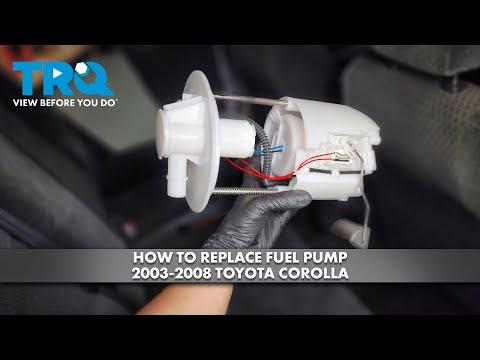
Your Corolla’s fuel pump sits inside the fuel tank as part of a pump module under the rear seat. Replacing it involves relieving fuel pressure, opening the access cover, disconnecting lines/wiring, and swapping the pump/module so the engine gets proper fuel pressure again.
Difficulty Level: Intermediate | Estimated Time: 1.5-3 hours
⚠️ Safety & Precautions
- ⚠️ Work outside or in a well-ventilated area (gas fumes are dangerous).
- ⚠️ No smoking, flames, heaters, or power tools that can spark near the car.
- ⚠️ Wear safety glasses and fuel-resistant gloves (gas can irritate skin/eyes).
- ⚠️ Relieve fuel pressure before disconnecting any fuel line (prevents spray).
- ⚠️ Disconnect the negative battery cable before unplugging the fuel pump wiring.
- ⚠️ Keep dirt out of the tank—clean the top of the module before opening it.
🔧 Required Tools
You'll need the following tools for this repair:
- Safety glasses
- Fuel-resistant nitrile gloves
- Fire extinguisher Class B
- 10mm socket
- 3/8" ratchet
- 6" extension
- Phillips screwdriver #2
- Flat trim tool
- Needle-nose pliers
- Small pick tool
- Torque wrench (inch-pound)
- Shop towels
- Catch pan
- Painter’s tape and marker
🔩 Required Parts
HowToo sells all the parts you need for this repair:
- Fuel pump module assembly - Qty: 1
- Fuel pump module tank seal / O-ring - Qty: 1
- New hose clamps (fuel-rated) - Qty: 2
📋 Before You Begin
- 🅿️ Park on level ground and open the fuel door to reduce tank vapor pressure.
- 🧯 Place a Fire extinguisher Class B within reach.
- 🧼 Have a clean work area and plenty of shop towels ready.
- 🔋 You will disconnect the negative battery cable after relieving fuel pressure.
🔨 Step-by-Step Instructions
Follow these steps in order:
Step 1: Relieve fuel pressure
- Open the under-hood fuse/relay box.
- Remove the EFI fuse using needle-nose pliers.
- Start the engine and let it run until it stalls (it may take a few seconds).
- Crank the engine for 2–3 seconds one more time to release leftover pressure.
- Turn key OFF.
- Tip: This reduces fuel spray at the line.
Step 2: Disconnect the battery
- Use a 10mm socket and 3/8" ratchet to loosen the negative battery terminal.
- Remove the negative cable and keep it from springing back.
Step 3: Remove the rear seat cushion
- From the rear footwell area, release the seat cushion retainers (they pop loose).
- Use a flat trim tool if needed, then lift the cushion out.
Step 4: Open the fuel pump access cover
- Locate the access panel in the floor under the rear seat.
- Use a Phillips screwdriver #2 or 10mm socket (varies by cover fasteners) to remove the cover screws/bolts.
- Peel back any butyl sealer carefully with a small pick tool.
Step 5: Clean the area (important)
- Wipe the top of the pump module and surrounding area with shop towels.
- Do not let dirt fall into the tank opening.
Step 6: Disconnect the electrical connector
- Press the connector tab and unplug it by hand.
- If stuck, use a small pick tool gently on the tab (don’t break it).
Step 7: Disconnect the fuel line(s)
- Place shop towels around the line connection to catch any fuel.
- Release the quick-connector by squeezing the tabs and pulling the line straight off.
- Let any small amount of fuel drain into a catch pan.
- Tip: Pull straight—twisting can damage the connector.
Step 8: Remove the pump module retaining fasteners
- Use painter’s tape and marker to mark the module orientation (so it goes back the same way).
- Remove the retaining nuts/bolts using a 10mm socket, ratchet, and extension.
Step 9: Lift out the pump module
- Lift the module straight up slowly.
- Angle it as needed to clear the float arm (fuel level sensor) without bending it.
- Have the catch pan ready—fuel will drip from the module.
Step 10: Replace the seal (O-ring) and install the new module
- Remove the old tank seal/O-ring and wipe the sealing surface clean with shop towels.
- Install the new seal/O-ring evenly in its groove (no twists).
- Lower the new module into the tank, keeping the float arm safe.
- Align it with your tape marks.
Step 11: Tighten the retaining fasteners
- Start all nuts/bolts by hand to avoid cross-threading.
- Tighten evenly in a crisscross pattern using a 10mm socket.
- Final tighten using an inch-pound torque wrench: Torque to 35 in-lbf (4 N·m).
Step 12: Reconnect fuel line(s) and electrical connector
- Push the fuel line on until it clicks. Tug lightly to confirm it’s locked.
- Plug in the electrical connector until it clicks.
Step 13: Reinstall the access cover and rear seat
- Reinstall the access cover using a Phillips screwdriver #2 or 10mm socket.
- Reinstall the rear seat cushion and press down firmly to lock the retainers.
Step 14: Restore power and prime the system
- Reinstall the EFI fuse using needle-nose pliers.
- Reconnect the negative battery terminal using a 10mm socket.
- Turn key to ON (do not start) for 5 seconds, then OFF. Repeat 3 times to prime.
- Start the engine.
✅ After Repair
- 🔎 With the engine running, check the pump module top and fuel line connection for leaks.
- 👃 If you smell strong fuel odor, shut it off and recheck the seal and line lock.
- 🛣️ Take a short test drive, then recheck for leaks again.
💰 DIY vs Shop Cost
Shop Cost: $650-$1,200 (parts + labor)
DIY Cost: $180-$450 (parts only)
You Save: $470-$750 by doing it yourself!
Shop labor rates vary but typically run $100-$150/hour. This repair takes a shop approximately 1.5-3 hours.
🎯 Ready to get started?
HowToo makes it easy: same-day/2-day shipping on every part, plus all the tools and specialty tools you need! Check out the parts and tools sections below to add everything to your cart.