

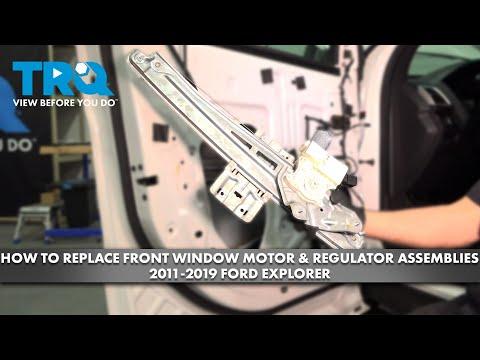





How to Replace the Front Window Regulator on a 2019 Ford Explorer
Step-by-step instructions with tools, parts, safety tips, and window relearn guidance for 2018, 2019
How to Replace the Front Window Regulator on a 2019 Ford Explorer
Step-by-step instructions with tools, parts, safety tips, and window relearn guidance for 2018, 2019


🔧 Front Window Regulator - Replacement
Your Explorer uses a power window regulator inside each front door. To replace it, you’ll remove the door trim panel, disconnect the glass, then swap the regulator assembly and reassemble the door.
Difficulty Level: Intermediate | Estimated Time: 2-3 hours per door
⚠️ Safety & Precautions
- Disconnect the negative battery cable before working inside the door to avoid accidental window motor movement.
- The door glass is heavy and can drop suddenly. Support it with tape or a helper.
- Be careful with sharp metal edges inside the door shell.
- If your Explorer has side airbags in the door, handle the trim panel gently and keep the ignition off.
🔧 Required Tools
You'll need the following tools for this repair:
- 7mm socket
- 8mm socket
- 10mm socket
- Ratchet
- Short extension
- Trim panel tool
- Phillips screwdriver
- Flat blade screwdriver
- Torx T20 screwdriver
- Torque wrench
- Painter's tape
- Pick tool
- Flashlight
- Safety glasses
- Mechanic gloves
🔩 Required Parts
HowToo sells all the parts you need for this repair:
- Front window regulator assembly - Qty: 1 per door
- Window regulator motor - Qty: 1 per door, if not included with regulator
- Door trim panel clips - Qty: 1 set
- Vapor barrier adhesive or sealant - Qty: 1
📋 Before You Begin
- Park on a level surface and fully raise the window if it still works.
- Turn the ignition off and disconnect the negative battery cable.
- Use painter's tape on the outside of the glass to hold it in place.
- Have a helper ready if the glass needs to be supported by hand.
🔨 Step-by-Step Instructions
Follow these steps in order:
Step 1: Remove the door trim panel
- Use a trim panel tool to pry off the trim caps and panel edges.
- Remove the screws with a 7mm socket and Phillips screwdriver.
- Lift the door panel up and away from the door shell.
- Disconnect the electrical connectors and set the panel aside.
Step 2: Peel back the vapor barrier
- Use a flat blade screwdriver or pick tool to carefully separate the vapor barrier adhesive.
- Peel it back slowly so you can reuse it if it stays clean.
- Keep the adhesive as intact as possible.
Step 3: Secure the glass
- Use painter's tape across the top of the door frame to hold the glass up.
- If the glass is already loose, have a helper hold it steady from the top.
- Lower the window slightly only if needed to reach the glass clamps, using the switch briefly before the battery is disconnected if applicable.
Step 4: Disconnect the glass from the regulator
- Use an 8mm socket or 10mm socket to remove the glass clamp fasteners through the access holes.
- Slide the glass upward and secure it with tape.
- Make sure the glass cannot fall before moving to the next step.
Step 5: Remove the regulator assembly
- Disconnect the window motor electrical connector.
- Use a 10mm socket and ratchet with extension to remove the regulator mounting bolts.
- Remove the regulator and motor assembly through the largest access opening in the door.
- Torque to factory specification on installation.
Step 6: Install the new regulator
- Feed the new regulator assembly into the door opening.
- Install the mounting bolts by hand first, then tighten with a 10mm socket and torque wrench.
- Reconnect the motor connector.
- Torque to factory specification.
Step 7: Reattach the glass
- Lower the taped glass carefully into the regulator clamps.
- Use an 8mm socket or 10mm socket to tighten the glass clamp fasteners.
- Remove the tape only after the glass is firmly secured.
- Torque to factory specification.
Step 8: Test the window
- Reconnect the battery negative cable using a 10mm socket.
- Turn the ignition on and run the window fully up and down.
- Listen for binding, clicking, or uneven movement.
- If the window one-touch feature is lost, perform the relearn procedure by holding the switch in the full-up position for a few seconds, then full-down and full-up again.
Step 9: Reinstall the door panel
- Reattach the vapor barrier with the original adhesive or fresh sealant.
- Reconnect all electrical connectors.
- Align the door panel and press in the clips.
- Install the screws with a 7mm socket and Phillips screwdriver.
- Torque to factory specification.
✅ After Repair
- Cycle the window several times to confirm smooth movement.
- Check that the glass seals evenly at the top.
- Make sure the door panel sits flush and no clips are loose.
- If the auto-up or auto-down feature does not work, repeat the window relearn process.
💰 DIY vs Shop Cost
Shop Cost: $350-$650 per door (parts + labor)
DIY Cost: $90-$220 per door (parts only)
You Save: $260-$430 per door by doing it yourself!
Shop labor rates vary but typically run $100-$150/hour. This repair takes a shop approximately 1.5-2.5 hours per door.
🎯 Ready to get started?
HowToo makes it easy: same-day/2-day shipping on every part, plus all the tools and specialty tools you need! Check out the parts and tools sections below to add everything to your cart.