

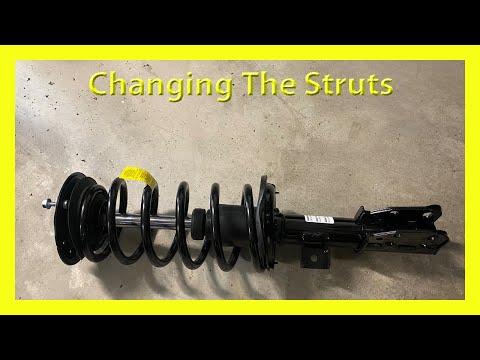







How to Replace the Front Struts on a 2019 Chevrolet Equinox
Step-by-step instructions with tools, parts, torque specs, safety tips, and alignment advice for 2018, 2019, 2020
How to Replace the Front Struts on a 2019 Chevrolet Equinox
Step-by-step instructions with tools, parts, torque specs, safety tips, and alignment advice for 2018, 2019, 2020


🔧 Struts - Front Strut Replacement
Assumption: front struts. On your Equinox, the front suspension uses a strut assembly, so this repair replaces the complete unit to restore ride control and reduce noise, bouncing, and uneven tire wear.
Difficulty Level: Advanced | Estimated Time: 3-5 hours
⚠️ Safety & Precautions
- Support the vehicle with jack stands; never work under a car held only by a jack.
- Use extreme care with the compressed coil spring. A strut spring stores a lot of energy and can cause serious injury.
- Disable the brake pedal and steering only as needed while the suspension is apart.
- If equipped with electronic ride or steering sensors, keep wiring and connectors unplugged only as long as needed.
- Battery disconnect is not required for basic front strut replacement unless a connector or sensor repair is needed.
🔧 Required Tools
You'll need the following tools for this repair:
- Floor jack (rated 3-ton minimum)
- Jack stands (rated 3-ton minimum)
- Wheel chocks
- Safety glasses
- Mechanic gloves
- 21mm socket
- 18mm socket
- 15mm socket
- 13mm socket
- Ratchet
- Breaker bar
- Torque wrench
- Penetrating oil
- Strut spring compressor (specialty)
- Trim tool
- Paint marker
🔩 Required Parts
HowToo sells all the parts you need for this repair:
- Front strut assembly - Qty: 2
- Front strut mount hardware - Qty: 2
- Front sway bar link nuts - Qty: 2
- Front strut-to-knuckle bolts and nuts - Qty: 4
- Front cowl trim clips - Qty: 1 set
📋 Before You Begin
- Park on level ground and set the parking brake.
- Loosen the front wheel lug nuts slightly before lifting.
- Wear eye protection before any suspension work.
- Plan for a post-repair wheel alignment. A strut replacement changes suspension geometry.
- Replace struts in pairs.
🔨 Step-by-Step Instructions
Follow these steps in order:
Step 1: Raise and secure the vehicle
- Use the floor jack to lift the front of the vehicle at the proper lift point.
- Place jack stands under the front support points and lower the vehicle onto them.
- Remove the front wheels with the 21mm socket.
Step 2: Disconnect attached components
- Spray the strut hardware with penetrating oil.
- Use the 18mm socket to remove the sway bar link nut from the strut.
- Use the 13mm socket to remove any brake hose or ABS wire brackets attached to the strut.
- Keep hoses relaxed and untwisted.
Step 3: Mark the strut position
- Use a paint marker to mark the relationship between the strut and steering knuckle.
- This helps with reassembly and keeps the alignment closer until the final alignment.
Step 4: Remove the lower strut bolts
- Use the 21mm socket and breaker bar to remove the two lower strut-to-knuckle bolts.
- Support the knuckle as the last bolt comes out so the axle and brake hose are not stressed.
Step 5: Remove the upper strut mount nuts
- Open the hood and remove the upper strut mount nuts with the 13mm socket.
- Hold the strut from below while removing the last nut so it does not drop.
Step 6: Remove the strut assembly
- Lift the complete strut assembly out of the wheel well.
- If it sticks, gently guide the knuckle outward with your hand while lifting the strut free.
Step 7: Transfer parts if needed
- If you bought a complete strut assembly, skip this step.
- If reusing parts, use the strut spring compressor to compress the coil spring before removing the top mount.
- Remove the center nut with the correct socket from the assembly.
- Transfer the mount and isolators only if they are in good condition.
- Never remove the top nut without compressing the spring.
Step 8: Install the new strut assembly
- Position the new strut into the tower and start the upper nuts by hand using the 13mm socket.
- Align the lower strut holes with the steering knuckle.
- Install the lower strut bolts and nuts using the 21mm socket.
- Torque the lower strut-to-knuckle bolts to 175 Nm (129 ft-lbs).
- Torque the upper strut mount nuts to 25 Nm (18 ft-lbs).
Step 9: Reattach the removed components
- Use the 18mm socket to reinstall the sway bar link nut.
- Use the 13mm socket to reinstall the brake hose and ABS wire brackets.
- Torque the sway bar link nut to 65 Nm (48 ft-lbs).
Step 10: Reinstall the wheel and lower the vehicle
- Reinstall the wheel and snug the lug nuts by hand with the 21mm socket.
- Raise the vehicle slightly with the floor jack, remove the jack stands, and lower it to the ground.
- Torque the wheel lug nuts to 140 Nm (103 ft-lbs).
✅ After Repair
- Start the vehicle and listen for clunks or rubbing.
- Turn the steering wheel lock-to-lock and check that hoses and wires move freely.
- Test drive slowly at first, then recheck for loose hardware.
- Schedule a professional wheel alignment as soon as possible.
💰 DIY vs Shop Cost
Shop Cost: $900-$1,500 (parts + labor)
DIY Cost: $300-$700 (parts only)
You Save: $600-$800 by doing it yourself!
Shop labor rates vary but typically run $100-$150/hour. This repair takes a shop approximately 3-5 hours.
🎯 Ready to get started?
HowToo makes it easy: same-day/2-day shipping on every part, plus all the tools and specialty tools you need! Check out the parts and tools sections below to add everything to your cart.