









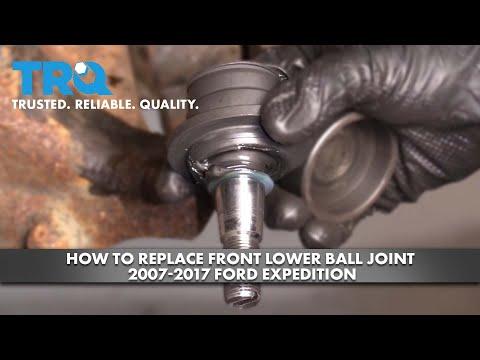







How to Replace the Front Lower Ball Joint on a 2017 Ford Explorer
Step-by-step instructions with tools, parts, torque tips, and alignment safety notes for 2011, 2012, 2013, 2014, 2015, 2016, 2017, 2018, 2019
How to Replace the Front Lower Ball Joint on a 2017 Ford Explorer
Step-by-step instructions with tools, parts, torque tips, and alignment safety notes for 2011, 2012, 2013, 2014, 2015, 2016, 2017, 2018, 2019


🔧 Ball Joints - Front Lower Control Arm Replacement
Assumption: On your Explorer, the front lower ball joint is serviced with the lower control arm assembly, so the repair is done by replacing the arm as a unit.
This job restores steering feel and removes looseness in the front suspension. It involves lifting the vehicle, separating the ball joint from the knuckle, and installing the new control arm with fresh hardware.
Difficulty Level: Intermediate | Estimated Time: 2-4 hours
⚠️ Safety & Precautions
- Support the vehicle with jack stands before working under it.
- Do not let the knuckle hang by the brake hose or ABS wire.
- If equipped with an electronic parking brake, keep the rear wheels chocked.
- Use a ball joint separator or pickle fork carefully; it can release suddenly. A ball joint separator is a tool that pops tapered joints apart.
- After installation, the front end must be aligned.
🔧 Required Tools
You'll need the following tools for this repair:
- Floor jack (rated 3-ton minimum)
- Jack stands (rated 3-ton minimum)
- Wheel chocks
- Safety glasses
- Mechanic gloves
- Breaker bar
- Torque wrench
- 21mm socket
- 24mm socket
- 18mm socket
- 15mm socket
- Torx T30 screwdriver
- Ratchet
- Ball joint separator (specialty)
- Penetrating oil
- Paint marker
🔩 Required Parts
HowToo sells all the parts you need for this repair:
- Front lower control arm assembly - Qty: 1 per side
- Front lower control arm bolt kit - Qty: 1 per side
- Front stabilizer link nut hardware - Qty: 1 per side, if removed
📋 Before You Begin
- Park on level ground and set the parking brake.
- Loosen the front wheel lug nuts slightly before lifting.
- Mark the position of any cam bolts before removal so alignment settings are easier to restore.
- Spray penetrating oil on suspension bolts and the ball joint area before starting.
🔨 Step-by-Step Instructions
Follow these steps in order:
Step 1: Raise and secure the front end
- Use a floor jack to lift the front of the Explorer at the proper lift point.
- Place jack stands under the frame and lower the vehicle onto them.
- Remove the front wheel using a 21mm socket.
Step 2: Remove brake hose and ABS wire retainers
- Use a 15mm socket or Torx T30 screwdriver to remove any bracket fasteners holding the hose or wire to the knuckle.
- Set the hose and wire aside so they do not stretch when the knuckle moves.
Step 3: Separate the ball joint from the steering knuckle
- Use a 21mm socket and breaker bar to remove the ball joint nut.
- Use a ball joint separator to pop the taper loose from the knuckle.
- Keep clear when the joint releases.
Step 4: Remove the lower control arm
- Use an 18mm socket and 24mm socket to remove the front and rear lower control arm bolts.
- If the vehicle has cam bolts, mark their position first with a paint marker.
- Remove the arm from the vehicle.
Step 5: Install the new lower control arm
- Position the new control arm in place by hand.
- Install the bolts finger-tight first using the 18mm socket and 24mm socket.
- Reconnect the ball joint stud into the knuckle and install the nut with a 21mm socket.
- Torque to manufacturer specification. Control arm and ball joint fastener torque values can vary by side and fastener type.
Step 6: Tighten suspension bolts at ride height
- Raise the lower control arm with the floor jack until it sits at normal ride height.
- Torque the lower control arm bolts to manufacturer specification while the suspension is loaded.
- This helps the bushings last longer.
Step 7: Reassemble and repeat on the other side if needed
- Reinstall the brake hose and ABS wire brackets.
- Reinstall the wheel and snug the lug nuts with a 21mm socket.
- If both sides are worn, replace them in pairs.
✅ After Repair
- Lower the vehicle and torque the wheel lug nuts to manufacturer specification.
- Start the vehicle and check for pulling, clunks, or loose steering.
- Take a short test drive over slow bumps and listen for abnormal noises.
- Get a professional front-end alignment as soon as possible.
💰 DIY vs Shop Cost
Shop Cost: $450-$900 (parts + labor)
DIY Cost: $120-$260 (parts only)
You Save: $330-$640 by doing it yourself!
Shop labor rates vary but typically run $100-$150/hour. This repair takes a shop approximately 2-4 hours.
🎯 Ready to get started?
HowToo makes it easy: same-day/2-day shipping on every part, plus all the tools and specialty tools you need! Check out the parts and tools sections below to add everything to your cart.