





How to Replace the Alternator on a 2015 Ford F-150 5.0L V8
Step-by-step DIY alternator replacement with tools, parts list, torque specs, and safety tips for your 2015 F-150 for 2015, 2016
How to Replace the Alternator on a 2015 Ford F-150 5.0L V8
Step-by-step DIY alternator replacement with tools, parts list, torque specs, and safety tips for your 2015 F-150 for 2015, 2016


F-150 - Alternator Replacement 🔧
Got it: 2015 F-150 Platinum 5.0L, 4WD. I’ll walk you through the alternator swap step-by-step.
Quick check first: Is your truck still on the factory dual-battery setup (two batteries under the hood) or just one battery? And do you have basic tools (socket set, ratchet, wrenches, and a breaker bar)?
Answer briefly and I’ll tailor the steps. For now, here’s the full guide assuming a single-battery, standard 200A alternator (most 5.0L Platinum trucks).
Safety First ⚠️
- 🛑 Disconnect the battery before touching the alternator. This prevents sparks and protects electronics.
- 🧤 Let the engine cool. The front of the engine and belt area can be hot.
- 🧱 If you raise the truck, always use jack stands (metal supports that hold the vehicle safely) under the frame.
Parts & Specs 📦
- 🔩 Alternator (5.0L, typically 200A; match by part number or amperage rating)
- 🔩 Serpentine belt (optional but recommended if old or cracked)
- 🔩 Dielectric grease (for electrical connectors; a non-conductive grease that protects from corrosion)
Tools You’ll Need 🧰
- 🔧 Socket set (metric):
- 8mm – battery terminal clamp
- 10mm – small brackets / covers
- 13mm – alternator output nut (B+ terminal)
- 15mm – belt tensioner and alternator bolts (most 5.0L)
- 🔧 Ratchets:
- 3/8" drive ratchet – general use
- 1/2" drive ratchet or breaker bar – for belt tensioner if tight
- 🔧 Serpentine belt tool or long breaker bar – a long handle that gives leverage to move the belt tensioner.
- 🔧 Wrench set (metric) – helpful where a socket doesn’t fit.
- 🔧 Flat trim tool or flat screwdriver – to gently release plastic clips (don’t pry hard).
- 🔧 Torque wrench – tool that tightens bolts to a specific force (torque).
- 🔧 Work light – the alternator area can be shadowed.
Key Torque Specs 🔩
- 🔧 Alternator mounting bolts: ~35–40 lb-ft (47–54 N·m)
- 🔧 Alternator B+ (main power) nut: ~80–100 in-lb (9–11 N·m) – snug, not gorilla tight
- 🔧 Battery terminal clamp: ~62 in-lb (7 N·m) – just tight enough that it doesn’t move
F-150 - Prep & Battery Disconnect 🔋
- 🧰 Step 1 – Park and secure
- Park on level ground, set the parking brake, shift to PARK.
- Open the hood and use the hood prop rod.
- 🧰 Step 2 – Disconnect the battery
- Locate the battery on the driver side front of the engine bay.
- Use an 8mm socket to loosen the negative (-) terminal clamp.
- Lift the clamp off and tuck it aside so it can’t spring back to the post. Always remove negative first.
F-150 - Accessing the Alternator 🔍
The alternator on the 5.0L sits at the front of the engine, upper passenger side, driven by the serpentine belt.
- 🧰 Step 3 – Remove any covers / intake tube if needed
- If your truck has a plastic engine cover, pull it up gently; it’s held by rubber grommets.
- If the intake tube blocks access:
- Loosen the hose clamps (usually 7mm or flat screwdriver).
- Unplug the MAF sensor connector (on the air tube) by pressing the tab and pulling straight off.
- Lift the tube out and set aside.
F-150 - Relieve Belt Tension & Remove Belt from Alternator 🧵
- 🧰 Step 4 – Note the belt routing
- Look for the belt routing diagram sticker on the radiator support or underside of the hood.
- If you don’t see one, take a clear photo of the belt path. This saves headaches later.
- 🧰 Step 5 – Rotate the belt tensioner
- The belt tensioner is a spring-loaded pulley that keeps the belt tight.
- On the 5.0L, it usually has a 15mm bolt head or a 3/8" or 1/2" square hole for a ratchet.
- Place your breaker bar or serpentine belt tool on the tensioner.
- Rotate the tensioner clockwise (usually) to relieve tension. You’ll feel the spring compress.
- While holding tension off, slip the belt off the alternator pulley only, then slowly release the tensioner.
- Leave the belt in place on the other pulleys if you’re reusing it.
F-150 - Disconnect Alternator Wiring 🔌
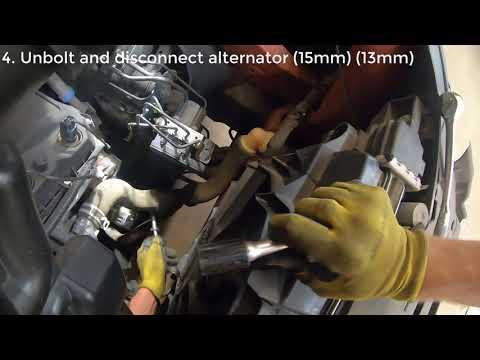
- 🧰 Step 6 – Unplug the electrical connector
- On the back of the alternator, find the small plug (field/voltage regulator connector).
- Press the locking tab and pull the connector straight out. Don’t pry with metal tools; use fingers or a plastic trim tool.
- 🧰 Step 7 – Remove the main power cable (B+)
- Locate the thick cable attached to a stud on the back of the alternator.
- Remove the plastic cap if present.
- Use a 13mm socket to remove the nut.
- Pull the cable eyelet off and move it aside so it can’t touch metal.
F-150 - Remove the Alternator 🏗️
- 🧰 Step 8 – Remove alternator mounting bolts
- The alternator is held by 2–3 bolts into the front of the engine bracket.
- Use a 15mm socket and ratchet to remove them.
- Support the alternator with your hand as you remove the last bolt so it doesn’t drop.
- 🧰 Step 9 – Lift the alternator out
- Wiggle the alternator free from its bracket. It may be snug in the locating sleeves.
- If it’s stuck, gently pry with a plastic or wooden tool at the mounting ears. Don’t pry on thin aluminum parts.
- Lift it out of the engine bay.
F-150 - Install the New Alternator 🆕
- 🧰 Step 10 – Compare old and new
- Check:
- Same mounting ear locations
- Same pulley diameter and number of grooves
- Same electrical connector style and B+ stud location
- Same or correct amperage rating (e.g., 200A)
- Check:
- 🧰 Step 11 – Set new alternator in place
- Lower the new alternator into position on the bracket.
- Align the bolt holes with the bracket.
- Start all mounting bolts by hand to avoid cross-threading.
- 🧰 Step 12 – Tighten alternator bolts
- Use the 15mm socket to snug all bolts evenly.
- Then torque each bolt to about 35–40 lb-ft (47–54 N·m).
- 🧰 Step 13 – Reconnect wiring
- Install the B+ cable on the stud, then the nut.
- Torque to about 80–100 in-lb (9–11 N·m) – firm but not over-tight.
- Snap the plastic cap back on if equipped.
- Plug in the small connector until it clicks.
- Optional: dab a little dielectric grease on the connector seal to help keep moisture out.
F-150 - Reinstall Belt 🪢
- 🧰 Step 14 – Route the belt
- Follow the belt routing diagram or your photo.
- Make sure the belt sits fully in the grooves on each pulley.
- 🧰 Step 15 – Tension the belt
- Again, use the belt tensioner with your breaker bar or belt tool.
- Rotate the tensioner to relieve tension.
- Slip the belt over the alternator pulley last.
- Slowly release the tensioner so it tightens the belt.
- Double-check that the belt is centered on all pulleys and not one rib off.
F-150 - Reassemble & Reconnect Battery 🔁
- 🧰 Step 16 – Reinstall intake tube / engine cover
- Reinstall the intake tube, tighten hose clamps.
- Reconnect the MAF sensor plug until it clicks.
- Press the engine cover back onto its mounting posts.
- 🧰 Step 17 – Reconnect battery
- Place the negative (-) terminal back on the battery post.
- Tighten the 8mm clamp bolt until the terminal doesn’t move by hand.
F-150 - Start-Up & Checks ✅
- 🧰 Step 18 – First start
- Start the engine and let it idle.
- Watch the dash for any battery/charging warning light. It should stay off.
- 🧰 Step 19 – Verify charging
- If you have a multimeter (tool that measures voltage):
- Set it to DC volts.
- Measure across the battery posts with engine running.
- You should see around 13.5–14.7 volts. That means the alternator is charging.
- If you have a multimeter (tool that measures voltage):
- 🧰 Step 20 – Final inspection
- Listen for any belt squeal or grinding noises.
- Look at the belt while running (from the side, keep hands clear) to ensure it runs straight.
- Check for any tools left in the engine bay.
Tips & Tricks 💡
- 🧰 If the belt is old, cracked, or glazed (shiny), replace it now while everything is apart.
- 🧰 If bolts don’t line up easily, don’t force them. Wiggle the alternator and start bolts by hand first.
- 🧰 If you get a charging system warning after replacement, double-check:
- Belt routing and tension
- All connectors fully seated
- Battery terminals clean and tight
HowToo makes it easy: below this guide you’ll see the correct alternator, serpentine belt, and any tools you’re missing, with same-day/2-day shipping. You can add them to your cart right from the parts section.
If you tell me whether you have one or two batteries, I can add any extra steps needed for a dual-battery setup.