






How to Replace the 12V Battery on a 2015 Nissan Rogue (Step-by-Step)
Detailed DIY battery change guide with tools, parts, safety tips, torque specs, and cost savings for 2008, 2009, 2010, 2011, 2012, 2013, 2014, 2015, 2016, 2017, 2018, 2019, 2020
How to Replace the 12V Battery on a 2015 Nissan Rogue (Step-by-Step)
Detailed DIY battery change guide with tools, parts, safety tips, torque specs, and cost savings for 2008, 2009, 2010, 2011, 2012, 2013, 2014, 2015, 2016, 2017, 2018, 2019, 2020


🔧 Rogue - 12V Battery Replacement
You’ll be removing the old 12V battery from the engine bay of your Rogue and installing a new one. This restores proper starting power and prevents no-start or electrical issues.
Difficulty Level: Beginner | Estimated Time: 0.5–1 hour
⚠️ Safety & Precautions
- ⚠️ Always switch the ignition off and remove the key before working on the battery.
- ⚠️ Wear safety glasses and gloves; battery acid can burn skin and eyes.
- ⚠️ Never let metal tools touch both battery terminals at the same time; this can cause sparks.
- ⚠️ Always disconnect the negative (black) terminal first and reconnect it last to reduce short-circuit risk.
- ⚠️ Keep flames, cigarettes, and sparks away from the battery; it can release explosive gas.
- ⚠️ Lift with your legs, not your back; the battery is heavy.
- Battery disconnect is required for this job; some settings (clock, radio presets, auto-up windows) may reset.
🔧 Required Tools
You'll need the following tools for this repair:
- 🔹10mm socket
- 🔹12mm socket
- 🔹1/4" or 3/8" drive ratchet
- 🔹3" socket extension
- 🔹10mm combination wrench
- 🔹Battery terminal puller (specialty)
- 🔹Small wire brush
- 🔹Shop rag or paper towels
- 🔹Baking soda and water mix in small container
- 🔹Safety glasses
- 🔹Mechanic gloves
- 🔹12V memory saver (OBD or power outlet type) (specialty)
🔩 Required Parts
HowToo sells all the parts you need for this repair:
- 🔹12V starting battery (BCI Group 35, 550+ CCA) - Qty: 1
- 🔹Battery anti-corrosion washers - Qty: 2
- 🔹Battery terminal protector spray - Qty: 1
- 🔹Dielectric grease - Qty: 1
- 🔹Battery hold-down hardware kit - Qty: 1 (only if existing parts are rusted or damaged)
📋 Before You Begin
- Park your Rogue on level ground, shift to P, and set the parking brake.
- Turn off all electrical items: headlights, fan, radio, and interior lights.
- Open the hood and secure it with the prop rod.
- If you use a memory saver (a small device that keeps power to electronics), plug it into the OBD port under the dash or a power outlet now, following its instructions.
🔨 Step-by-Step Instructions
Follow these steps in order:
Step 1: Locate the battery and clear the area
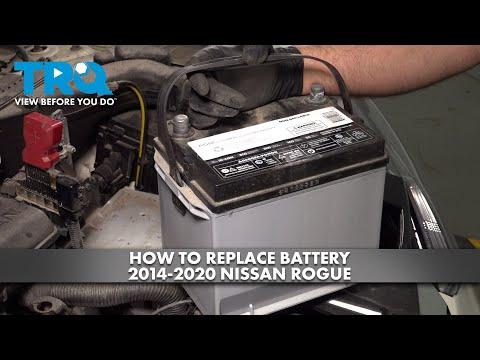
- Open the hood; the battery is on the driver’s side, near the front of the engine bay.
- If there is a plastic battery cover, gently lift or unclip it by hand to expose the battery.
- Use a shop rag to wipe off dirt so you can clearly see the terminals and hold-down bracket.
Step 2: Identify positive and negative terminals
- The positive (+) terminal usually has a red cover and a plus sign.
- The negative (−) terminal is usually black and marked with a minus sign.
- Double-check markings before loosening anything.
Step 3: Disconnect the negative (black) cable
- Use a 10mm socket and ratchet or a 10mm wrench to loosen the nut on the negative terminal clamp.
- Once loose, twist the clamp gently and lift it off the battery post. If it’s stuck, use the battery terminal puller to lift it straight up.
- Move the negative cable away from the battery and tuck it to the side so it cannot spring back and touch the terminal.
Step 4: Disconnect the positive (red) cable
- Flip open or remove the red plastic cover over the positive terminal.
- Use a 10mm socket and ratchet or 10mm wrench to loosen the nut on the positive terminal clamp.
- Lift the clamp off the terminal, using the battery terminal puller if needed.
- Move the positive cable slightly aside, taking care not to let it touch any metal parts.
Step 5: Remove the battery hold-down bracket
- At the base of the battery there is a metal or plastic clamp that holds it in place.
- Use a 12mm socket, ratchet, and 3" extension to remove the bolt(s) securing the battery hold-down.
- Lift the hold-down bracket out and set it aside.
- Torque when reinstalling: 20 Nm (15 ft-lbs)
Step 6: Lift out the old battery
- Stand close to the vehicle, keep your back straight, and bend your knees.
- Grab the battery by its built-in handle (if present) or carefully from the sides.
- Lift the battery straight up and out. It is heavy; take your time.
- Set it down on the ground in a safe, upright position.
Step 7: Clean the battery tray and terminals
- Sprinkle a small amount of baking soda and water mix on any corrosion (white or blue crust) in the tray or on the cable ends.
- Use the wire brush to scrub the inside of the terminal clamps until shiny metal is visible.
- Wipe everything dry with a shop rag.
- Clean connections help prevent future starting problems.
Step 8: Place the new battery in the tray
- Check the new battery: make sure the positive and negative posts are in the same positions as the old one.
- Lift the new battery and lower it into the tray, keeping it level.
- Make sure it sits flat and the posts are close to their matching cables (positive to red, negative to black).
Step 9: Reinstall the hold-down bracket
- Position the hold-down bracket over or at the base of the battery exactly as before.
- Install the bolt(s) by hand to avoid cross-threading.
- Use the 12mm socket, ratchet, and extension to tighten the hold-down bolt(s).
- Torque to 20 Nm (15 ft-lbs) – snug but not crushing the battery case.
Step 10: Install anti-corrosion washers and connect the positive terminal
- Slide a battery anti-corrosion washer down over the positive battery post.
- Apply a very thin layer of dielectric grease to the post.
- Place the positive terminal clamp over the positive (+) post.
- Use a 10mm socket and ratchet or 10mm wrench to tighten the terminal nut.
- Torque to 5 Nm (44 in-lbs) – firm, but do not overtighten.
- Snap the red plastic cover back over the positive terminal.
Step 11: Connect the negative terminal
- Slide a battery anti-corrosion washer over the negative (−) post.
- Apply a thin layer of dielectric grease to the post.
- Place the negative terminal clamp over the negative post.
- Use a 10mm socket and ratchet or 10mm wrench to tighten the terminal nut.
- Torque to 5 Nm (44 in-lbs).
- Lightly spray battery terminal protector over both connections if you have it.
Step 12: Reinstall any covers and check your work
- Reinstall the plastic battery cover by hand if your Rogue has one.
- Gently tug each cable at the battery posts; they should not move or rotate.
- Make sure no tools or rags are left in the engine bay.
✅ After Repair
- Start your Rogue and make sure it cranks quickly and runs smoothly.
- Check that headlights, interior lights, wipers, and blower fan work normally.
- Set your clock and radio presets again if they were lost.
- If an auto-up window function doesn’t work, relearn it:
- Close the door and turn ignition to ON (engine can be running or not).
- Fully lower the window using the switch and hold it down 2–3 seconds.
- Then fully raise the window and hold the switch up 2–3 seconds.
- If any warning lights stay on (other than a brief ABS/traction light that goes out after moving), note which ones and ask for help.
- Recycle the old battery at a parts store or recycling center; most will take it for free and may give a core credit.
💰 DIY vs Shop Cost
Shop Cost: $220–$350 (parts + labor)
DIY Cost: $130–$200 (parts only)
You Save: $90–$150 by doing it yourself!
Shop labor rates vary but typically run $100–$150/hour. This repair takes a shop approximately 0.4–0.6 hours.
🎯 Ready to get started?
HowToo makes it easy: same-day/2-day shipping on every part, plus all the tools and specialty tools you need! Check out the parts and tools sections above to add everything to your cart.