

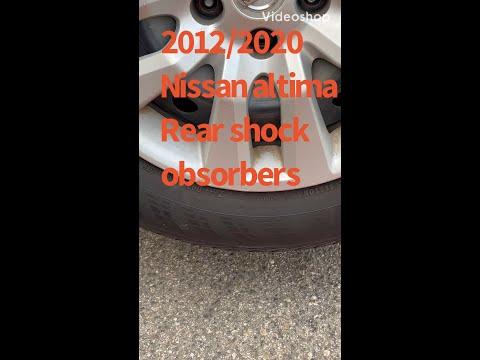





How to Replace Rear Shock Absorbers on a 2019-2025 Nissan Altima
Step-by-step DIY guide with tools, parts, torque specs, safety tips, and cost savings for 2019, 2020, 2021, 2022, 2023, 2024, 2025
How to Replace Rear Shock Absorbers on a 2019-2025 Nissan Altima
Step-by-step DIY guide with tools, parts, torque specs, safety tips, and cost savings for 2019, 2020, 2021, 2022, 2023, 2024, 2025


🔧 Altima - Rear Shock Absorber Replacement
This guide covers replacing the rear shock absorbers on your Altima. Rear shocks control bouncing and keep the tires planted; worn shocks can cause poor ride quality, longer stopping distance, and uneven tire wear.
Difficulty Level: Beginner | Estimated Time: 1.5-2.5 hours
⚠️ Safety & Precautions
- ⚠️ Work on flat, solid ground only. Never work under a vehicle supported only by a jack.
- ⚠️ Use jack stands. A jack stand is a fixed support that safely holds the vehicle after lifting.
- ⚠️ Chock the front wheels before lifting the rear of your Altima.
- ⚠️ Do not remove coil springs for this repair. The rear shock is separate from the spring on this Altima.
- ⚠️ Replace rear shocks in pairs so both sides respond the same way.
- ⚠️ Battery disconnect is not required for rear shock absorber replacement.
🔧 Required Tools
You'll need the following tools for this repair:
- 21mm lug nut socket
- 18mm socket
- 18mm wrench
- Ratchet wrench 3/8-inch drive
- Breaker bar 1/2-inch drive
- Torque wrench 1/2-inch drive
- Floor jack rated 2-ton minimum
- Jack stands rated 2-ton minimum
- Wheel chocks
- Flat trim tool
- Penetrating oil spray
- Wire brush
- Safety glasses
- Mechanic gloves
🔩 Required Parts
HowToo sells all the parts you need for this repair:
- Rear shock absorbers - Qty: 2
- Rear shock upper mounting nuts - Qty: 4
- Rear shock lower mounting bolts and nuts - Qty: 2 sets
📋 Before You Begin
- Park your Altima on level ground and shift to Park.
- Set the parking brake and place wheel chocks in front of both front wheels.
- Open the trunk and clear out items around the side trim panels.
- Spray penetrating oil on the lower rear shock bolts and let it soak for 10-15 minutes.
- Take photos before removing parts.
🔨 Step-by-Step Instructions
Follow these steps in order:
Step 1: Loosen the Rear Wheel Lug Nuts
- Use a 21mm lug nut socket and breaker bar 1/2-inch drive to loosen the rear lug nuts one turn while the tires are still on the ground.
- Do not fully remove the lug nuts yet.
- Loose first, lift second.
Step 2: Raise and Support the Rear of the Vehicle
- Use a floor jack rated 2-ton minimum at the rear center jacking point or approved rear lift point.
- Raise the rear of your Altima high enough to remove both rear wheels.
- Place jack stands rated 2-ton minimum under the approved rear side support points.
- Lower the vehicle gently onto the jack stands.
- Lightly shake the vehicle by hand to confirm it is stable before working.
Step 3: Remove the Rear Wheels
- Use the 21mm lug nut socket to remove the loosened lug nuts.
- Remove both rear wheels and place them flat under the vehicle edge as an extra safety backup.
Step 4: Access the Upper Shock Mounts
- Open the trunk.
- Use a flat trim tool to carefully move the trunk side trim away from the upper shock mounting area.
- The upper shock mount has two small nuts at the top of each rear shock.
- A trim tool is a plastic pry tool that helps remove panels without scratching them.
Step 5: Support the Rear Suspension Arm
- Place the floor jack rated 2-ton minimum lightly under the rear lower suspension arm near the shock mount.
- Raise the jack just enough to support the arm. Do not lift the vehicle off the jack stand.
- This removes tension from the lower shock bolt.
Step 6: Remove the Lower Shock Bolt
- Use penetrating oil spray on the lower shock bolt if it looks rusty.
- Use a wire brush to clean exposed threads if needed.
- Use an 18mm socket, 18mm wrench, and breaker bar 1/2-inch drive to remove the lower shock bolt and nut.
- If the bolt feels tight, rock the suspension arm slightly with the jack until the bolt slides out more easily.
- Do not force a loaded bolt.
Step 7: Remove the Upper Shock Nuts
- Use an 18mm socket and ratchet wrench 3/8-inch drive to remove the two upper shock mounting nuts from inside the trunk area.
- Hold the shock with one hand as the last nut comes off so it does not drop.
- Remove the old shock absorber from under the vehicle.
Step 8: Install the New Rear Shock
- Position the new rear shock absorber into place with the upper studs going through the body mounting holes.
- Start the new upper mounting nuts by hand to avoid cross-threading.
- Use an 18mm socket and ratchet wrench 3/8-inch drive to snug the upper nuts.
- Do not fully torque them yet.
Step 9: Install the Lower Shock Bolt
- Use the floor jack rated 2-ton minimum to raise or lower the rear suspension arm until the lower shock hole lines up.
- Install the new lower mounting bolt and nut by hand.
- Use an 18mm socket and 18mm wrench to snug the lower bolt.
- Do not final-tighten with the suspension hanging. Final torque should be done near normal ride height.
Step 10: Torque the Shock Mounting Hardware
- Use the floor jack rated 2-ton minimum to raise the lower suspension arm until it is close to normal ride height.
- Use a torque wrench 1/2-inch drive, 18mm socket, and 18mm wrench to tighten the lower shock bolt. Torque to 100 Nm (74 ft-lbs).
- Use a torque wrench 1/2-inch drive and 18mm socket to tighten the upper shock nuts. Torque to 35 Nm (26 ft-lbs).
- Torque means final measured tightness.
Step 11: Repeat on the Other Side
- Repeat Steps 4 through 10 on the opposite rear shock absorber.
- Use the same 18mm socket, 18mm wrench, floor jack rated 2-ton minimum, and torque wrench 1/2-inch drive.
Step 12: Reinstall the Wheels
- Place each rear wheel back on the hub.
- Start all lug nuts by hand.
- Use the 21mm lug nut socket and ratchet wrench 3/8-inch drive to snug the lug nuts in a star pattern.
Step 13: Lower the Vehicle and Torque Lug Nuts
- Use the floor jack rated 2-ton minimum to lift the rear slightly off the jack stands.
- Remove the jack stands rated 2-ton minimum.
- Lower the vehicle fully to the ground.
- Use the torque wrench 1/2-inch drive and 21mm lug nut socket to tighten the rear lug nuts in a star pattern. Torque to 113 Nm (83 ft-lbs).
Step 14: Refit the Trunk Trim
- Use your hands and the flat trim tool to gently place the trunk side trim back into position.
- Make sure the trim clips are seated and no tools are left in the trunk.
✅ After Repair
- ✅ Bounce each rear corner of your Altima by hand. It should settle quickly without repeated bouncing.
- ✅ Drive slowly at first and listen for clunks, rattles, or rubbing noises.
- ✅ Recheck the rear lug nut torque after 25-50 miles using a torque wrench 1/2-inch drive and 21mm lug nut socket.
- ✅ If the steering wheel is off-center, tires are wearing unevenly, or the vehicle pulls, have the alignment checked.
💰 DIY vs Shop Cost
Shop Cost: $350-$650 (parts + labor)
DIY Cost: $120-$280 (parts only)
You Save: $230-$370 by doing it yourself!
Shop labor rates vary but typically run $100-$150/hour. This repair takes a shop approximately 1.0-1.5 hours.
🎯 Ready to get started?
HowToo makes it easy: same-day/2-day shipping on every part, plus all the tools and specialty tools you need! Check out the parts and tools sections below to add everything to your cart.