

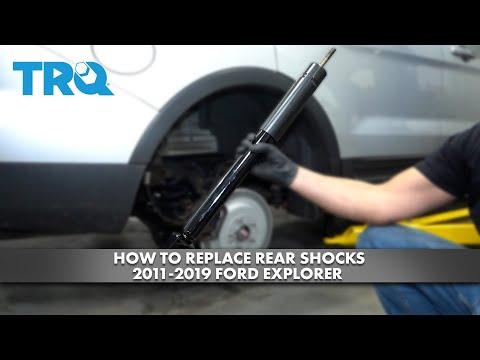







How to Replace Rear Shock Absorbers on a 2018 Ford Explorer
Step-by-step instructions with tools, parts, torque specs, and safety tips for 2013, 2014, 2015, 2016, 2017, 2018, 2019
How to Replace Rear Shock Absorbers on a 2018 Ford Explorer
Step-by-step instructions with tools, parts, torque specs, and safety tips for 2013, 2014, 2015, 2016, 2017, 2018, 2019


🔧 Rear Shock Absorbers - Replacement
Assumption: your Explorer uses rear shock absorbers, since the front suspension uses struts instead of separate shocks. This job is mostly straightforward, but the rear spring area and fasteners can be stubborn from rust. If your ride feels bouncy or you see oil on the shocks, replacing both rear units is the right move.
Difficulty Level: Intermediate | Estimated Time: 2-3 hours
⚠️ Safety & Precautions
- Support the vehicle with jack stands on solid, level ground. Never work under a vehicle held up only by a jack.
- Use wheel chocks on the front wheels before lifting the rear.
- Do not let the rear suspension hang freely under tension without support.
- Torque fasteners with the suspension at normal ride height when possible to avoid bushing damage.
- If your Explorer has a load-leveling or air-assisted setup, disable it before starting and avoid lifting by the rear axle alone.
🔧 Required Tools
You'll need the following tools for this repair:
- Floor jack (rated 3-ton minimum)
- Jack stands (rated for vehicle weight)
- Wheel chocks
- Safety glasses
- Mechanic gloves
- 13mm socket
- 15mm socket
- 18mm socket
- Ratchet
- Torque wrench
- Breaker bar
- Penetrating oil
- Trim panel tool
- Flat screwdriver
- Paint marker
🔩 Required Parts
HowToo sells all the parts you need for this repair:
- Rear shock absorber - Qty: 2
- Rear shock upper mounting nut - Qty: 2
- Rear shock lower bolt hardware - Qty: 2
- Rear shock dust boot - Qty: 2
- Rear shock bump stop - Qty: 2
📋 Before You Begin
- Park on level ground and set the parking brake.
- Shift into Park and chock the front wheels.
- Loosen the rear wheel lug nuts slightly before lifting, if you plan to remove the wheels for more room.
- Spray the upper and lower shock fasteners with penetrating oil and let it soak.
- If a fastener is heavily rusted, clean the threads first with a wire brush.
🔨 Step-by-Step Instructions
Follow these steps in order:
Step 1: Lift and secure the rear
- Use the floor jack to lift the rear of the Explorer at the approved jacking point.
- Place jack stands under the rear support points and lower the vehicle onto them.
- If needed for access, remove the rear wheels with a 13mm socket or the correct lug tool for your wheel nuts.
Step 2: Access the upper shock mount
- Open the rear cargo area and move the trim aside using the trim panel tool.
- On many Explorers, the upper shock mount is reached from inside the rear cargo side area behind trim.
- Remove any access cover or fastener with a flat screwdriver if equipped.
Step 3: Remove the lower shock bolt
- Support the rear suspension arm with the floor jack so the shock is not under load.
- Use an 18mm socket and breaker bar to remove the lower shock mounting bolt.
- Keep the suspension supported.
Step 4: Remove the upper shock fastener
- Use a 15mm socket or the correct size for the upper nut to remove the top mount fastener.
- Hold the shock body if needed while removing the last threads.
- Remove the shock absorber from the wheel well.
Step 5: Prepare the new shock
- Compare the new shock absorber to the old one to confirm length and mounting style.
- Transfer any dust boot or bump stop if your replacement does not include them.
- Install new hardware if supplied.
Step 6: Install the new shock
- Position the new shock in place and start the upper fastener by hand first.
- Align the lower mount and install the lower bolt by hand.
- Use the 15mm socket for the upper fastener and the 18mm socket for the lower bolt.
- Tighten both fasteners evenly.
- Torque to 76 Nm (56 ft-lbs) for the lower bolt and Torque to 47 Nm (35 ft-lbs) for the upper shock nut.
Step 7: Reassemble and lower the vehicle
- Reinstall any cargo trim or access covers using the trim panel tool.
- Reinstall the rear wheels and snug the lug nuts.
- Lower the vehicle with the floor jack and remove the jack stands.
- Torque the lug nuts to 150 Nm (111 ft-lbs) in a star pattern if wheels were removed.
✅ After Repair
- Bounce each rear corner of the vehicle lightly and confirm the body settles quickly.
- Test-drive on a smooth road first, then over small bumps.
- Listen for clunks, squeaks, or rattles from the rear.
- Recheck all fasteners after the test drive.
💰 DIY vs Shop Cost
Shop Cost: $450-$800 (parts + labor)
DIY Cost: $120-$280 (parts only)
You Save: $330-$520 by doing it yourself!
Shop labor rates vary but typically run $100-$150/hour. This repair takes a shop approximately 2-3 hours.
🎯 Ready to get started?
HowToo makes it easy: same-day/2-day shipping on every part, plus all the tools and specialty tools you need! Check out the parts and tools sections below to add everything to your cart.