

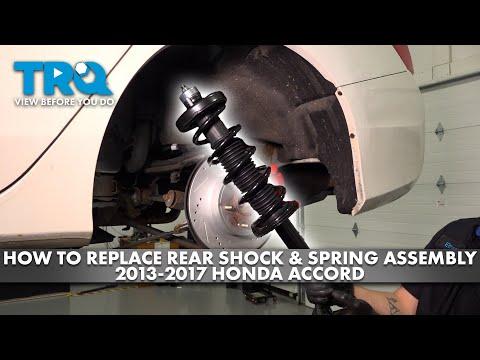







How to Replace Rear Shock Absorbers on a 2017 Honda Accord
Step-by-step instructions with tools, parts, torque specs, and safety tips for 2013, 2014, 2015, 2016, 2017
How to Replace Rear Shock Absorbers on a 2017 Honda Accord
Step-by-step instructions with tools, parts, torque specs, and safety tips for 2013, 2014, 2015, 2016, 2017


🔧 Shock Absorbers - Replacement
This guide covers the rear shock absorbers on your Accord. The front suspension uses struts, which is a different job. Replacing rear shocks restores ride control and helps reduce bouncing, rear-end sway, and clunking.
Difficulty Level: Intermediate | Estimated Time: 1.5-3 hours
⚠️ Safety & Precautions
- Work on a flat surface and support the car with jack stands; never rely on the jack alone.
- Chock the front wheels before lifting the rear.
- The rear suspension is under load; keep hands clear while lowering or raising the control arm.
- Use caution around rusted fasteners and spring-loaded suspension components.
- No battery disconnect is required for this job.
🔧 Required Tools
You'll need the following tools for this repair:
- Floor jack (rated 3-ton minimum)
- Jack stands
- Wheel chocks
- Safety glasses
- Mechanic gloves
- 17mm socket
- 19mm socket
- 14mm socket
- Ratchet
- Breaker bar
- Torque wrench
- Penetrating oil
- Trim clip tool
- Trim removal tool
- Paint marker
🔩 Required Parts
HowToo sells all the parts you need for this repair:
- Rear shock absorber assembly - Qty: 2, replace in pairs
- Rear upper shock mount nuts - Qty: 4
- Rear lower shock bolt/nut hardware - Qty: 2
- Rear shock dust boots - Qty: 2
- Rear shock bump stops - Qty: 2
📋 Before You Begin
- Park on level ground and set the parking brake.
- Loosen the rear wheel lug nuts slightly before lifting.
- Lift the rear of the car and support it securely on jack stands.
- Remove both rear wheels for easier access.
- Replace shocks in pairs for even handling.
🔨 Step-by-Step Instructions
Follow these steps in order:
Step 1: Remove the rear wheels
- Use a 19mm socket and breaker bar to loosen the lug nuts, then remove the wheels.
- Set the wheels aside flat so they do not roll.
Step 2: Access the upper shock mount
- Open the trunk.
- Use a trim removal tool and trim clip tool to carefully remove the rear trunk side trim on the side you are working on.
- Expose the upper shock mount area.
Step 3: Support the rear suspension arm
- Place the floor jack under the rear lower control arm and raise it slightly.
- This takes tension off the shock bolt.
- Keep the arm gently supported.
Step 4: Remove the lower shock bolt
- Use a 17mm socket on the lower shock bolt and a matching wrench or socket on the nut side if needed.
- Remove the lower bolt and free the shock from the control arm.
Step 5: Remove the upper shock nuts
- Use a 14mm socket to remove the upper shock mount nuts.
- Hold the shock with your other hand as the last nut comes off.
- Remove the shock assembly from the wheel well.
Step 6: Transfer parts if needed
- If your new shock does not include a mount, boot, or bump stop, transfer the reusable parts now.
- Inspect the mount and rubber isolators for cracks or tearing.
- Replace any worn hardware before installation.
Step 7: Install the new shock absorber
- Position the new shock in place from the wheel well.
- Start the upper nuts by hand using a 14mm socket.
- Install the lower bolt by hand using a 17mm socket.
- Do not fully tighten yet.
Step 8: Torque the fasteners
- With the suspension sitting at normal ride height, tighten the lower shock bolt using a 17mm socket.
- Torque the lower shock bolt to 59 Nm (44 ft-lbs).
- Tighten the upper shock mount nuts using a 14mm socket.
- Torque the upper shock mount nuts to 22 Nm (16 ft-lbs).
- Final torque at ride height helps protect bushings.
Step 9: Reinstall the trim and wheel
- Reinstall the trunk trim panel with the trim removal tool.
- Reinstall the wheel and hand-tighten the lug nuts.
- Lower the car and torque the lug nuts in a star pattern.
- Torque the lug nuts to 108 Nm (80 ft-lbs).
✅ After Repair
- Test drive slowly at first and listen for clunks or rattles.
- Check that the car sits level and feels stable over bumps.
- Recheck the shock fasteners and lug nuts after the test drive.
- If the rear still bounces or feels loose, inspect the other side and rear suspension bushings.
💰 DIY vs Shop Cost
Shop Cost: $450-$850 (parts + labor)
DIY Cost: $180-$380 (parts only)
You Save: $270-$470 by doing it yourself!
Shop labor rates vary but typically run $100-$150/hour. This repair takes a shop approximately 1.5-3 hours.
🎯 Ready to get started?
HowToo makes it easy: same-day/2-day shipping on every part, plus all the tools and specialty tools you need! Check out the parts and tools sections below to add everything to your cart.