

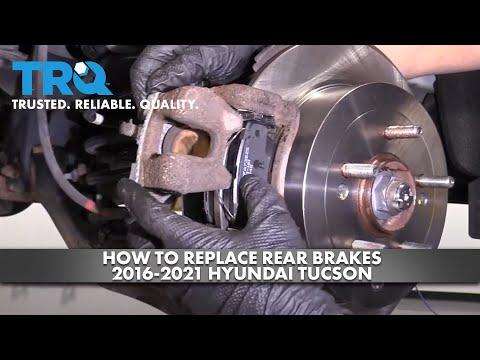







How to Replace Rear Brake Pads & Rotors on a 2018 Hyundai Tucson (EPB Service Mode)
Step-by-step rear brake job with required tools/parts, EPB maintenance mode steps, and key torque specs for 2018
How to Replace Rear Brake Pads & Rotors on a 2018 Hyundai Tucson (EPB Service Mode)
Step-by-step rear brake job with required tools/parts, EPB maintenance mode steps, and key torque specs for 2018


Assumption: Your Tucson has an electronic parking brake (EPB). If yours has a manual parking brake lever/pedal, follow the “Non-EPB” notes in the steps.
🔧 Tucson - Rear Brake Pads & Rotor Replacement
You’ll remove the rear wheels, take off the rear calipers and brackets, replace the pads and rotors, then reassemble and bed-in the new brakes. The key on your Tucson is handling the parking brake system correctly so the rear caliper pistons retract safely.
Difficulty Level: Intermediate | Estimated Time: 2-4 hours
⚠️ Safety & Precautions
- 🧯 Support the Tucson with jack stands; never rely on a floor jack.
- 🧤 Brakes make dust; wear gloves and safety glasses and use brake cleaner (don’t blow dust with compressed air).
- 🔥 Rotors can be hot; let everything cool before you start.
- 🛑 If equipped with EPB: put EPB in service/maintenance mode before removing calipers; do not force the piston back with a clamp.
- 🔋 Battery disconnect is typically not required for pads/rotors, but keep the ignition OFF during EPB service mode steps.
🔧 Required Tools
You'll need the following tools for this repair:
- Floor jack (rated 3-ton minimum)
- Jack stands (rated 3-ton minimum)
- Wheel chocks
- 21mm socket
- 3/8" drive ratchet
- 1/2" drive breaker bar
- 14mm socket
- 17mm socket
- Torque wrench (10-200 Nm range)
- Flat trim/pry tool
- Wire brush
- Bungee cord
- Brake caliper piston tool (specialty)
- Scan tool with EPB service mode (specialty)
- Brake cleaner
- Shop towels
- Nitrile gloves
- Safety glasses
🔩 Required Parts
HowToo sells all the parts you need for this repair:
- Rear brake pad set - Qty: 1
- Rear brake rotors - Qty: 2
- Rear brake hardware kit (abutment clips) - Qty: 1
- Brake lubricant (silicone or synthetic brake grease) - Qty: 1
- Brake cleaner - Qty: 1
- DOT 3 brake fluid - Qty: 1 (small bottle for top-off)
📋 Before You Begin
- Park on level ground, steering straight, and place wheel chocks at the front wheels.
- Make sure the parking brake is released before lifting the rear.
- Loosen rear lug nuts 1/2 turn with a 21mm socket and breaker bar before lifting.
- If equipped with EPB: plan to use a scan tool with EPB service mode (this retracts the parking brake motor so the caliper can be serviced safely).
🔨 Step-by-Step Instructions
Follow these steps in order:
Step 1: Lift and secure the rear
- Use a floor jack (rated 3-ton minimum) to lift the rear at the approved rear jacking point.
- Set the Tucson onto jack stands (rated 3-ton minimum) at the rear support points.
- Remove the rear wheels using a 21mm socket.
Step 2: Put the EPB into service mode (EPB-equipped)
- Connect a scan tool with EPB service mode (specialty).
- Run the scan tool function to retract/release rear EPB actuators (often labeled “EPB Maintenance Mode” or “Pad Replacement Mode”).
- If you don’t have EPB service mode, don’t continue.
- Non-EPB note: If your Tucson has a manual parking brake, skip this step.
Step 3: Remove the rear caliper
- Turn the steering wheel slightly if needed for access (rear is usually straight-on access).
- Remove the two caliper slide pin bolts using a 14mm socket and ratchet.
- Lift the caliper off the bracket and support it with a bungee cord so it doesn’t hang by the brake hose.
- Torque spec (reassembly): Torque caliper slide pin bolts to 25-30 Nm (18-22 ft-lbs).
Step 4: Remove pads and caliper bracket
- Slide the old pads out of the bracket by hand or using a flat trim/pry tool gently.
- Remove the caliper bracket bolts using a 17mm socket and breaker bar.
- Remove the bracket from the knuckle.
- Torque spec (reassembly): Torque rear caliper bracket bolts to 80-100 Nm (59-74 ft-lbs).
Step 5: Remove the rear rotor
- Pull the rotor straight off the hub.
- If the rotor is stuck from rust, tap around the hat area (the “top hat” center section) while pulling; use a breaker bar carefully as leverage if needed.
- Clean the hub face with a wire brush and wipe with brake cleaner to help prevent rotor wobble (pulsation).
Step 6: Install the new rotor
- Spray both sides of the new rotor with brake cleaner and wipe with shop towels to remove protective oil.
- Install the rotor onto the hub.
- Hold it in place temporarily by hand (or thread on one lug nut a few turns using a 21mm socket so it stays seated while you work).
Step 7: Service the bracket and install new hardware
- Remove old abutment clips (hardware) from the bracket using a flat trim/pry tool.
- Clean pad contact areas on the bracket with a wire brush (this helps the pads slide smoothly).
- Install new abutment clips from the rear brake hardware kit.
- Apply a thin film of brake lubricant where pads slide on the clips (not on pad friction material).
Step 8: Retract the rear caliper piston
- EPB-equipped: With EPB in service mode, retract the piston using a brake caliper piston tool (specialty) as needed to make room for new thicker pads.
- Non-EPB note: Many rear calipers require the piston to be rotated while pushing in; the brake caliper piston tool does both.
- Check the brake fluid level; if it rises near “MAX,” remove a small amount safely before it spills (use shop towels to protect paint).
- Go slow; a torn boot causes caliper failure.
Step 9: Install new pads and reinstall bracket/caliper
- Install the new pads into the bracket by hand (inner/outer as designed).
- Reinstall the bracket using a 17mm socket and torque wrench.
- Torque to 80-100 Nm (59-74 ft-lbs).
- Reinstall the caliper over the new pads and install slide pin bolts using a 14mm socket and torque wrench.
- Torque to 25-30 Nm (18-22 ft-lbs).
Step 10: Exit EPB service mode (EPB-equipped)
- Use the scan tool with EPB service mode (specialty) to command EPB out of maintenance mode (often “Close/Apply” or “End Maintenance”).
- Verify the EPB applies and releases normally before driving.
Step 11: Reinstall wheels and torque lug nuts
- Reinstall the wheels and hand-thread lug nuts.
- Lower the Tucson off the jack stands using the floor jack.
- Tighten lug nuts in a star pattern using a torque wrench.
- Torque to 90-110 Nm (66-81 ft-lbs).
✅ After Repair
- With the engine OFF, pump the brake pedal 10-15 times until it feels firm (this seats the pistons).
- Check brake fluid level and top off with DOT 3 brake fluid if needed.
- Test EPB operation: apply/release several times (EPB-equipped).
- Do a careful test drive: low-speed stops first, listen for grinding, and confirm straight braking.
- Bed-in new pads (typical): 6-10 moderate stops from ~30–40 mph to ~5 mph, with cool-down driving between stops. Avoid hard stops for 200 miles.
💰 DIY vs Shop Cost
Shop Cost: $450-$900 (parts + labor)
DIY Cost: $160-$380 (parts only)
You Save: $290-$520 by doing it yourself!
Shop labor rates vary but typically run $100-$150/hour. This repair takes a shop approximately 2-3 hours.
🎯 Ready to get started?
HowToo makes it easy: same-day/2-day shipping on every part, plus all the tools and specialty tools you need! Check out the parts and tools sections below to add everything to your cart.