
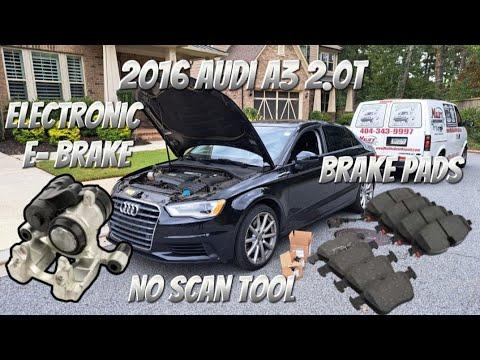







How to Replace Rear Brake Pads on a 2016 Audi A3 (EPB Service Mode Guide)
Step-by-step DIY instructions with tools, parts list, EPB/VCDS-OBDeleven steps, and torque specs for 2017, 2018, 2019, 2020
How to Replace Rear Brake Pads on a 2016 Audi A3 (EPB Service Mode Guide)
Step-by-step DIY instructions with tools, parts list, EPB/VCDS-OBDeleven steps, and torque specs for 2017, 2018, 2019, 2020


🔧 A3 - Rear Brake Pad Replacement
You’ll be removing the rear calipers, retracting the electronic parking brake (EPB) motors, installing new pads, and then re-initializing the EPB. This matters because the EPB must be put into “service mode” before you compress the rear pistons, or you can damage the caliper/EPB motor.
Difficulty Level: Intermediate | Estimated Time: 1.5-3.0 hours
⚠️ Safety & Precautions
- ⚠️ Work on level ground; use jack stands—never rely on a jack.
- ⚠️ Put the EPB in service mode before removing the calipers or pushing pistons back.
- ⚠️ Keep fingers clear when compressing the caliper piston; pinch hazard.
- ⚠️ Brake dust is harmful—use brake cleaner, not compressed air.
- ⚠️ Don’t press the brake pedal with a caliper removed.
- ⚠️ Brake fluid can overflow when pistons are pushed in; protect paint and check the reservoir level.
🔧 Required Tools
You'll need the following tools for this repair:
- Floor jack (rated 3-ton minimum)
- Jack stands (rated 3-ton minimum)
- Wheel chocks
- 17mm socket
- Breaker bar (1/2" drive)
- Torque wrench (10-200 Nm range)
- Ratchet (3/8" drive)
- 13mm socket
- 15mm wrench
- 7mm hex bit socket
- Small flathead screwdriver
- Brake caliper piston compressor tool (specialty)
- Caliper hanger hook
- Wire brush
- Brake cleaner spray
- Nitrile gloves
- Safety glasses
- OBDeleven or VCDS scan tool (specialty)
- Battery maintainer/charger (10A)
🔩 Required Parts
HowToo sells all the parts you need for this repair:
- Rear brake pad set - Qty: 1
- Brake pad anti-squeal grease - Qty: 1
- Rear caliper carrier bolts - Qty: 4
- Brake cleaner - Qty: 1
📋 Before You Begin
- Park on level ground, steering straight, and place wheel chocks at the front wheels.
- Turn ignition ON (engine OFF) and connect a battery maintainer/charger (10A). This helps prevent low-voltage faults while the EPB motors retract.
- Open the hood and locate the brake fluid reservoir. If it’s near MAX, remove a little fluid with a clean syringe/turkey baster so it won’t overflow when pistons retract.
- “Caliper carrier” is the bracket the caliper bolts to.
🔨 Step-by-Step Instructions
Follow these steps in order:
Step 1: Put the EPB into service mode (retract)
- Plug in your OBDeleven or VCDS scan tool (specialty).
- Use the app/software to run the rear parking brake service function (often labeled “Open/Release parking brake” or “Brake pad replacement mode”).
- Wait until it confirms the EPB is fully retracted/open.
- Do not start pad removal before this.
Step 2: Loosen rear wheel bolts and raise the rear
- Use a 17mm socket and breaker bar (1/2" drive) to loosen the rear wheel bolts 1/2 turn.
- Lift the rear using a floor jack (rated 3-ton minimum) at the proper jack point.
- Support with jack stands (rated 3-ton minimum).
- Remove wheel bolts with the 17mm socket and take the wheel off.
Step 3: Remove the rear caliper from the carrier
- Locate the two caliper slider bolts on the back side of the caliper.
- Common fastener styles on the A3 rear caliper:
- Use a 13mm socket to remove the slider bolts while holding the slider pin with a 15mm wrench, or use a 7mm hex bit socket if your sliders are internal-hex style.
- Lift the caliper off and hang it from the suspension spring using a caliper hanger hook. Do not let it hang by the brake hose.
Step 4: Remove old pads and prep the hardware
- Pull the inner and outer pads out of the caliper carrier by hand (use a small flathead screwdriver gently if they’re stuck).
- Remove the pad abutment clips (if equipped) and clean the contact areas on the carrier with brake cleaner spray and a wire brush.
- Clean the rotor face and caliper area with brake cleaner spray.
Step 5: Compress the rear caliper piston
- Place the old inner pad against the piston.
- Use a brake caliper piston compressor tool (specialty) to slowly push the piston straight back into the caliper.
- Go slowly and check the brake fluid reservoir as you compress; remove excess fluid if it rises too high.
- If it won’t compress, stop—EPB may not be retracted.
Step 6: Install new pads
- Apply a thin layer of brake pad anti-squeal grease to pad backing plates and pad “ears” where they touch the carrier. Keep grease off pad friction material and rotor.
- Install the new inner and outer pads into the carrier in the same orientation as removed.
Step 7: Reinstall the caliper and torque fasteners
- Set the caliper over the new pads.
- Reinstall slider bolts using a 13mm socket (and 15mm wrench if needed) or the 7mm hex bit socket, depending on your hardware.
- Torque to 35 Nm (26 ft-lbs) for rear caliper slider bolts (typical A3 spec).
- If you removed the carrier: reinstall with new bolts and torque to 90 Nm (66 ft-lbs) + 90° (common one-time-use stretch-bolt spec). If unsure, do not reuse visibly stretched/corroded bolts.
- Assumption: Torque values reflect common A3 (8V/MQB) rear brake hardware; verify with a repair database if your fasteners differ.
Step 8: Reinstall wheels
- Put the wheel back on and hand-thread the bolts.
- Lower the car off the stands using the floor jack (rated 3-ton minimum).
- Use a torque wrench (10-200 Nm range) and 17mm socket to tighten wheel bolts in a star pattern: Torque to 120 Nm (89 ft-lbs).
Step 9: Close EPB service mode (initialize)
- Use your OBDeleven or VCDS scan tool (specialty) to run the function to close/initialize the rear parking brake (often “Close/Apply parking brake” or “End service mode”).
- Clear any stored EPB/brake faults if present.
✅ After Repair
- With ignition ON, press the brake pedal firmly 5-10 times until it feels solid (this seats the pads to the rotors).
- Check brake fluid level and top off only if needed.
- Test the parking brake switch operation with the car stationary.
- Road test at low speed first; confirm no grinding, pulling, or warning lights.
- Brake pad bed-in: do 6-10 gentle stops from 30-10 mph, then drive to cool for 5-10 minutes.
💰 DIY vs Shop Cost
Shop Cost: $350-$650 (parts + labor)
DIY Cost: $80-$200 (parts only)
You Save: $270-$450 by doing it yourself!
Shop labor rates vary but typically run $100-$150/hour. This repair takes a shop approximately 1.5-2.5 hours.
🎯 Ready to get started?
HowToo makes it easy: same-day/2-day shipping on every part, plus all the tools and specialty tools you need! Check out the parts and tools sections below to add everything to your cart.