









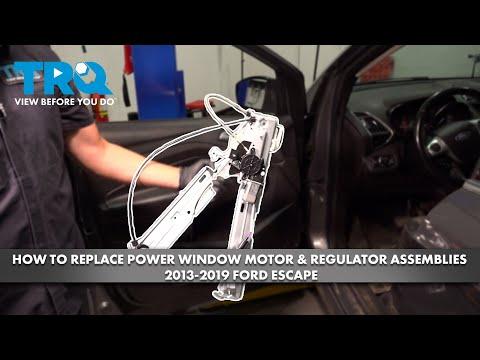





How to Replace Front Window Regulators on a 2014 Ford Escape
Step-by-step door panel removal, regulator installation, tools, parts, and torque specs for 2013, 2014, 2015, 2016, 2017, 2018, 2019
How to Replace Front Window Regulators on a 2014 Ford Escape
Step-by-step door panel removal, regulator installation, tools, parts, and torque specs for 2013, 2014, 2015, 2016, 2017, 2018, 2019


🔧 Escape - Front Window Regulator Replacement
This repair replaces the front door window regulator, which is the scissor/cable mechanism that moves the glass up and down inside the door. On your Escape, the front regulator is serviced through the inner door panel and access openings in the door shell.
Difficulty Level: Intermediate | Estimated Time: 1.5-2.5 hours per door
⚠️ Safety & Precautions
- ⚠️ Disconnect the negative battery cable before unplugging door electrical connectors to reduce the chance of short circuits.
- ⚠️ The window glass can drop suddenly once it is unbolted from the regulator. Always tape or support the glass before removing regulator fasteners.
- ⚠️ Wear gloves. The inside of the door has sharp stamped-metal edges.
- ⚠️ Do not turn the ignition on with door connectors unplugged. This can set body control or airbag-related fault codes.
- ⚠️ Keep fingers away from the regulator tracks and cable spool when testing the motor.
🔧 Required Tools
You'll need the following tools for this repair:
- 10mm socket
- 7mm socket
- 8mm socket
- Ratchet
- 6-inch extension
- Trim removal tool set
- Small flathead screwdriver
- Phillips screwdriver
- Torx T20 screwdriver
- Torx T30 screwdriver
- Painter’s tape
- Torque wrench inch-pound
- Torque wrench foot-pound
- Needle-nose pliers
- Work light
- Safety glasses
- Mechanic gloves
🔩 Required Parts
HowToo sells all the parts you need for this repair:
- Front left window regulator assembly - Qty: 1 if replacing driver side
- Front right window regulator assembly - Qty: 1 if replacing passenger side
- Front window regulator motor - Qty: 1 if not included with regulator
- Door trim panel retaining clips - Qty: As needed
- Butyl tape or vapor barrier sealant - Qty: 1 roll
📋 Before You Begin
- 🅿️ Park your Escape on level ground and set the parking brake.
- 🔋 Lower the affected window about halfway if it still moves. This makes the glass clamp bolts easier to reach.
- 🔋 Use a 10mm socket to disconnect the negative battery cable, then wait 2 minutes before unplugging door connectors.
- 🧰 A trim removal tool is a plastic pry tool that helps pop panels loose without scratching them.
- 🧼 Keep the door vapor barrier intact if possible. It is the plastic moisture shield behind the trim panel and helps keep water out of the cabin.
🔨 Step-by-Step Instructions
Follow these steps in order:
Step 1: Remove the Door Switch Trim
- Use a trim removal tool to gently pry up the window switch trim from the armrest area.
- Use a small flathead screwdriver to press the connector lock tab, then unplug the window switch connector.
- Set the switch trim aside where it will not get scratched.
- Go slow to avoid broken clips.
Step 2: Remove Hidden Door Panel Screws
- Use a small flathead screwdriver to remove the small cover behind the inside door handle.
- Use a Torx T20 screwdriver or 7mm socket, depending on screw style, to remove the screw behind the handle cover.
- Use a 7mm socket to remove the screws inside the armrest/pull handle area.
- Use a 7mm socket to remove any lower door panel screws along the bottom edge.
Step 3: Remove the Front Door Trim Panel
- Use a trim removal tool at the lower rear corner of the door panel and gently pop the first retaining clip loose.
- Work around the sides and bottom of the panel with the trim removal tool until all clips release.
- Lift the door panel straight upward to unhook it from the window ledge.
- Use a small flathead screwdriver to disconnect the door handle cable from the interior handle lever.
- Use a small flathead screwdriver to unplug any remaining courtesy light or speaker connectors.
Step 4: Remove the Vapor Barrier
- Use your fingers or a trim removal tool to slowly peel the vapor barrier away from the door.
- If the black sticky sealant stretches, use a small flathead screwdriver to guide it without tearing the plastic.
- Fold the vapor barrier upward and tape it out of the way with painter’s tape.
- Do not rip the moisture shield.
Step 5: Position and Secure the Window Glass
- If the motor still works, temporarily reconnect the window switch and negative battery cable using a 10mm socket.
- Move the glass until the glass clamp bolts are visible through the door access openings.
- Use a 10mm socket to disconnect the negative battery cable again before continuing.
- Apply painter’s tape from the outside of the glass over the top of the door frame and down the inside of the glass.
- Use at least 3 long strips of painter’s tape to hold the glass fully up.
- If the glass will not move, carefully slide it upward by hand while wearing mechanic gloves, then tape it in place.
Step 6: Separate the Glass from the Regulator
- Use a 10mm socket to loosen the two window glass clamp bolts through the access openings.
- Do not fully remove the glass clamp bolts unless the replacement regulator design requires it.
- Carefully lift the glass fully upward by hand and secure it again with painter’s tape.
- Make sure the glass cannot slide down before removing the regulator.
Step 7: Disconnect the Window Motor
- Use a small flathead screwdriver to release the window motor electrical connector lock tab.
- Pull the connector straight off the motor.
- Use a work light to check that the harness is not clipped to the regulator frame.
- Use needle-nose pliers to release any harness retainers from the regulator if needed.
Step 8: Remove the Old Regulator Assembly
- Use a 10mm socket with a 6-inch extension to remove the regulator mounting bolts from the door shell.
- Use an 8mm socket or Torx T30 screwdriver to remove the window motor mounting bolts if the motor must be transferred.
- Support the regulator with one hand while removing the last mounting bolt.
- Angle the regulator assembly out through the largest door opening.
- Be patient. The regulator must rotate slightly to clear the door brace.
Step 9: Transfer the Window Motor if Needed
- If the new regulator does not include a motor, use an 8mm socket or Torx T30 screwdriver to remove the motor from the old regulator.
- Install the motor onto the new regulator in the same position.
- Use the torque wrench inch-pound to tighten the motor screws to Torque to 5 Nm (44 in-lbs).
- Do not force the motor gear. It should sit flat before tightening.
Step 10: Install the New Regulator Assembly
- Feed the new regulator through the door opening by hand.
- Align the regulator mounting holes with the door shell.
- Use a 10mm socket to start all regulator mounting bolts by hand first.
- Use a torque wrench foot-pound with 10mm socket to tighten the regulator bolts to Torque to 10 Nm (89 in-lbs).
- Reconnect the window motor electrical connector until it clicks.
Step 11: Attach the Glass to the New Regulator
- Carefully remove enough painter’s tape to lower the glass into the regulator clamps by hand.
- Make sure the glass sits squarely and fully inside both clamps.
- Use a 10mm socket to snug the glass clamp bolts.
- Use a torque wrench inch-pound with 10mm socket to tighten the glass clamp bolts to Torque to 8 Nm (71 in-lbs).
- Reapply painter’s tape lightly until testing is complete.
Step 12: Test Window Operation Before Reassembly
- Use a 10mm socket to reconnect the negative battery cable.
- Plug the window switch back in by hand.
- Turn the ignition to accessory mode.
- Run the window down and up slowly while watching the glass travel.
- If the glass tilts or binds, stop immediately and use a 10mm socket to loosen the glass clamp bolts, realign the glass, and retighten to Torque to 8 Nm (71 in-lbs).
- Use a 10mm socket to disconnect the negative battery cable again before final reassembly.
Step 13: Reinstall the Vapor Barrier
- Press the vapor barrier back into place by hand along the original sealant line.
- Use butyl tape or vapor barrier sealant anywhere the original seal no longer sticks.
- Make sure all wiring passes through the correct openings before sealing the barrier.
- Water leaks often start here.
Step 14: Reinstall the Door Panel
- Reconnect the door handle cable by hand and make sure it snaps into the handle lever.
- Reconnect all electrical connectors by hand until they click.
- Hook the upper edge of the door panel over the window ledge.
- Press around the door panel by hand to seat the retaining clips.
- Use a 7mm socket to reinstall the armrest and lower door panel screws.
- Use a Torx T20 screwdriver or 7mm socket to reinstall the inside handle screw.
- Snap the screw covers and switch trim back into place by hand.
Step 15: Reconnect Battery and Initialize the Auto Window
- Use a 10mm socket to reconnect the negative battery cable.
- Turn the ignition on.
- Hold the window switch down until the window reaches the bottom, then keep holding for 2 seconds.
- Hold the window switch up until the window reaches the top, then keep holding for 2 seconds.
- Repeat once if the one-touch feature does not work the first time.
✅ After Repair
- ✅ Test the window from the driver switch and the passenger door switch if replacing the passenger front regulator.
- ✅ Check that the glass seals evenly at the top and does not rattle with the door closed.
- ✅ Spray a small amount of silicone window-channel lubricant into the rubber glass run if the window moves slowly.
- ✅ Confirm the door lock, mirror switch, speaker, and interior handle all work before driving.
- ✅ If a warning light appears after the battery disconnect, drive normally for a short distance; steering angle and window functions often relearn after basic operation.
💰 DIY vs Shop Cost
Shop Cost: $300-$550 per front door (parts + labor)
DIY Cost: $80-$220 per front door (parts only)
You Save: $220-$330 per door by doing it yourself!
Shop labor rates vary but typically run $100-$150/hour. This repair takes a shop approximately 1.0-1.8 hours per door.
🎯 Ready to get started?
HowToo makes it easy: same-day/2-day shipping on every part, plus all the tools and specialty tools you need! Check out the parts and tools sections below to add everything to your cart.