









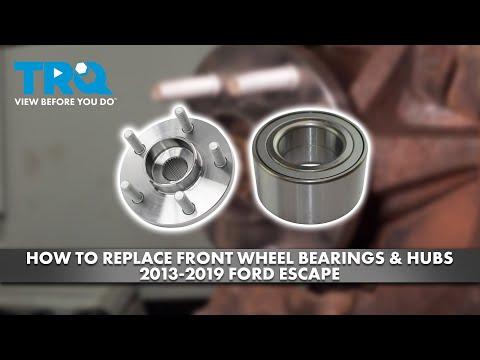







How to Replace Front Wheel Bearing Hub on a 2017 Ford Escape
Step-by-step DIY guide with tools, parts, torque specs, ABS tips, and safety checks for 2013, 2014, 2015, 2016, 2017, 2018, 2019
How to Replace Front Wheel Bearing Hub on a 2017 Ford Escape
Step-by-step DIY guide with tools, parts, torque specs, ABS tips, and safety checks for 2013, 2014, 2015, 2016, 2017, 2018, 2019


🔧 Escape - Wheel Bearing Replacement
Your Escape uses sealed hub-and-bearing assemblies, so the practical DIY repair is replacing the complete wheel hub/bearing unit rather than pressing the bearing out separately. A bad wheel bearing usually causes a growling or humming noise that changes with road speed, and it should be repaired promptly to avoid wheel looseness or ABS sensor issues.
Assumption: This guide covers one front wheel bearing/hub assembly. Rear AWD hub replacement is similar, but torque values and access differ.
Difficulty Level: Intermediate | Estimated Time: 2-3 hours per side
⚠️ Safety & Precautions
- ⚠️ Work on a flat, solid surface and support your Escape with jack stands before going under or around the wheel area.
- ⚠️ Do not rely on a floor jack alone. A floor jack lifts the vehicle; jack stands hold it safely.
- ⚠️ The axle nut is very tight. Loosen it only with the wheel on the ground or have a helper hold the brake pedal.
- ⚠️ Do not let the brake caliper hang by the rubber brake hose. Support it with wire or a caliper hanger.
- ⚠️ Avoid pulling, twisting, or striking the ABS wheel speed sensor wiring near the hub.
- ⚠️ Replace the axle nut if supplied with the new hub or if the nut is a one-time-use staked style.
- ⚠️ Battery disconnect is not normally required for this repair.
🔧 Required Tools
You'll need the following tools for this repair:
- Safety glasses
- Mechanic gloves
- Wheel chocks
- Floor jack rated 3-ton minimum
- Jack stands rated 3-ton minimum
- 1/2-inch drive breaker bar
- 1/2-inch drive torque wrench rated to 250 ft-lbs
- 19mm lug nut socket
- 32mm axle nut socket
- 13mm socket
- 15mm socket
- 18mm socket
- Ratchet 3/8-inch drive
- Ratchet 1/2-inch drive
- Flathead screwdriver
- Needle-nose pliers
- Rubber mallet
- Dead blow hammer
- Hub puller kit (specialty)
- Caliper hanger hook
- Wire brush
- Brake cleaner spray
- Anti-seize compound
🔩 Required Parts
HowToo sells all the parts you need for this repair:
- Front wheel hub and bearing assembly - Qty: 1 per side
- Front axle nut - Qty: 1 per side
- Brake caliper bracket bolts - Qty: 2 per side if corroded or specified one-time-use
- Brake cleaner - Qty: 1 can
- Anti-seize compound - Qty: 1 small tube
📋 Before You Begin
- 🚗 Park your Escape on level ground, shift to Park, and apply the parking brake.
- 🧱 Place wheel chocks behind the rear wheels.
- 🔩 Slightly loosen the front lug nuts before lifting the vehicle.
- 📌 A hub puller is a tool that bolts to the wheel studs and helps pull a stuck hub out evenly.
- 📌 Anti-seize is a paste that helps prevent metal parts from rusting together later.
- 📌 If replacing both front wheel bearings, do one side at a time so the other side can be used as a visual reference.
🔨 Step-by-Step Instructions
Follow these steps in order:
Step 1: Loosen the axle nut and lug nuts
- Use the 19mm lug nut socket and 1/2-inch drive breaker bar to loosen each lug nut about half a turn.
- Use the 32mm axle nut socket and 1/2-inch drive breaker bar to loosen the axle nut while the tire is still on the ground.
- If the axle nut is staked into a groove, use a flathead screwdriver to carefully lift the staked area first.
- Break it loose before lifting.
Step 2: Raise and support the vehicle
- Use the floor jack rated 3-ton minimum at the front jacking point to lift your Escape.
- Place jack stands rated 3-ton minimum under the proper front support points.
- Gently lower the vehicle onto the jack stands using the floor jack rated 3-ton minimum.
- Lightly shake the vehicle by hand to make sure it is stable before continuing.
Step 3: Remove the wheel
- Use the 19mm lug nut socket and ratchet 1/2-inch drive to remove the lug nuts.
- Remove the wheel and place it flat under the side of the vehicle as an extra safety backup.
Step 4: Remove the brake caliper
- Use the 13mm socket and ratchet 3/8-inch drive to remove the two brake caliper slide pin bolts.
- Slide the caliper off the brake rotor.
- Hang the caliper from the strut spring using the caliper hanger hook.
- Do not stretch or twist the brake hose.
Step 5: Remove the caliper bracket and rotor
- Use the 18mm socket and 1/2-inch drive breaker bar to remove the two caliper bracket bolts.
- Remove the caliper bracket and set it aside.
- Slide the brake rotor off the hub by hand.
- If the rotor is stuck, tap around the rotor hat with the rubber mallet.
- Do not hit the braking surface hard.
Step 6: Remove the axle nut
- Use the 32mm axle nut socket and ratchet 1/2-inch drive to remove the loosened axle nut.
- Push the axle inward slightly by hand.
- If it is stuck, thread the old axle nut on a few turns and tap it gently with the dead blow hammer.
- Do not damage the axle threads.
Step 7: Disconnect the ABS wheel speed sensor wiring from the hub area
- Use needle-nose pliers to release any ABS wire retaining clips attached near the hub or steering knuckle.
- Move the wire aside carefully so it cannot be pulled while the hub is removed.
- Do not yank on the ABS wire.
Step 8: Remove the hub mounting bolts
- From the back side of the steering knuckle, use the 15mm socket and ratchet 1/2-inch drive to remove the hub mounting bolts.
- If the bolts are rusty, use the 1/2-inch drive breaker bar for extra leverage.
- Support the hub with one hand as the final bolt comes out.
Step 9: Remove the old hub and bearing assembly
- Pull the old hub straight out by hand.
- If it is stuck in the knuckle, attach the hub puller kit (specialty) to the wheel studs and tighten it evenly.
- Use the dead blow hammer to tap around the hub flange if needed.
- Remove the hub and guide the axle shaft through the center opening.
Step 10: Clean the mounting surface
- Use the wire brush to clean rust and debris from the steering knuckle where the hub sits.
- Spray the area with brake cleaner spray and let it dry.
- Apply a very thin film of anti-seize compound to the hub bore using a gloved finger.
- Keep anti-seize away from the wheel studs, brake rotor surface, and ABS sensor tip.
Step 11: Install the new hub and bearing assembly
- Guide the axle shaft through the new hub center by hand.
- Seat the new hub squarely into the steering knuckle.
- Install the hub mounting bolts by hand first to avoid cross-threading.
- Use the 15mm socket and torque wrench rated to 250 ft-lbs to tighten the hub bolts to Torque to 115 Nm (85 ft-lbs).
Step 12: Reinstall the ABS wire routing
- Use needle-nose pliers to secure the ABS wire retaining clips back into their original positions.
- Make sure the wire is not touching the axle, rotor, or tire path.
Step 13: Install the new axle nut
- Thread the new axle nut on by hand.
- Use the 32mm axle nut socket and ratchet 1/2-inch drive to snug the nut.
- Final axle nut torque is done after the wheel is installed and the vehicle is on the ground.
Step 14: Reinstall the brake rotor and caliper bracket
- Slide the brake rotor onto the new hub by hand.
- Install the caliper bracket over the rotor.
- Use the 18mm socket and torque wrench rated to 250 ft-lbs to tighten the caliper bracket bolts to Torque to 175 Nm (129 ft-lbs).
Step 15: Reinstall the brake caliper
- Remove the caliper hanger hook and place the caliper back over the rotor and bracket.
- Install the caliper slide pin bolts by hand.
- Use the 13mm socket and torque wrench rated to 250 ft-lbs to tighten the slide pin bolts to Torque to 35 Nm (26 ft-lbs).
Step 16: Reinstall the wheel
- Place the wheel back onto the hub.
- Install the lug nuts by hand.
- Use the 19mm lug nut socket and ratchet 1/2-inch drive to snug the lug nuts in a star pattern.
Step 17: Lower the vehicle and torque the fasteners
- Use the floor jack rated 3-ton minimum to lift slightly, remove the jack stands rated 3-ton minimum, and lower your Escape to the ground.
- Use the 19mm lug nut socket and torque wrench rated to 250 ft-lbs to tighten the lug nuts in a star pattern to Torque to 135 Nm (100 ft-lbs).
- Use the 32mm axle nut socket and torque wrench rated to 250 ft-lbs to tighten the axle nut to Torque to 258 Nm (190 ft-lbs).
- If the new axle nut is a staked style, use the flathead screwdriver to stake the nut into the axle groove.
✅ After Repair
- ✅ Pump the brake pedal several times before driving. This seats the brake caliper back into place.
- ✅ Start with a slow test drive in a quiet area and listen for grinding, humming, clicking, or rubbing.
- ✅ Check that the ABS warning light stays off.
- ✅ After 25-50 miles, recheck lug nut torque with the 19mm lug nut socket and torque wrench rated to 250 ft-lbs to Torque to 135 Nm (100 ft-lbs).
- ✅ If the steering wheel is off-center or the vehicle pulls, have the alignment checked.
💰 DIY vs Shop Cost
Shop Cost: $450-$750 per front side (parts + labor)
DIY Cost: $130-$280 per front side (parts only)
You Save: $320-$470 by doing it yourself!
Shop labor rates vary but typically run $100-$150/hour. This repair takes a shop approximately 1.5-2.5 hours.
🎯 Ready to get started?
HowToo makes it easy: same-day/2-day shipping on every part, plus all the tools and specialty tools you need! Check out the parts and tools sections below to add everything to your cart.