

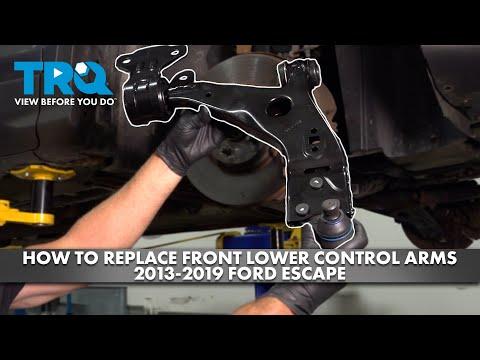







How to Replace Front Lower Control Arms on a 2017 Ford Escape
Step-by-step DIY guide with tools, parts, torque specs, safety tips, and alignment advice for 2013, 2014, 2015, 2016, 2017, 2018, 2019
How to Replace Front Lower Control Arms on a 2017 Ford Escape
Step-by-step DIY guide with tools, parts, torque specs, safety tips, and alignment advice for 2013, 2014, 2015, 2016, 2017, 2018, 2019


🔧 Escape - Front Lower Control Arm Replacement
This repair covers replacing the front lower control arms on your Escape. The lower control arm connects the wheel hub area to the vehicle frame and uses bushings plus a ball joint to control wheel movement, steering feel, and tire alignment.
Difficulty Level: Intermediate | Estimated Time: 2.5-4 hours
Assumption: This is for the front lower control arms, which are the most common “control arm” replacement on your Escape.
⚠️ Safety & Precautions
- ⚠️ Support your Escape with jack stands only; never work under a vehicle held up by a jack.
- ⚠️ Use wheel chocks behind the rear wheels before lifting the front.
- ⚠️ Do not loosen suspension bolts while the vehicle is only partially supported.
- ⚠️ The ball joint separator can release suddenly; keep hands and face clear.
- ⚠️ A wheel alignment is required after replacing control arms.
- ⚠️ Tighten final control arm bushing bolts at normal ride height to prevent early bushing failure.
🔧 Required Tools
You'll need the following tools for this repair:
- Floor jack (rated 2-ton minimum)
- Jack stands (rated 2-ton minimum)
- Wheel chocks
- Safety glasses
- Mechanic gloves
- 1/2-inch drive breaker bar
- 1/2-inch drive torque wrench (up to 200 Nm)
- 3/8-inch drive ratchet
- Impact wrench (optional)
- 19mm socket
- 21mm socket
- 18mm socket
- 15mm socket
- 10mm socket
- 18mm wrench
- 21mm wrench
- Flat pry bar
- Ball joint separator (specialty)
- Rubber mallet
- Needle-nose pliers
- Paint marker
- Penetrating oil
- Wire brush
- Hydraulic jack with wood block
🔩 Required Parts
HowToo sells all the parts you need for this repair:
- Front lower control arm assembly - Left: Qty: 1
- Front lower control arm assembly - Right: Qty: 1
- Front lower ball joint pinch bolt and nut - Qty: 2
- Front lower control arm mounting bolts - Qty: 4
- Front stabilizer bar link nuts - Qty: 2
📋 Before You Begin
- 🅿️ Park your Escape on level ground and set the parking brake.
- 🧱 Place wheel chocks behind both rear wheels.
- 🔩 Slightly loosen the front lug nuts with a 19mm socket before lifting the vehicle.
- 🧴 Spray penetrating oil on the control arm bolts, ball joint pinch bolt, and stabilizer link nut.
- 📌 A ball joint separator is a tool that separates the ball joint stud from the steering knuckle without hammering directly on the joint.
- 📌 A torque wrench is a tool that tightens bolts to the correct force so parts do not loosen or get damaged.
🔨 Step-by-Step Instructions
Follow these steps in order:
Step 1: Loosen the Front Wheel Lug Nuts
- Use a 19mm socket and breaker bar to loosen each front lug nut about half a turn.
- Do not remove the lug nuts yet.
- Break them loose while tires touch ground.
Step 2: Lift and Support the Front of the Vehicle
- Use a floor jack to lift the front of your Escape at the front center jacking point.
- Place jack stands under the front side pinch weld jacking points.
- Lower the vehicle gently onto the jack stands.
- Use safety glasses and mechanic gloves before working underneath.
Step 3: Remove the Front Wheels
- Use a 19mm socket to remove the loosened lug nuts.
- Remove both front wheels and set them flat under the vehicle as an extra safety backup.
Step 4: Mark the Control Arm Position
- Use a paint marker to mark the position of the control arm mounting points on the subframe.
- This helps you install the new arm close to the original position before alignment.
Step 5: Disconnect the Stabilizer Bar Link from the Control Arm
- Use a wire brush to clean the stabilizer bar link nut threads.
- Use an 18mm socket and 18mm wrench to remove the stabilizer bar link nut from the control arm.
- If the stud spins, hold the stud with the correct wrench while turning the nut with the 18mm wrench.
- Move the stabilizer link aside by hand.
Step 6: Remove the Ball Joint Pinch Bolt
- Use a 15mm socket and ratchet to remove the ball joint pinch bolt nut at the steering knuckle.
- Use a 15mm socket to slide the pinch bolt out of the knuckle.
- The steering knuckle is the metal part that holds the wheel hub and connects steering and suspension parts.
Step 7: Separate the Ball Joint from the Steering Knuckle
- Use a ball joint separator to carefully separate the lower ball joint stud from the steering knuckle.
- Use a flat pry bar only if needed to gently push the control arm downward.
- Do not pull outward hard on the axle shaft.
- Keep the axle seated in the transmission.
Step 8: Support the Control Arm Area
- Use a hydraulic jack with wood block under the lower control arm area.
- Apply only light support pressure.
- This prevents the arm from dropping suddenly when bolts are removed.
Step 9: Remove the Rear Control Arm Mounting Bolt
- Use a 21mm socket and breaker bar to loosen the rear lower control arm mounting bolt.
- Use a 21mm wrench on the nut if it turns.
- Remove the bolt and nut, then set them aside only if reusing temporarily.
Step 10: Remove the Front Control Arm Mounting Bolt
- Use an 18mm socket and breaker bar to loosen the front lower control arm mounting bolt.
- Use an 18mm wrench on the nut if needed.
- Remove the bolt and nut.
Step 11: Remove the Old Control Arm
- Use a flat pry bar to carefully slide the control arm out of the subframe pockets.
- Lower the hydraulic jack slowly as needed.
- Remove the control arm from the vehicle.
Step 12: Compare the New and Old Control Arms
- Place the new control arm next to the old one.
- Check that the bushing locations, ball joint angle, and stabilizer link mount match.
- Do not install the part if it does not match.
Step 13: Install the New Control Arm into the Subframe
- Use a flat pry bar to guide the new control arm into the front and rear subframe pockets.
- Install the front and rear mounting bolts by hand first.
- Do not fully tighten the mounting bolts yet.
- Hand-start bolts to avoid cross-threading.
Step 14: Connect the Ball Joint to the Steering Knuckle
- Use the hydraulic jack with wood block to raise the new control arm slowly.
- Guide the ball joint stud fully into the steering knuckle by hand.
- Install a new ball joint pinch bolt and nut using a 15mm socket.
- Tighten the pinch bolt securely, then final torque later with the vehicle supported safely.
Step 15: Reconnect the Stabilizer Bar Link
- Use your hand to guide the stabilizer bar link stud through the control arm bracket.
- Install a new stabilizer bar link nut.
- Use an 18mm socket and 18mm wrench to tighten the nut.
Step 16: Repeat on the Other Side
- Use the same tools and steps to replace the opposite front lower control arm.
- Replace control arms in pairs when bushings or ball joints are worn unevenly.
Step 17: Pre-Tighten the Fasteners
- Use an 18mm socket to snug the front control arm mounting bolt.
- Use a 21mm socket to snug the rear control arm mounting bolt.
- Use a 15mm socket to snug the ball joint pinch bolt.
- Use an 18mm socket to snug the stabilizer bar link nut.
- Do not final-torque the control arm bushing bolts while the suspension is hanging.
Step 18: Load the Suspension to Ride Height
- Use a hydraulic jack with wood block under the outer control arm area near the ball joint.
- Raise the control arm until the vehicle just starts to lift slightly off the jack stand on that side.
- This simulates normal ride height so the rubber bushings are not twisted when tightened.
Step 19: Final-Torque the Control Arm Fasteners
- Use an 18mm socket and torque wrench on the front control arm mounting bolt: Torque to 115 Nm (85 ft-lbs).
- Use a 21mm socket and torque wrench on the rear control arm mounting bolt: Torque to 175 Nm (129 ft-lbs).
- Use a 15mm socket and torque wrench on the ball joint pinch bolt: Torque to 63 Nm (46 ft-lbs).
- Use an 18mm socket and torque wrench on the stabilizer bar link nut: Torque to 55 Nm (41 ft-lbs).
Step 20: Reinstall the Front Wheels
- Place each wheel back onto the hub by hand.
- Install the lug nuts by hand first.
- Use a 19mm socket to snug the lug nuts in a star pattern.
Step 21: Lower the Vehicle and Torque the Lug Nuts
- Use the floor jack to lift your Escape slightly off the jack stands.
- Remove the jack stands.
- Lower the vehicle fully to the ground.
- Use a 19mm socket and torque wrench to tighten the lug nuts in a star pattern: Torque to 135 Nm (100 ft-lbs).
✅ After Repair
- ✅ Turn the steering wheel left and right while parked to check for clunks or binding.
- ✅ Test drive slowly at first and listen for knocking, scraping, or looseness.
- ✅ Get a professional wheel alignment as soon as possible.
- ✅ Recheck lug nut torque after 25-50 miles: Torque to 135 Nm (100 ft-lbs).
- ✅ If the steering wheel is off-center or the vehicle pulls, avoid long driving until alignment is done.
💰 DIY vs Shop Cost
Shop Cost: $650-$1,100 (parts + labor + alignment)
DIY Cost: $220-$500 (parts only, alignment extra)
You Save: $350-$600 by doing it yourself!
Shop labor rates vary but typically run $100-$150/hour. This repair takes a shop approximately 2-3 hours.
🎯 Ready to get started?
HowToo makes it easy: same-day/2-day shipping on every part, plus all the tools and specialty tools you need! Check out the parts and tools sections below to add everything to your cart.