

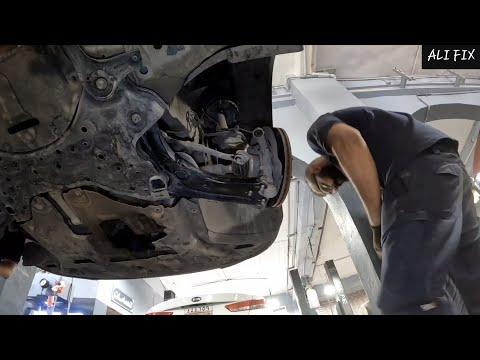







How to Replace Front Lower Control Arms on a 2013 Hyundai Tucson
Step-by-step suspension repair guide with tools, parts, torque specs, and safety tips for 2014, 2015
How to Replace Front Lower Control Arms on a 2013 Hyundai Tucson
Step-by-step suspension repair guide with tools, parts, torque specs, and safety tips for 2014, 2015


🔧 Tucson - Front Lower Control Arm Replacement
This repair replaces the front lower control arms on your Tucson. These arms connect the front suspension to the vehicle frame and include bushings and a ball joint that wear out over time, causing clunks, loose steering, vibration, or uneven tire wear.
Difficulty Level: Intermediate | Estimated Time: 2-4 hours
Assumption: This guide covers the front lower control arms, which are the common service item on your Tucson.
⚠️ Safety & Precautions
- ⚠️ Support your Tucson securely with jack stands. Never work under a vehicle held only by a floor jack.
- ⚠️ Wear safety glasses and gloves. Suspension parts can release suddenly when separated.
- ⚠️ Do not strike the ball joint threads directly with a hammer. Use a ball joint separator.
- ⚠️ Final-tighten the control arm bushing bolts at normal ride height to avoid twisting and damaging the new bushings.
- ⚠️ A wheel alignment is required after replacing control arms.
🔧 Required Tools
You'll need the following tools for this repair:
- Floor jack (rated 2-ton minimum)
- Jack stands (rated 2-ton minimum)
- Wheel chocks
- Safety glasses
- Mechanic gloves
- Breaker bar 1/2-inch drive
- Torque wrench 1/2-inch drive
- Ratchet 1/2-inch drive
- Ratchet 3/8-inch drive
- 21mm socket
- 19mm socket
- 17mm socket
- 14mm socket
- 19mm wrench
- 17mm wrench
- Needle-nose pliers
- Ball joint separator (specialty)
- Pry bar 18-inch
- Rubber mallet
- Paint marker
- Wire brush
- Penetrating oil
🔩 Required Parts
HowToo sells all the parts you need for this repair:
- Front lower control arm assembly - Left: Qty: 1
- Front lower control arm assembly - Right: Qty: 1
- Lower ball joint cotter pin - Qty: 2
- Lower ball joint retaining nut - Qty: 2
- Control arm mounting bolt and nut kit - Qty: 1 set
Recommendation: Replace both front lower control arms together for even handling and tire wear.
📋 Before You Begin
- Park your Tucson on a flat, solid surface.
- Set the parking brake and place wheel chocks behind the rear wheels.
- Spray penetrating oil on the ball joint nut and control arm bolts 10-15 minutes before removal.
- Take clear photos of the control arm and bolt positions before disassembly.
- A ball joint separator is a tool that presses the ball joint stud out of the steering knuckle without damaging the threads.
🔨 Step-by-Step Instructions
Follow these steps in order:
Step 1: Loosen the Front Wheel Lug Nuts
- Use a 21mm socket and breaker bar 1/2-inch drive to loosen each front lug nut about half a turn.
- Do not remove the lug nuts yet.
- Loosen before lifting the vehicle.
Step 2: Raise and Secure the Front End
- Use a floor jack rated 2-ton minimum to lift the front of your Tucson at the front subframe lift area.
- Place jack stands rated 2-ton minimum under the approved front support points.
- Lower the vehicle gently onto the stands.
- Use your hands to gently shake the vehicle and confirm it is stable.
Step 3: Remove the Front Wheels
- Use a 21mm socket and ratchet 1/2-inch drive to remove the lug nuts.
- Remove both front wheels.
- Place the wheels flat under the side rails as an extra safety backup.
Step 4: Mark the Old Control Arm Position
- Use a paint marker to mark around the front and rear control arm bushing mounts.
- This helps place the new arm close to the original position before alignment.
Step 5: Clean and Soak the Fasteners
- Use a wire brush to clean the lower ball joint nut and control arm mounting bolt threads.
- Spray penetrating oil on the cleaned fasteners.
- Let the oil soak for several minutes.
Step 6: Remove the Ball Joint Cotter Pin
- Use needle-nose pliers to straighten and pull out the cotter pin from the lower ball joint stud.
- A cotter pin is a small locking pin that prevents the nut from loosening.
- Discard the old cotter pin.
Step 7: Loosen the Lower Ball Joint Nut
- Use a 19mm socket and breaker bar 1/2-inch drive to loosen the lower ball joint nut.
- Leave the nut threaded on a few turns so the control arm does not drop suddenly.
Step 8: Separate the Ball Joint from the Knuckle
- Install the ball joint separator between the control arm ball joint and the steering knuckle.
- The steering knuckle is the metal part that holds the wheel hub and connects to the suspension.
- Tighten the separator until the ball joint pops free.
- Use a rubber mallet for light tapping only if needed.
Step 9: Remove the Ball Joint Nut Fully
- Use a 19mm socket and ratchet 1/2-inch drive to remove the lower ball joint nut.
- Use a pry bar 18-inch to carefully push the control arm down and free the ball joint stud from the knuckle.
Step 10: Remove the Front Control Arm Mounting Bolt
- Use a 17mm socket and breaker bar 1/2-inch drive to loosen the front control arm mounting bolt.
- Use a 17mm wrench to hold the nut if it spins.
- Remove the front bolt and nut.
Step 11: Remove the Rear Control Arm Mounting Bolt
- Use a 19mm socket and breaker bar 1/2-inch drive to loosen the rear control arm mounting bolt.
- Use a 19mm wrench to hold the nut if needed.
- Remove the rear bolt and nut.
Step 12: Remove the Old Control Arm
- Use a pry bar 18-inch to gently work the control arm out of the subframe mounting pockets.
- The subframe is the heavy metal frame section that supports the engine and front suspension.
- Remove the old control arm from your Tucson.
Step 13: Compare the Old and New Control Arms
- Place the old and new control arms side by side on the ground.
- Confirm the ball joint, bushings, and mounting holes are in the same locations.
- Use mechanic gloves while handling the parts to avoid cuts from sharp edges.
Step 14: Install the New Control Arm
- Slide the new control arm into the front and rear subframe pockets by hand.
- Use a rubber mallet for gentle taps if the bushings are snug.
- Install the front and rear mounting bolts by hand.
- Do not fully tighten the bushing bolts yet.
- Hand-start bolts to avoid cross-threading.
Step 15: Reconnect the Ball Joint
- Use a pry bar 18-inch to carefully align the lower ball joint stud with the steering knuckle.
- Guide the stud into the knuckle by hand.
- Install the new lower ball joint nut by hand.
- Use a 19mm socket and torque wrench 1/2-inch drive to tighten the lower ball joint nut to Torque to 78-98 Nm (58-72 ft-lbs).
- Use needle-nose pliers to install a new cotter pin.
Step 16: Raise the Control Arm to Ride Height
- Place the floor jack rated 2-ton minimum under the outer end of the lower control arm.
- Raise the control arm slightly until it sits close to normal driving position.
- This is called loading the suspension. It keeps the rubber bushings from being tightened in a twisted position.
Step 17: Torque the Control Arm Mounting Bolts
- Use the 17mm socket, 19mm socket, matching wrenches, and torque wrench 1/2-inch drive.
- Tighten the front control arm mounting bolt to Torque to 137-157 Nm (101-116 ft-lbs).
- Tighten the rear control arm mounting bolt to Torque to 156-176 Nm (115-130 ft-lbs).
- Lower and remove the floor jack from under the control arm.
Step 18: Repeat on the Other Side
- Use the same procedure and tools to replace the opposite front lower control arm.
- Keep the old left and right parts separate so you can compare them if needed.
Step 19: Reinstall the Front Wheels
- Place each wheel back onto the hub by hand.
- Install the lug nuts by hand first.
- Use a 21mm socket and ratchet 1/2-inch drive to snug the lug nuts in a star pattern.
Step 20: Lower the Vehicle and Torque Lug Nuts
- Use the floor jack rated 2-ton minimum to lift your Tucson slightly off the jack stands.
- Remove the jack stands rated 2-ton minimum.
- Lower the vehicle to the ground.
- Use a 21mm socket and torque wrench 1/2-inch drive to tighten the lug nuts to Torque to 88-107 Nm (65-79 ft-lbs).
✅ After Repair
- ✅ Turn the steering wheel fully left and right while parked. Listen for popping, rubbing, or binding.
- ✅ Drive slowly around the block first. Check for clunks, pulling, vibration, or an off-center steering wheel.
- ✅ Recheck the lug nut torque after the first short drive.
- ✅ Get a professional wheel alignment as soon as possible after replacing the control arms.
- ✅ Avoid long highway driving until the alignment is done.
💰 DIY vs Shop Cost
Shop Cost: $550-$950 (parts + labor)
DIY Cost: $180-$420 (parts only)
You Save: $370-$530 by doing it yourself!
Shop labor rates vary but typically run $100-$150/hour. This repair takes a shop approximately 2-3 hours.
🎯 Ready to get started?
HowToo makes it easy: same-day/2-day shipping on every part, plus all the tools and specialty tools you need! Check out the parts and tools sections below to add everything to your cart.