

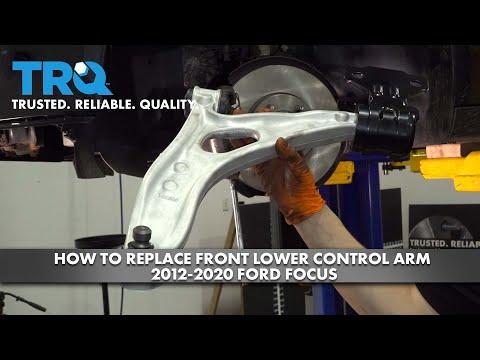







How to Replace Front Lower Control Arms on a 2012-2018 Ford Focus (Trim: SE)
Step-by-step DIY guide with tools, parts, torque specs, safety tips, and alignment notes for 2012, 2013, 2014, 2015, 2016, 2017, 2018
How to Replace Front Lower Control Arms on a 2012-2018 Ford Focus (Trim: SE)
Step-by-step DIY guide with tools, parts, torque specs, safety tips, and alignment notes for 2012, 2013, 2014, 2015, 2016, 2017, 2018


🔧 Focus - Front Lower Control Arm Replacement
This repair replaces the front lower control arms on your Focus. The lower control arm holds the wheel in position and includes bushings and a ball joint, which can cause clunks, wandering steering, uneven tire wear, or vibration when worn.
Difficulty Level: Intermediate | Estimated Time: 2-4 hours
Assumption: This guide covers replacing the front lower control arms; replace both sides as a pair for best handling and tire wear.
⚠️ Safety & Precautions
- ⚠️ Support your Focus with jack stands only. Never work under a vehicle held by a jack alone.
- ⚠️ Wear safety glasses and gloves. Rust, dirt, and spring tension can release suddenly.
- ⚠️ Do not loosen the axle nut or separate the strut from the knuckle unless needed. This helps avoid unnecessary alignment changes.
- ⚠️ The ball joint is the pivot that connects the control arm to the steering knuckle. Keep hands clear when separating it.
- ⚠️ A wheel alignment is required after control arm replacement.
- ⚠️ Battery disconnect is not required for this repair.
🔧 Required Tools
You'll need the following tools for this repair:
- Floor jack (rated 2-ton minimum)
- Jack stands (rated 2-ton minimum)
- Wheel chocks
- Safety glasses
- Mechanic gloves
- Breaker bar 1/2-inch drive
- Torque wrench 1/2-inch drive
- Torque wrench 3/8-inch drive
- Impact wrench 1/2-inch drive
- 17mm socket
- 18mm socket
- 21mm socket
- 15mm wrench
- 18mm wrench
- 21mm wrench
- Ratchet 1/2-inch drive
- Ratchet 3/8-inch drive
- 6-inch extension 1/2-inch drive
- Trim clip removal tool
- Flat blade screwdriver
- Pry bar 18-inch
- Ball joint separator (specialty)
- Hammer 2-lb
- Paint marker
- Penetrating oil
🔩 Required Parts
HowToo sells all the parts you need for this repair:
- Front lower control arm assembly - Left: 1
- Front lower control arm assembly - Right: 1
- Control arm mounting bolts - Qty: 4
- Ball joint pinch bolts and nuts - Qty: 2
- Stabilizer bar link nuts - Qty: 2
- Alignment service - Qty: 1
Replace in pairs: Left and right front control arms should be replaced together.
📋 Before You Begin
- Park your Focus on level ground, shift into 1st gear, and set the parking brake.
- Place wheel chocks behind the rear wheels.
- Use a paint marker to mark the approximate position of the old control arm bolts before removal. This helps you get close enough to drive to an alignment shop.
- Spray penetrating oil on the control arm bolts, ball joint pinch bolt, and stabilizer link nut. Let it soak for 10-15 minutes.
- No infotainment menu steps, scan tool commands, EPB retraction, ADAS calibration mode, or battery registration are required for this repair.
🔨 Step-by-Step Instructions
Follow these steps in order:
Step 1: Loosen the Front Wheel Lug Nuts
- Use a 17mm socket and breaker bar 1/2-inch drive to loosen the front lug nuts about half a turn while the tires are still on the ground.
- Do not remove the lug nuts yet.
- Loosen first, lift second.
Step 2: Raise and Support the Front of the Vehicle
- Use a floor jack (rated 2-ton minimum) at the front center jacking point or approved side lift point.
- Place jack stands (rated 2-ton minimum) under the approved front support points.
- Slowly lower your Focus onto the jack stands and gently shake the vehicle to confirm it is stable.
Step 3: Remove the Front Wheels
- Use a 17mm socket and ratchet 1/2-inch drive to remove the loosened lug nuts.
- Remove both front wheels and set them flat on the ground.
Step 4: Remove the Lower Splash Shield if Needed
- Use a trim clip removal tool to remove plastic clips from the lower splash shield if it blocks access to the control arm bolts.
- Use a flat blade screwdriver to gently release stubborn clips.
- Set the clips aside in a small container so they do not get lost.
Step 5: Disconnect the Stabilizer Bar Link from the Control Arm
- The stabilizer bar link is a short rod that connects the suspension arm to the sway bar to reduce body roll.
- Use an 18mm socket with a ratchet 3/8-inch drive to remove the stabilizer link nut at the control arm.
- If the stud spins, hold the back side with a 15mm wrench while turning the nut with the 18mm socket.
- Move the link away from the control arm.
Step 6: Remove the Ball Joint Pinch Bolt
- The pinch bolt clamps the steering knuckle around the ball joint stud.
- Use an 18mm socket and 18mm wrench to remove the ball joint pinch bolt and nut from the bottom of the steering knuckle.
- If rusted, use penetrating oil and work the bolt back and forth carefully.
- Do not reuse a damaged pinch bolt.
Step 7: Separate the Ball Joint from the Steering Knuckle
- Use a ball joint separator (specialty) between the control arm ball joint and steering knuckle.
- A ball joint separator is a fork or press-style tool that safely pushes the tapered joint loose.
- Use a hammer 2-lb only on the separator tool, not directly on the ball joint boot.
- Use a pry bar 18-inch to press the control arm downward once the joint is loose.
- Keep fingers away from pinch points.
Step 8: Mark the Control Arm Mounting Positions
- Use a paint marker to outline the control arm bushing brackets and bolt positions on the subframe.
- This does not replace an alignment, but it helps keep the vehicle driveable to the shop.
Step 9: Remove the Rear Control Arm Mounting Bolt
- Use a 21mm socket, 21mm wrench, and breaker bar 1/2-inch drive to loosen the rear control arm mounting bolt.
- Use an impact wrench 1/2-inch drive only if the bolt is very tight and access is safe.
- Support the control arm by hand as the bolt comes out.
Step 10: Remove the Front Control Arm Mounting Bolt
- Use an 18mm socket, 18mm wrench, and ratchet 1/2-inch drive to remove the front control arm mounting bolt.
- Use a 6-inch extension 1/2-inch drive if access is tight.
- Remove the old control arm from the subframe.
Step 11: Compare the New Control Arm
- Place the old and new control arms side by side.
- Check that the bushings, ball joint, bolt holes, and stabilizer link mount are in the same locations.
- Use safety glasses and inspect for shipping damage before installation.
Step 12: Install the New Control Arm into the Subframe
- Slide the new control arm into position by hand.
- Install the front mounting bolt by hand first.
- Install the rear mounting bolt by hand next.
- Use an 18mm socket and 21mm socket to snug the bolts, but do not fully torque them yet.
- Start bolts by hand to avoid cross-threading.
Step 13: Install the Ball Joint into the Steering Knuckle
- Use a pry bar 18-inch to guide the control arm downward as needed.
- Insert the ball joint stud fully into the steering knuckle.
- Install the new pinch bolt and nut by hand.
- Use an 18mm socket and 18mm wrench to tighten the pinch bolt.
- Torque to 63 Nm (46 ft-lbs)
Step 14: Reconnect the Stabilizer Bar Link
- Insert the stabilizer link stud into the control arm.
- Install the new nut by hand.
- Use an 18mm socket and 15mm wrench if the stud spins.
- Torque to 55 Nm (41 ft-lbs)
Step 15: Preload the Suspension Before Final Torque
- Use a floor jack (rated 2-ton minimum) under the outer end of the control arm.
- Raise the arm until it sits close to normal ride height.
- This prevents twisting the rubber bushings when the vehicle is lowered.
- Rubber bushings last longer when torqued loaded.
Step 16: Torque the Control Arm Mounting Bolts
- Use a torque wrench 1/2-inch drive with the correct socket for each bolt.
- Tighten the front control arm mounting bolt.
- Torque to 115 Nm (85 ft-lbs)
- Tighten the rear control arm mounting bolt.
- Torque to 150 Nm (111 ft-lbs)
Step 17: Repeat on the Other Side
- Use the same tools and steps to replace the control arm on the opposite side.
- Replace the opposite side even if only one side is noisy, because worn bushings affect steering balance.
Step 18: Reinstall the Splash Shield
- Use a trim clip removal tool or flat blade screwdriver to reinstall the lower splash shield clips.
- Make sure the shield sits flat and does not touch the tires or suspension.
Step 19: Reinstall the Front Wheels
- Install the front wheels by hand.
- Thread all lug nuts by hand first.
- Use a 17mm socket and ratchet 1/2-inch drive to snug the lug nuts in a star pattern.
Step 20: Lower the Vehicle and Torque the Lug Nuts
- Use the floor jack (rated 2-ton minimum) to lift slightly, remove the jack stands (rated 2-ton minimum), and lower your Focus to the ground.
- Use a torque wrench 1/2-inch drive and 17mm socket to tighten the lug nuts in a star pattern.
- Torque to 135 Nm (100 ft-lbs)
✅ After Repair
- ✅ Bounce the front of your Focus a few times to settle the suspension.
- ✅ Test drive slowly at first. Listen for clunks, rubbing, or steering pull.
- ✅ Recheck that the lug nuts are torqued to 135 Nm (100 ft-lbs) after the first short drive.
- ✅ Schedule a front wheel alignment immediately. New control arms can change toe and camber.
- ✅ Avoid highway speeds or long trips until the alignment is completed.
💰 DIY vs Shop Cost
Shop Cost: $650-$1,050 (parts + labor)
DIY Cost: $180-$420 (parts only)
You Save: $470-$630 by doing it yourself!
Shop labor rates vary but typically run $100-$150/hour. This repair takes a shop approximately 2-3 hours.
🎯 Ready to get started?
HowToo makes it easy: same-day/2-day shipping on every part, plus all the tools and specialty tools you need! Check out the parts and tools sections below to add everything to your cart.