

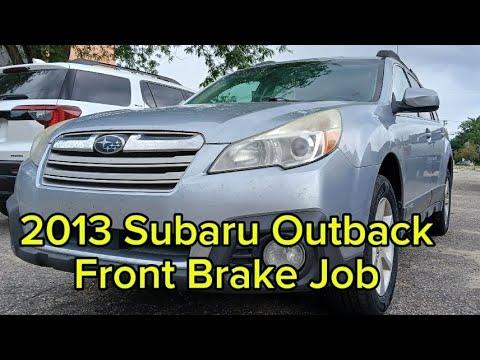







How to Replace Front Brake Pads & Rotors on a 2013 Subaru Outback (DIY Guide)
Step-by-step instructions with required tools/parts, torque specs, safety tips, and pad bed-in procedure for 2013, 2014
How to Replace Front Brake Pads & Rotors on a 2013 Subaru Outback (DIY Guide)
Step-by-step instructions with required tools/parts, torque specs, safety tips, and pad bed-in procedure for 2013, 2014


🔧 Outback - Front Brake Pads & Rotor Replacement
You’ll remove the front wheels, swap the brake pads, and replace the front rotors. This restores safe stopping power and fixes grinding, pulsation, or a worn-thin pad/rotor.
Difficulty Level: Intermediate | Estimated Time: 2-4 hours
⚠️ Safety & Precautions
- 🛑 Work on level ground and chock the rear wheels before lifting.
- 🛑 Support your Outback with jack stands; never rely on a jack.
- 🛑 Brake dust is harmful—use brake cleaner, not compressed air.
- 🛑 Do not let the caliper hang by the brake hose; it can damage the hose.
- 🛑 If brake fluid is near “MAX,” fluid may overflow when compressing pistons—check the reservoir first.
🔧 Required Tools
You'll need the following tools for this repair:
- Floor jack (rated 3-ton minimum)
- Jack stands (rated 3-ton minimum)
- Wheel chocks
- 19mm socket
- Breaker bar (1/2")
- Torque wrench (20–150 ft-lbs range)
- 14mm socket
- 17mm socket
- Ratchet (3/8")
- Ratchet (1/2")
- Flathead screwdriver
- C-clamp (6")
- Bungee cord
- Wire brush
- Rubber mallet
- Brake cleaner spray
- Shop rags
- Nitrile gloves
- Safety glasses
🔩 Required Parts
HowToo sells all the parts you need for this repair:
- Front brake pad set - Qty: 1
- Front brake rotors - Replace in pairs - Qty: 2
- Brake pad hardware kit (clips/shims) - Qty: 1
- High-temp silicone brake grease - Qty: 1
- Brake cleaner - Qty: 1
📋 Before You Begin
- 🚗 Park on level ground, leave the transmission in 1st gear, and set the parking brake.
- 🧱 Place wheel chocks behind both rear tires.
- 🧴 Open the hood and check the brake fluid level; if it’s at the top, siphon a little out with a clean turkey baster (optional) so it won’t overflow when you compress the pistons.
- 🔩 Break the front lug nuts loose about 1/2 turn with a 19mm socket and breaker bar before lifting.
🔨 Step-by-Step Instructions
Follow these steps in order:
Step 1: Lift and secure the front end
- Lift the front of your Outback using a floor jack (rated 3-ton minimum) at the proper front jacking point.
- Set it down onto jack stands (rated 3-ton minimum) placed at solid support points.
- Remove the front wheels using a 19mm socket and ratchet (1/2").
Step 2: Remove the brake caliper (do not disconnect the hose)
- Turn the steering wheel to give yourself space (left for right-side work, right for left-side work).
- Remove the two caliper slide bolts using a 14mm socket and ratchet (3/8").
- Lift the caliper off the bracket. Hang it from the strut spring using a bungee cord.
- Never let the caliper dangle by the hose.
Step 3: Remove the old pads and hardware
- Pull the inner and outer pads out by hand. If they’re stuck, gently pry with a flathead screwdriver.
- Remove the pad clips/hardware from the bracket (usually pulls out by hand). Keep note of how it sits.
Step 4: Remove the caliper bracket
- Remove the two caliper bracket bolts using a 17mm socket and breaker bar (1/2").
- Set the bracket aside.
- When reinstalling later: Torque to 80 Nm (59 ft-lbs) using a torque wrench (20–150 ft-lbs range).
Step 5: Remove the rotor
- Pull the rotor straight off the hub.
- If it’s stuck with rust, tap around the rotor “hat” with a rubber mallet until it breaks free.
- Clean rust from the hub face using a wire brush, then spray with brake cleaner spray and wipe with shop rags.
Step 6: Install the new rotor
- Spray both sides of the new rotor with brake cleaner spray and wipe with shop rags (this removes protective oil).
- Slide the new rotor onto the hub.
- To keep it from flopping while you work, thread on 1-2 lug nuts by hand (use your 19mm socket to snug lightly).
Step 7: Service the bracket and install new hardware
- Install the new pad clips/hardware into the bracket by hand.
- Apply a thin film of high-temp silicone brake grease where the pad “ears” touch the hardware (not on the pad friction surface).
- Reinstall the bracket and tighten the bolts with a 17mm socket and ratchet (1/2").
- Torque to 80 Nm (59 ft-lbs) using a torque wrench (20–150 ft-lbs range).
Step 8: Compress the caliper piston
- Place an old pad against the piston face, then compress the piston slowly using a C-clamp (6").
- A C-clamp is a screw clamp that pushes the piston back in evenly.
- Go slowly and watch the brake fluid reservoir as the level rises.
Step 9: Install the new pads and reinstall the caliper
- Install the new inner and outer pads into the bracket by hand.
- Lower the caliper over the new pads.
- Install the slide bolts using a 14mm socket and ratchet (3/8").
- Torque to 27 Nm (20 ft-lbs) using a torque wrench (20–150 ft-lbs range).
Step 10: Reinstall wheels
- Reinstall the wheels and hand-thread the lug nuts.
- Snug lug nuts in a star pattern using a 19mm socket and ratchet (1/2").
- Lower your Outback off the jack stands (rated 3-ton minimum) using the floor jack (rated 3-ton minimum).
- Torque to 120 Nm (88.5 ft-lbs) in a star pattern using a torque wrench (20–150 ft-lbs range) and 19mm socket.
✅ After Repair
- 🦶 Pump the brake pedal 10–15 times until it feels firm before moving the car.
- 🧴 Check brake fluid level and top off if needed (do not overfill).
- 🔍 Look for leaks and make sure both calipers move freely and nothing is rubbing.
- 🛣️ Bed-in the pads: make 8–10 moderate stops from ~40 mph down to ~10 mph, with cooling time between stops; avoid hard panic stops for the first 200 miles.
💰 DIY vs Shop Cost
Shop Cost: $450-$850 (parts + labor)
DIY Cost: $150-$350 (parts only)
You Save: $300-$500 by doing it yourself!
Shop labor rates vary but typically run $100-$150/hour. This repair takes a shop approximately 1.5-2.5 hours.
🎯 Ready to get started?
HowToo makes it easy: same-day/2-day shipping on every part, plus all the tools and specialty tools you need! Check out the parts and tools sections below to add everything to your cart.