

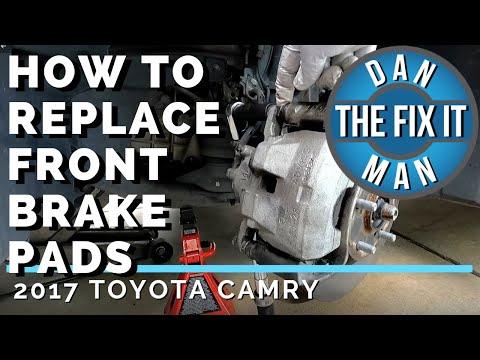






How to Replace Front Brake Pads on a 2017 Toyota Camry
Step-by-step instructions with tools, parts, torque specs, and safety tips for 2007, 2008, 2009, 2010, 2011, 2012, 2013, 2014, 2015, 2016, 2017
How to Replace Front Brake Pads on a 2017 Toyota Camry
Step-by-step instructions with tools, parts, torque specs, and safety tips for 2007, 2008, 2009, 2010, 2011, 2012, 2013, 2014, 2015, 2016, 2017


🔧 Front Brake Pads - Replacement
Your Camry uses a floating front caliper, so the job is to remove the caliper, swap the pads, and compress the caliper piston before reassembly. Since the pads wear down in pairs, replace both front sides at the same time for even braking.
Difficulty Level: Beginner | Estimated Time: 1.5-2.5 hours
⚠️ Safety & Precautions
- Work on a flat surface and keep the parking brake engaged.
- Use jack stands; never rely on a floor jack alone.
- Brake parts may be hot if the car was just driven.
- Do not press the brake pedal with the caliper removed.
- Support the caliper with wire or a hanger so the brake hose is not stretched.
- Brake dust can be harmful; avoid blowing it off with compressed air.
- No battery disconnect is required for this repair.
🔧 Required Tools
You'll need the following tools for this repair:
- Floor jack (rated 3-ton minimum)
- Jack stands
- Wheel chocks
- 21mm socket
- 14mm socket
- Ratchet
- Torque wrench
- Brake caliper compression tool (specialty)
- Flat blade screwdriver
- Wire hanger or bungee cord
- Wire brush
- Brake cleaner
- Gloves
- Safety glasses
🔩 Required Parts
HowToo sells all the parts you need for this repair:
- Front brake pad set - Qty: 1
- Brake caliper hardware kit - Qty: 1
- Brake grease - Qty: 1
📋 Before You Begin
- Park on level ground and chock the rear wheels.
- Loosen the front lug nuts slightly before lifting the car.
- If the brake fluid reservoir is very full, remove a small amount before compressing the piston.
- Keep the old pads nearby to compare thickness.
🔨 Step-by-Step Instructions
Follow these steps in order:
Step 1: Lift and remove the wheel
- Use the 21mm socket to loosen the front lug nuts, then raise the front of the car with the floor jack.
- Place the car securely on jack stands.
- Remove the lug nuts and wheel.
- Keep lug nuts in a clean spot.
Step 2: Remove the caliper
- Use the 14mm socket to remove the two caliper slide pin bolts.
- Lift the caliper off the bracket carefully.
- Hang the caliper with a wire hanger or bungee cord.
- Torque on reassembly: 34 Nm (25 ft-lbs)
Step 3: Remove the old pads and hardware
- Pull the inner and outer pads out of the bracket.
- Remove the pad clips and hardware from the bracket.
- Use the wire brush to clean rust and buildup from the pad contact points.
- Spray the cleaned areas with brake cleaner.
Step 4: Compress the caliper piston
- Use the brake caliper compression tool (specialty) to push the piston fully back into the caliper.
- Go slow and make sure the brake fluid reservoir does not overflow.
- Press evenly to avoid damaging the piston.
Step 5: Install new hardware and pads
- Install the new pad clips from the brake pad set or brake caliper hardware kit.
- Apply a thin layer of brake grease to the pad ears and contact points only.
- Install the new inner and outer pads into the bracket.
- Make sure the pads sit fully in the clips.
Step 6: Reinstall the caliper
- Slide the caliper back over the new pads.
- Install the two caliper slide pin bolts using the 14mm socket.
- Torque to 34 Nm (25 ft-lbs)
Step 7: Reinstall the wheel
- Put the wheel back on and start all lug nuts by hand.
- Lower the car enough so the tire touches the ground, then use the torque wrench and 21mm socket to tighten the lug nuts in a star pattern.
- Torque to 103 Nm (76 ft-lbs)
Step 8: Repeat on the other side
- Do the same repair on the opposite front brake.
- Replace pads in pairs for even braking.
✅ After Repair
- Before moving the car, pump the brake pedal several times until it feels firm.
- Check the brake fluid level and top off if needed.
- Test the brakes at low speed first.
- Listen for abnormal scraping or clicking.
- New pads need a short break-in period.
💰 DIY vs Shop Cost
Shop Cost: $250-$450 (parts + labor)
DIY Cost: $60-$140 (parts only)
You Save: $190-$310 by doing it yourself!
Shop labor rates vary but typically run $100-$150/hour. This repair takes a shop approximately 1.5-2.5 hours.
🎯 Ready to get started?
HowToo makes it easy: same-day/2-day shipping on every part, plus all the tools and specialty tools you need! Check out the parts and tools sections below to add everything to your cart.