

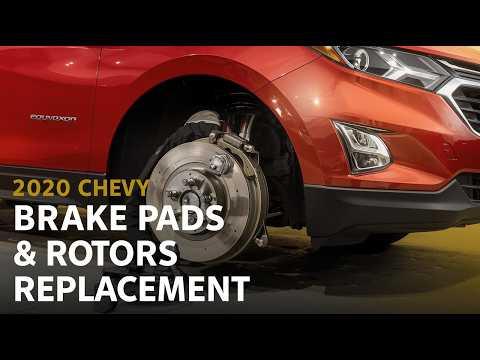






How to Replace Front Brake Pads and Rotors on a 2020 Chevrolet Equinox
Step-by-step DIY front brake job with tools, parts list, torque specs, safety tips, and cost comparison for 2018, 2019, 2020
How to Replace Front Brake Pads and Rotors on a 2020 Chevrolet Equinox
Step-by-step DIY front brake job with tools, parts list, torque specs, safety tips, and cost comparison for 2018, 2019, 2020


🔧 Equinox - Front Brake Pads & Rotors Replacement
You'll be replacing the front brake pads and brake rotors on your Equinox. This restores braking power, reduces vibration, and prevents metal-on-metal damage.
Difficulty Level: Beginner/Intermediate | Estimated Time: 2–3 hours
⚠️ Safety & Precautions
- 🛑 Always support the vehicle with jack stands; never rely only on a jack.
- 🛑 Work on a flat, solid surface so the vehicle cannot roll or shift.
- 🛑 Wear safety glasses and mechanic gloves; brake dust and metal edges can injure you.
- 🛑 Do one side at a time so you can look at the other side as a reference.
- 🛑 Do not press the brake pedal when a caliper is removed; it can push the piston out.
- 🛑 Keep grease and oil off the friction surfaces of pads and rotors.
- 🛑 No battery disconnect is required for front brakes on your Equinox.
🔧 Required Tools
You'll need the following tools for this repair:
- 🧰 Floor jack (rated 3-ton minimum)
- 🧰 Jack stands (rated 3-ton minimum), Qty: 2
- 🧰 Wheel chocks
- 🧰 Lug nut wrench or 22mm socket with breaker bar
- 🧰 13mm socket
- 🧰 18mm socket
- 🧰 Ratchet (3/8" drive)
- 🧰 Breaker bar (1/2" drive)
- 🧰 Torque wrench (ft-lbs scale, up to 150 ft-lbs)
- 🧰 C-clamp (6" or larger) or disc brake caliper piston tool
- 🧰 Flathead screwdriver (medium size)
- 🧰 Bungee cord or strong wire hanger
- 🧰 Wire brush
- 🧰 Shop rags
- 🧰 Brake cleaner spray
- 🧰 Small nylon or brass brush
- 🧰 Rubber mallet
- 🧰 Pick tool or small flat screwdriver
- 🧰 Safety glasses
- 🧰 Mechanic gloves
🔩 Required Parts
HowToo sells all the parts you need for this repair:
- 🔩 Front brake pad set (left and right) - Qty: 1 set (replace in pairs)
- 🔩 Front brake rotors - Qty: 2 (replace in pairs)
- 🔩 Front brake hardware kit (pad abutment clips / anti-rattle clips) - Qty: 1 set
- 🔩 High-temperature silicone brake grease - Qty: 1 tube
- 🔩 Brake cleaner - Qty: 1–2 cans
- 🔩 Penetrating oil spray - Qty: 1 (for rusty rotor/hub)
- 🔩 Shop towels - Qty: As needed
📋 Before You Begin
- 🚗 Park the Equinox on level ground, put the transmission in PARK, and set the parking brake.
- 🧱 Place wheel chocks behind the rear wheels so the vehicle cannot roll.
- 📦 Lay out your new pads, rotors, and hardware so you know where everything is.
- 🧴 Loosen (but do not remove) both front wheel lug nuts slightly before lifting the vehicle.
- 🧯 Keep a small water spray bottle or extinguisher nearby as a general shop safety habit.
🔨 Step-by-Step Instructions
Follow these steps in order:
Step 1: Loosen Front Wheel Lug Nuts
- Use the lug nut wrench or 22mm socket with breaker bar to loosen each front wheel lug nut about one turn while the vehicle is still on the ground.
- Do not remove the lug nuts yet; only break them loose.
- Loosening on the ground prevents the wheel from spinning.
Step 2: Lift and Support the Front of the Vehicle
- Position the floor jack under the front center jacking point or under the recommended front subframe area per your owner’s manual.
- Raise the front of the Equinox until both front wheels are off the ground.
- Place jack stands under the proper front pinch welds or frame points on both sides and slowly lower the vehicle onto the stands with the floor jack.
- Gently rock the vehicle by hand to confirm it is stable on the jack stands.
Step 3: Remove Front Wheels
- Use the 22mm socket and ratchet or lug wrench to remove the loosened lug nuts from one front wheel.
- Remove the wheel and set it aside.
- Repeat for the other front wheel once you finish one side, or remove both wheels now if you are comfortable.
Step 4: Inspect the Brake Assembly
- Look at the brake caliper (the clamp-shaped part), the pads (between caliper and rotor), and the rotor (the big disc).
- Note how the pads sit in the bracket and how the anti-rattle/abutment clips are installed; you will match this with the new hardware.
- Take a quick photo with your phone for reference.
Step 5: Remove Caliper Guide Pin Bolts
- On one side, locate the two small bolts on the back of the caliper (guide pin bolts).
- Use a 13mm socket and ratchet to loosen and remove the upper and lower guide pin bolts.
- Set the bolts aside in a clean place.
Step 6: Remove and Support the Caliper
- Use a flathead screwdriver to gently pry the caliper away from the rotor if needed.
- Lift the caliper off the pads and rotor.
- Use a bungee cord or wire hanger to hang the caliper from the spring or strut so that it is not hanging by the rubber brake hose.
- Never let the caliper dangle from the brake hose.
Step 7: Remove Old Brake Pads and Hardware
- Slide the inner and outer brake pads out of the caliper bracket by hand.
- Use a pick tool or small flat screwdriver to remove the metal abutment/anti-rattle clips from the caliper bracket.
- Note the position and shape; they must be reinstalled in the same orientation with the new hardware.
Step 8: Remove Caliper Bracket
- Locate the two larger bolts on the back of the steering knuckle that hold the caliper bracket.
- Use an 18mm socket with breaker bar to loosen and remove these two caliper bracket bolts.
- Remove the caliper bracket and set it on a clean surface.
- Torque on reassembly: 170 Nm (125 ft-lbs)
Step 9: Remove the Old Rotor
- If the rotor is stuck due to rust, spray a little penetrating oil where the rotor meets the hub.
- Let it soak for a few minutes, then tap around the rotor hat (center area) with a rubber mallet to loosen it.
- Slide the rotor straight off the hub.
Step 10: Clean Hub Surface
- Use a wire brush to clean the face of the hub where the rotor sits; remove rust and debris.
- Wipe with a shop rag and a bit of brake cleaner so the new rotor sits flat.
- A clean hub prevents brake pulsation later.
Step 11: Install New Rotor
- Spray the new rotor friction surfaces with brake cleaner to remove any protective oil, then dry with a clean rag.
- Place the new rotor onto the hub, aligning the bolt holes.
- You can temporarily install one lug nut by hand to hold the rotor flush while you work.
Step 12: Service Caliper Slide Pins
- Take the caliper bracket you removed earlier.
- Pull the two slide pins (also called guide pins) out of the bracket by hand; note which pin goes top and bottom.
- Clean old grease and dirt off the pins with a shop rag and a little brake cleaner.
- Apply a thin, even coat of high-temperature silicone brake grease to each pin and reinsert them into the bracket boots; make sure they move smoothly.
Step 13: Install New Pad Hardware
- Use a wire brush or small nylon/brass brush to clean the pad contact areas on the caliper bracket where the clips sit.
- Snap the new abutment/anti-rattle clips from your hardware kit into the same locations on the bracket.
- Apply a very light film of brake grease to the surfaces of the clips where the pad “ears” will touch. Do not get grease on pad friction material.
Step 14: Reinstall Caliper Bracket
- Position the caliper bracket over the new rotor and line up the bolt holes.
- Install the two caliper bracket bolts by hand to avoid cross-threading.
- Use the 18mm socket and ratchet to snug them, then use a torque wrench with 18mm socket to tighten to 170 Nm (125 ft-lbs).
Step 15: Install New Brake Pads
- Compare new pads to old ones to confirm shape and size match.
- Apply a thin layer of brake grease to the pad ears (the small tabs that sit in the clips) and to the backing plate where it contacts the caliper/piston; keep grease off the friction surface.
- Slide the inner and outer pads into the new clips in the bracket. They should move freely but fit snugly.
Step 16: Compress the Caliper Piston
- Take the hanging caliper and position an old brake pad against the piston face.
- Use a C-clamp or disc brake caliper piston tool to slowly push the piston back into the caliper housing until it is fully seated.
- Go slowly and check that the rubber boot around the piston does not pinch or tear.
- Compressing makes room for the thicker new pads.
Step 17: Reinstall the Caliper Over New Pads
- Position the caliper over the new pads and caliper bracket.
- Align the slide pin holes with the threaded holes in the bracket.
- Install the slide pin bolts by hand to avoid cross-threading.
- Use a 13mm socket and ratchet to tighten both guide pin bolts, then torque them with a torque wrench to 32 Nm (24 ft-lbs).
Step 18: Repeat on the Other Side
- Repeat Steps 5–17 on the other front wheel.
- Ensure both sides have new pads, rotors, and hardware installed the same way.
Step 19: Reinstall Front Wheels
- Place the wheel back onto the hub, lining up the holes.
- Install the lug nuts by hand and snug them in a star pattern using the 22mm socket and ratchet.
Step 20: Lower Vehicle and Torque Lug Nuts
- Use the floor jack to raise the vehicle slightly, remove the jack stands, then lower the vehicle fully to the ground.
- Use a torque wrench with 22mm socket to tighten the lug nuts in a star pattern to 140 Nm (103 ft-lbs).
Step 21: Pump Brake Pedal
- Sit in the driver’s seat and slowly press and release the brake pedal several times until it feels firm.
- This seats the pads against the rotors and takes up the gap from the compressed pistons.
✅ After Repair
- 🚦 Start the engine and press the brake pedal again to confirm it feels solid and does not sink.
- 🛻 Perform a short test drive in a safe area: make several gentle stops from low speeds to confirm there are no noises, pulling, or vibrations.
- 🧊 New pads and rotors need to be “bedded in”: for the first 200–300 km, avoid hard panic stops unless necessary and avoid riding the brakes.
- 🔍 After the test drive, check around the front wheels for any obvious leaks or loose hardware, and recheck lug nut torque once the brakes have cooled.
💰 DIY vs Shop Cost
Shop Cost: $450–$650 (parts + labor)
DIY Cost: $160–$260 (parts only)
You Save: $290–$390 by doing it yourself!
Shop labor rates vary but typically run $100–$150/hour. This repair takes a shop approximately 1.5–2.0 hours.
🎯 Ready to get started?
HowToo makes it easy: same-day/2-day shipping on every part, plus all the tools and specialty tools you need! Check out the parts and tools sections above to add everything to your cart.