

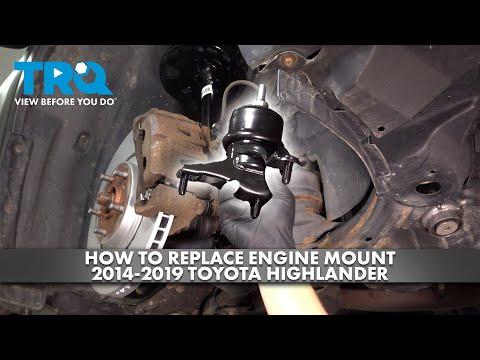



How to Replace Engine Mounts on a 2014-2019 Toyota Highlander (Engine: Inline 4 2.7L)
Step-by-step guide with tools, parts, torque specs, and safety tips for 2014, 2015, 2016, 2017, 2018, 2019
How to Replace Engine Mounts on a 2014-2019 Toyota Highlander (Engine: Inline 4 2.7L)
Step-by-step guide with tools, parts, torque specs, and safety tips for 2014, 2015, 2016, 2017, 2018, 2019


🔧 Highlander - Rear Window Regulator Replacement
This repair replaces a failed rear door window regulator, which is the scissor/cable mechanism that moves the glass up and down inside the door. On your Highlander, the rear regulator is serviced from inside the rear door after removing the interior door trim panel and carefully supporting the glass.
Difficulty Level: Intermediate | Estimated Time: 1.5-2.5 hours per door
⚠️ Safety & Precautions
- ⚠️ Disconnect the negative battery cable before unplugging door electrical connectors.
- ⚠️ Wear safety glasses and gloves; the inside of the door has sharp metal edges.
- ⚠️ Support the window glass before removing the regulator bolts. The glass can drop suddenly and break.
- ⚠️ Do not turn the ignition ON while door connectors are unplugged.
- ⚠️ Work slowly around the door panel clips so the trim panel does not crack.
🔧 Required Tools
You'll need the following tools for this repair:
- 10mm socket
- Ratchet handle
- 6-inch extension
- Phillips #2 screwdriver
- Plastic trim removal tool set
- Small flat-blade screwdriver
- Panel clip pliers
- Painter’s tape 2-inch wide
- Pick tool
- Torque wrench 1/4-inch drive
- Work light
- Safety glasses
- Mechanic gloves
🔩 Required Parts
HowToo sells all the parts you need for this repair:
- Rear window regulator - Qty: 1 per door
- Rear window regulator with motor assembly - Qty: 1 per door if motor is included or failed
- Rear door trim panel clips - Qty: 4-8 recommended
- Butyl sealing tape - Qty: 1 roll if vapor barrier adhesive is damaged
📋 Before You Begin
- Park your Highlander on level ground and set the parking brake.
- Lower or raise the affected rear window until the glass-to-regulator bolts are visible through the door access holes, if the motor still works.
- If the window does not move, you may need to access the bolts after removing the door panel and carefully move the glass by hand.
- Disconnect the negative battery cable using a 10mm socket.
- A “vapor barrier” is the clear plastic sheet behind the door panel. It keeps rainwater from reaching the cabin, so do not tear it.
🔨 Step-by-Step Instructions
Follow these steps in order:
Step 1: Remove the rear door switch panel
- Use a plastic trim removal tool set to gently lift the rear power window switch panel from the armrest.
- Use a small flat-blade screwdriver to press the connector tab, then unplug the switch connector.
- Tip: Pry gently from the rear edge.
Step 2: Remove hidden screws from the door panel
- Use a small flat-blade screwdriver or pick tool to open the small trim covers in the pull handle and door handle area.
- Use a Phillips #2 screwdriver to remove the exposed screws.
- Place the screws in a cup or tray so they do not get lost.
Step 3: Release the rear door trim panel
- Use a plastic trim removal tool set at the lower edge of the door panel.
- Pop the clips loose one at a time around the sides and bottom of the panel.
- Use panel clip pliers if a clip stays stuck in the door.
- Lift the panel straight upward to unhook it from the window ledge.
Step 4: Disconnect cables and connectors
- Use your hands to unclip the interior door handle cable and lock cable from the back of the trim panel.
- Use a small flat-blade screwdriver only if a connector lock is tight.
- Set the door panel on a clean towel or soft surface.
Step 5: Peel back the vapor barrier
- Use a plastic trim removal tool set to slowly separate the vapor barrier from the black butyl adhesive.
- Peel it back only far enough to access the regulator and motor.
- If the butyl stretches, use the pick tool to guide it back onto the door.
- Tip: Do not cut the plastic sheet.
Step 6: Support the window glass
- Use painter’s tape 2-inch wide to tape the glass to the outside top of the door frame.
- Apply at least 3 vertical strips from the glass over the top of the frame.
- Press the tape firmly so the glass cannot slide down.
Step 7: Remove the glass-to-regulator bolts
- Use a work light to locate the two glass clamp bolts through the access holes.
- Use a 10mm socket, 6-inch extension, and ratchet handle to loosen and remove the two bolts that attach the glass to the regulator.
- Carefully slide the glass fully upward by hand and add more painter’s tape 2-inch wide if needed.
Step 8: Unplug the window motor
- Use a small flat-blade screwdriver to release the lock tab on the rear window motor connector.
- Pull the connector straight out by the plug body, not by the wires.
Step 9: Remove the old regulator assembly
- Use a 10mm socket, 6-inch extension, and ratchet handle to remove the regulator mounting bolts.
- If the motor is separate from the replacement regulator, use a 10mm socket to remove the motor mounting bolts and transfer the motor.
- Guide the regulator out through the large door opening.
- Tip: Take a photo before removal.
Step 10: Install the new regulator
- Feed the new rear window regulator into the door through the large opening.
- Use your hand to start all mounting bolts before tightening.
- Use a 10mm socket and torque wrench 1/4-inch drive to tighten regulator mounting bolts to Torque to 8 Nm (71 in-lbs).
- If installing the motor separately, tighten motor mounting bolts to Torque to 5.4 Nm (48 in-lbs).
Step 11: Reconnect the motor and test movement briefly
- Reconnect the window motor plug by hand until it clicks.
- Reconnect the negative battery cable using a 10mm socket.
- Temporarily plug in the window switch by hand.
- Move the regulator until the glass mounting points line up with the access holes.
- Disconnect the negative battery cable again using a 10mm socket before placing hands inside the door.
Step 12: Attach the glass to the regulator
- Carefully remove enough painter’s tape 2-inch wide to lower the glass by hand onto the regulator clamps.
- Use a 10mm socket and ratchet handle to start the glass bolts by hand first.
- Use a 10mm socket and torque wrench 1/4-inch drive to tighten the glass bolts to Torque to 8 Nm (71 in-lbs).
- Do not overtighten. Glass can crack from too much force.
Step 13: Re-seal the vapor barrier
- Use your fingers and a plastic trim removal tool set to press the vapor barrier back into the butyl adhesive.
- If the adhesive no longer seals, apply butyl sealing tape around the opening.
- Make sure all wiring passes through the correct openings.
Step 14: Reinstall the rear door trim panel
- Reconnect the door handle and lock cables by hand.
- Reconnect electrical connectors by hand until they click.
- Hang the panel over the top window ledge.
- Use your palm to press around the panel edges and seat the clips.
- Use a Phillips #2 screwdriver to reinstall the door panel screws.
- Snap the trim covers and switch panel back into place by hand.
Step 15: Final battery connection
- Use a 10mm socket to reconnect and snug the negative battery cable.
- Do not overtighten the battery terminal clamp.
✅ After Repair
- ✅ Turn the ignition ON and operate the repaired rear window fully down and fully up several times.
- ✅ Check that the glass moves smoothly and does not tilt, bind, or rattle.
- ✅ Confirm the rear window switch and driver master switch both operate the repaired window.
- ✅ Check the door lock, inside handle, outside handle, and speaker operation.
- ✅ If the window auto function needs relearning, hold the switch down until fully open, then hold it up until fully closed and keep holding for about 2 seconds.
- ✅ Spray a small amount of water on the outside of the window and confirm no water enters past the vapor barrier into the cabin.
💰 DIY vs Shop Cost
Shop Cost: $350-$650 per rear door (parts + labor)
DIY Cost: $90-$250 per rear door (parts only)
You Save: $260-$400 by doing it yourself!
Shop labor rates vary but typically run $100-$150/hour. This repair takes a shop approximately 1.0-1.8 hours per door.
🎯 Ready to get started?
HowToo makes it easy: same-day/2-day shipping on every part, plus all the tools and specialty tools you need! Check out the parts and tools sections below to add everything to your cart.
🔧 Highlander - Engine Mount Replacement
Engine mounts hold the engine in place and absorb vibration. On your Highlander, replacing them means safely supporting the engine, removing the failed mount, and installing the new one without letting the engine shift.
Difficulty Level: Advanced | Estimated Time: 3-5 hours
⚠️ Safety & Precautions
- ⚠️ Support the engine before removing any mount. Never rely on the mount bolts to hold engine weight while loose.
- ⚠️ Use a wood block between the jack and engine oil pan to spread the load and avoid cracking the pan.
- ⚠️ Do not lift the engine high. Raise it only enough to remove mount tension.
- ⚠️ Support your Highlander with jack stands if lifting the vehicle. Never work under a vehicle supported only by a jack.
- ⚠️ Disconnect the negative battery cable before working near the starter, alternator wiring, or engine harness brackets.
- ⚠️ Keep hands clear between the engine and body brackets while raising or lowering the engine.
🔧 Required Tools
You'll need the following tools for this repair:
- 10mm socket
- 12mm socket
- 14mm socket
- 17mm socket
- 19mm socket
- 21mm socket
- Ratchet handle 3/8-inch drive
- Ratchet handle 1/2-inch drive
- Breaker bar 1/2-inch drive
- Torque wrench 3/8-inch drive
- Torque wrench 1/2-inch drive
- 6-inch extension 3/8-inch drive
- 6-inch extension 1/2-inch drive
- Universal joint socket adapter 3/8-inch drive
- Floor jack rated 3-ton minimum
- Jack stands rated 3-ton minimum
- Wheel chocks
- Wood block 2x6-inch
- Trim clip removal tool
- Flat-blade screwdriver 1/4-inch
- Pry bar 18-inch
- Work light
- Paint marker
- Safety glasses
- Mechanic gloves
🔩 Required Parts
HowToo sells all the parts you need for this repair:
- Right engine mount - Qty: 1
- Left transaxle mount - Qty: 1 if failed
- Front engine mount - Qty: 1 if failed
- Rear engine mount - Qty: 1 if failed
- Engine mount fasteners - Qty: As needed if corroded or damaged
- Plastic splash shield clips - Qty: 4-8 recommended
📋 Before You Begin
- Park your Highlander on a flat surface, shift to Park, and set the parking brake.
- Place wheel chocks behind the rear wheels.
- Open the hood and let the engine cool completely.
- Use a 10mm socket to disconnect the negative battery cable.
- Use a paint marker to mark each mount’s position before removal. This helps line up the new mount.
- A “transaxle” is the transmission and front differential combined into one unit on your front-wheel-drive Highlander.
- A “breaker bar” is a long handle used to loosen tight bolts with more leverage.
🔨 Step-by-Step Instructions
Follow these steps in order:
Step 1: Raise and secure the front of the vehicle
- Use a floor jack rated 3-ton minimum at the front center jacking point.
- Place jack stands rated 3-ton minimum under the front side support points.
- Lower your Highlander gently onto the jack stands.
- Leave the floor jack nearby for supporting the engine later.
Step 2: Remove the lower splash shield
- Use a trim clip removal tool to remove the plastic clips from the lower engine splash shield.
- Use a 10mm socket and ratchet handle 3/8-inch drive to remove any shield bolts.
- Lower the shield and set it aside.
Step 3: Support the engine
- Place a wood block 2x6-inch on the saddle of the floor jack rated 3-ton minimum.
- Position the wood block under a strong flat area of the engine oil pan.
- Raise the jack until the block just touches the oil pan.
- Lift only slightly to take weight off the mount. Do not lift the vehicle off the jack stands.
- Tip: Small jack movements are safest.
Step 4: Replace the right engine mount
- Use a 10mm socket and ratchet handle 3/8-inch drive to move any small wire brackets or hose brackets attached near the mount.
- Use a paint marker to mark the mount position on the body bracket.
- Use a 17mm socket, breaker bar 1/2-inch drive, and 6-inch extension 1/2-inch drive to loosen the mount through-bolt and bracket bolts.
- Use a 17mm socket and ratchet handle 1/2-inch drive to remove the bolts after they are loose.
- Use the floor jack rated 3-ton minimum to raise or lower the engine slightly until the mount slides free.
- Install the new right engine mount by hand-starting every bolt before tightening.
- Use a 17mm socket and torque wrench 1/2-inch drive to tighten mount bracket bolts to Torque to 64 Nm (47 ft-lbs).
- Use a 17mm socket and torque wrench 1/2-inch drive to tighten the through-bolt to Torque to 95 Nm (70 ft-lbs).
Step 5: Replace the left transaxle mount if needed
- Move the floor jack rated 3-ton minimum and wood block 2x6-inch under the transaxle case, not under a thin cover.
- Raise the jack only until the transaxle is supported.
- Use a 10mm socket or 12mm socket and ratchet handle 3/8-inch drive to remove any nearby brackets blocking access.
- Use a paint marker to mark the mount position.
- Use a 17mm socket, 19mm socket, breaker bar 1/2-inch drive, and 6-inch extension 1/2-inch drive to loosen the transaxle mount bolts.
- Use a 17mm socket or 19mm socket and ratchet handle 1/2-inch drive to remove the bolts.
- Lift or lower the transaxle slightly with the jack until the mount can be removed.
- Install the new left transaxle mount and hand-start every bolt.
- Use a 17mm socket or 19mm socket and torque wrench 1/2-inch drive to tighten mount bolts to Torque to 64 Nm (47 ft-lbs).
- Use a 19mm socket and torque wrench 1/2-inch drive to tighten the through-bolt to Torque to 95 Nm (70 ft-lbs).
Step 6: Replace the front engine mount if needed
- Keep the engine supported with the floor jack rated 3-ton minimum and wood block 2x6-inch.
- Use a work light to view the front mount from underneath.
- Use a 17mm socket, breaker bar 1/2-inch drive, and universal joint socket adapter 3/8-inch drive if access is angled.
- Remove the front mount through-bolt and mount-to-frame bolts using a 17mm socket and ratchet handle 1/2-inch drive.
- Use a pry bar 18-inch gently only to align the mount holes. Do not pry on rubber sections.
- Install the new front engine mount and hand-start all bolts.
- Use a 17mm socket and torque wrench 1/2-inch drive to tighten mount-to-frame bolts to Torque to 64 Nm (47 ft-lbs).
- Use a 17mm socket and torque wrench 1/2-inch drive to tighten the through-bolt to Torque to 95 Nm (70 ft-lbs).
Step 7: Replace the rear engine mount if needed
- Use a work light to locate the rear mount at the back side of the engine/transaxle assembly.
- Use a 14mm socket, 17mm socket, 6-inch extension 1/2-inch drive, and universal joint socket adapter 3/8-inch drive for access.
- Use a breaker bar 1/2-inch drive to loosen the rear mount through-bolt and bracket bolts.
- Use a ratchet handle 1/2-inch drive to remove the bolts after they are loose.
- Use the floor jack rated 3-ton minimum to move the engine slightly if the bolt is binding.
- Install the new rear engine mount and hand-start every bolt before tightening.
- Use a 17mm socket and torque wrench 1/2-inch drive to tighten mount bracket bolts to Torque to 64 Nm (47 ft-lbs).
- Use a 17mm socket and torque wrench 1/2-inch drive to tighten the through-bolt to Torque to 95 Nm (70 ft-lbs).
Step 8: Settle the engine before final checks
- Use the floor jack rated 3-ton minimum to slowly lower the engine or transaxle until its weight rests fully on the new mounts.
- Use a torque wrench 1/2-inch drive with the correct sockets to recheck all mount fasteners.
- Use a work light to confirm no hoses, wiring, or brackets are pinched.
Step 9: Reinstall the lower splash shield
- Lift the splash shield into position by hand.
- Use a 10mm socket and ratchet handle 3/8-inch drive to reinstall the shield bolts.
- Use a trim clip removal tool or your fingers to install new plastic splash shield clips if old clips broke.
- Tighten splash shield bolts snugly only; they are small fasteners.
Step 10: Lower the vehicle and reconnect the battery
- Use a floor jack rated 3-ton minimum to lift your Highlander slightly off the jack stands.
- Remove the jack stands rated 3-ton minimum.
- Lower the vehicle slowly to the ground.
- Use a 10mm socket to reconnect the negative battery cable.
✅ After Repair
- ✅ Start the engine and let it idle while listening for clunks, rattles, or new vibration.
- ✅ With your foot firmly on the brake, shift from Park to Reverse and Drive. The engine should not jump excessively.
- ✅ Test drive slowly first, then check for vibration during acceleration and braking.
- ✅ Recheck the mount area with a work light after the test drive for loose brackets or shifted wiring.
- ✅ If the idle feels rough after battery disconnect, drive normally for 10-15 minutes so the throttle idle can relearn.
💰 DIY vs Shop Cost
Shop Cost: $750-$1,600 depending on how many mounts are replaced
DIY Cost: $180-$650 depending on mount count and brand
You Save: $570-$950 by doing it yourself!
Shop labor rates vary but typically run $100-$150/hour. This repair takes a shop approximately 3-5 hours.
🎯 Ready to get started?
HowToo makes it easy: same-day/2-day shipping on every part, plus all the tools and specialty tools you need! Check out the parts and tools sections below to add everything to your cart.