
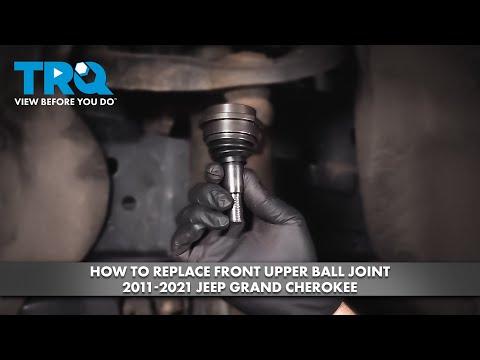







How to Replace Ball Joints on a 2011-2015 Jeep Grand Cherokee
Step-by-step front upper control arm and lower ball joint guide with tools, parts, and safety tips for 2011, 2012, 2013, 2014, 2015
How to Replace Ball Joints on a 2011-2015 Jeep Grand Cherokee
Step-by-step front upper control arm and lower ball joint guide with tools, parts, and safety tips for 2011, 2012, 2013, 2014, 2015


🔧 Grand Cherokee - Front Ball Joint Replacement
This guide covers replacing the front upper and lower ball joints on your Grand Cherokee. On this suspension, the upper ball joint is normally serviced with the upper control arm, while the lower ball joint is pressed into the steering knuckle.
Assumption: This is for front suspension ball joints on a stock Grand Cherokee.
Difficulty Level: Advanced | Estimated Time: 4-6 hours
⚠️ Safety & Precautions
- ⚠️ Support your Grand Cherokee only on jack stands. Never work under a vehicle held up by a jack alone.
- ⚠️ The front coil spring/strut carries load. Do not loosen strut-to-body or spring hardware for this repair.
- ⚠️ Ball joint separation can release suddenly. Keep hands and face away from the joint while using a separator.
- ⚠️ Disconnecting the battery is not normally required for this repair.
- ⚠️ A wheel alignment is required after replacing upper control arms or disturbing suspension geometry.
- ⚠️ If your Grand Cherokee has air suspension, set it to normal ride height before lifting and do not place body parts under unsupported suspension components.
🔧 Required Tools
You'll need the following tools for this repair:
- Floor jack (rated 3-ton minimum)
- Jack stands (rated 3-ton minimum)
- Wheel chocks
- Safety glasses
- Mechanic gloves
- 1/2-inch drive breaker bar
- 1/2-inch drive torque wrench (up to 200 ft-lbs)
- 3/8-inch drive ratchet
- Metric socket set 10mm-24mm
- Metric wrench set 10mm-24mm
- 21mm socket
- 22mm socket
- 24mm socket
- 18mm wrench
- 21mm wrench
- 22mm wrench
- Flat-blade screwdriver
- Needle-nose pliers
- Ball joint separator (specialty)
- Ball joint press kit with Jeep adapters (specialty)
- Hammer 3-lb dead blow
- Pry bar 24-inch
- Paint marker
- Wire brush
🔩 Required Parts
HowToo sells all the parts you need for this repair:
- Front upper control arm with ball joint - Left: Qty: 1
- Front upper control arm with ball joint - Right: Qty: 1
- Front lower ball joint - Qty: 2
- Front lower ball joint retaining clips - Qty: 2
- New ball joint cotter pins - Qty: 4
- Replacement suspension nuts/bolts as required - Qty: 1 set
- Anti-seize compound - Qty: 1
📋 Before You Begin
- Park your Grand Cherokee on level ground.
- Set the parking brake and place wheel chocks behind the rear wheels.
- Loosen the front wheel lug nuts slightly before lifting the vehicle.
- If equipped with air suspension, keep the system at normal ride height before jacking.
- Take pictures before disassembly. This helps with reassembly.
- Mark bolt positions with a paint marker before removal. A paint marker leaves a visible reference line.
🔨 Step-by-Step Instructions
Follow these steps in order:
Step 1: Lift and Support the Front
- Use a 21mm socket and 1/2-inch drive breaker bar to loosen the front lug nuts 1/2 turn.
- Use the floor jack to lift the front of your Grand Cherokee at the proper front lift point.
- Place jack stands under the approved support points.
- Lower the vehicle gently onto the jack stands.
- Use a 21mm socket to remove the lug nuts and wheels.
- Shake vehicle gently to confirm stability.
Step 2: Remove Brake Caliper and Rotor
- Use the correct metric socket to remove the brake caliper bracket bolts.
- Lift the caliper and bracket off the rotor as one assembly.
- Use mechanic wire or a bungee cord to hang the caliper from the suspension.
- Do not let the caliper hang by the brake hose.
- Slide the brake rotor off by hand. If stuck, tap lightly with the 3-lb dead blow hammer.
Step 3: Disconnect ABS Wire and Brake Hose Brackets
- Use a 10mm socket or matching metric socket to remove any ABS wire or brake hose bracket bolts attached to the control arm or knuckle.
- Move the wire and hose aside carefully.
- A knuckle is the large metal steering part that the wheel hub and ball joints attach to.
Step 4: Separate the Upper Ball Joint
- Use needle-nose pliers to remove the cotter pin from the upper ball joint castle nut.
- A castle nut is a slotted nut that uses a cotter pin to keep it from loosening.
- Use a metric socket or metric wrench to loosen the upper ball joint nut.
- Leave the nut threaded on a few turns for safety.
- Use a ball joint separator to separate the upper ball joint from the steering knuckle.
- Once separated, remove the nut fully using the same metric socket or metric wrench.
Step 5: Remove the Upper Control Arm
- Use a paint marker to mark the position of the upper control arm mounting bolts.
- Use metric sockets and metric wrenches to remove the two upper control arm mounting bolts.
- Remove the upper control arm from the vehicle.
- Install the new front upper control arm with ball joint in the same orientation.
- Start both mounting bolts by hand first.
- Do not fully tighten the inner control arm bolts yet.
- Final tightening must happen at ride height.
Step 6: Separate the Lower Ball Joint
- Use needle-nose pliers to remove the cotter pin from the lower ball joint nut.
- Use a metric socket or metric wrench to loosen the lower ball joint nut.
- Leave the nut threaded on a few turns for safety.
- Use the ball joint separator to separate the lower ball joint from the lower control arm.
- Remove the nut fully using the same metric socket or metric wrench.
Step 7: Remove the Steering Knuckle
- Use the correct metric socket to remove the tie rod end nut if extra knuckle movement is needed.
- Use the ball joint separator to separate the tie rod end from the steering knuckle.
- Support the steering knuckle by hand while separating it from the lower control arm.
- Set the knuckle on a sturdy work surface.
Step 8: Press Out the Lower Ball Joint
- Use a flat-blade screwdriver or needle-nose pliers to remove the lower ball joint retaining clip.
- Use a wire brush to clean dirt and rust around the ball joint bore.
- A ball joint bore is the round hole the ball joint presses into.
- Set up the ball joint press kit with Jeep adapters so the receiver cup supports the knuckle and leaves room for the old joint to exit.
- Use the 1/2-inch drive breaker bar to press the old lower ball joint out of the knuckle.
- Keep the press straight. If it tilts, stop and reset it.
Step 9: Press In the New Lower Ball Joint
- Apply a very light coat of anti-seize compound to the outside edge of the new lower ball joint only if the part instructions allow it.
- Use the ball joint press kit with Jeep adapters to press the new lower ball joint squarely into the knuckle.
- Press until the ball joint shoulder is fully seated against the knuckle.
- Install the new retaining clip using needle-nose pliers.
- Make sure the clip is fully seated in its groove.
Step 10: Reinstall the Steering Knuckle
- Position the steering knuckle back onto the lower control arm.
- Install the lower ball joint nut by hand.
- Connect the upper ball joint stud into the top of the steering knuckle.
- Install the upper ball joint nut by hand.
- If removed, reinstall the tie rod end into the steering knuckle and install its nut by hand.
Step 11: Tighten Ball Joint and Tie Rod Nuts
- Use a torque wrench and correct metric socket to tighten the lower ball joint nut to the specification supplied with the replacement part.
- Use a torque wrench and correct metric socket to tighten the upper ball joint nut to the specification supplied with the replacement upper control arm.
- Use a torque wrench and correct metric socket to tighten the tie rod nut to the specification supplied with the replacement hardware if removed.
- Install new cotter pins using needle-nose pliers.
- If the cotter pin hole does not line up, tighten the nut slightly more. Never loosen it to align the hole.
Step 12: Reinstall Brake Hose and ABS Wire Brackets
- Use a 10mm socket or matching metric socket to reinstall all ABS wire and brake hose brackets.
- Make sure the ABS wire is routed exactly as it was before removal.
- Turn the steering by hand left and right to confirm the wire does not stretch or rub.
Step 13: Reinstall Brake Rotor and Caliper
- Slide the brake rotor onto the wheel hub by hand.
- Install the caliper and bracket assembly over the rotor.
- Use a metric socket and torque wrench to tighten the caliper bracket bolts to factory specification.
- If factory torque data is not available, do not guess. Use verified service data before driving.
Step 14: Tighten Upper Control Arm Bolts at Ride Height
- Use the floor jack under the lower control arm to raise the suspension until it is near normal ride height.
- Use metric sockets, metric wrenches, and the torque wrench to tighten the upper control arm mounting bolts to factory specification.
- This prevents the rubber bushings from being twisted at normal ride height.
Step 15: Reinstall Wheels
- Install the wheels by hand.
- Use a 21mm socket to snug the lug nuts in a star pattern.
- Use the floor jack to lift the vehicle slightly and remove the jack stands.
- Lower your Grand Cherokee to the ground.
- Use a 21mm socket and torque wrench to tighten the wheel lug nuts in a star pattern to Torque to 176 Nm (130 ft-lbs).
✅ After Repair
- ✅ Pump the brake pedal until it feels firm before moving the vehicle.
- ✅ Turn the steering wheel lock-to-lock and listen for clunks or rubbing.
- ✅ Test drive slowly at first. Avoid highway speeds until alignment is done.
- ✅ Get a professional 4-wheel alignment as soon as possible.
- ✅ Recheck lug nut torque after 25-50 miles.
- ✅ If the steering wheel is off-center, the vehicle pulls, or warning lights appear, stop driving and have the alignment and ABS wiring checked.
💰 DIY vs Shop Cost
Shop Cost: $900-$1,600 (parts + labor)
DIY Cost: $250-$650 (parts only)
You Save: $650-$950 by doing it yourself!
Shop labor rates vary but typically run $100-$150/hour. This repair takes a shop approximately 4-6 hours.
🎯 Ready to get started?
HowToo makes it easy: same-day/2-day shipping on every part, plus all the tools and specialty tools you need! Check out the parts and tools sections below to add everything to your cart.