







How to Replace Ball Joints on a 2005-2023 Toyota Tacoma
Step-by-step front control arm guide with tools, parts, torque specs, and safety tips for 2005, 2006, 2007, 2008, 2009, 2010, 2011, 2012, 2013, 2014, 2015, 2016, 2017, 2018, 2019, 2020, 2021, 2022, 2023
How to Replace Ball Joints on a 2005-2023 Toyota Tacoma
Step-by-step front control arm guide with tools, parts, torque specs, and safety tips for 2005, 2006, 2007, 2008, 2009, 2010, 2011, 2012, 2013, 2014, 2015, 2016, 2017, 2018, 2019, 2020, 2021, 2022, 2023


🔧 Tacoma - Ball Joint Replacement
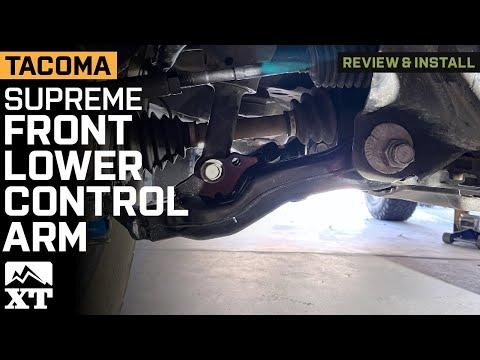
This job replaces the worn front ball joints that connect the steering knuckle to the control arms. On your Tacoma, the lower ball joint is normally serviced as part of the lower control arm assembly, while the upper ball joint is serviced with the upper control arm assembly.
Assumption: This guide covers front upper and lower ball joint/control arm replacement on one side. Repeat the same process on the other side if needed.
Difficulty Level: Advanced | Estimated Time: 4-6 hours per side
⚠️ Safety & Precautions
- ⚠️ Suspension parts hold vehicle weight. Never work under your Tacoma supported only by a jack.
- ⚠️ Use jack stands on solid frame points before removing the wheel.
- ⚠️ A ball joint separator is a tool that safely pops the tapered ball joint stud loose from the steering knuckle.
- ⚠️ Do not hammer directly on the ball joint threads. It can damage the joint and make the nut unsafe to reinstall.
- ⚠️ Keep the brake hose and ABS wheel speed sensor wire from stretching while the steering knuckle is loose.
- ⚠️ Front-end alignment is required after replacing control arms or ball joints.
- ⚠️ Battery disconnect is not required for this repair.
🔧 Required Tools
You'll need the following tools for this repair:
- Floor jack (rated 3-ton minimum)
- Jack stands (rated 3-ton minimum)
- Wheel chocks
- Safety glasses
- Mechanic gloves
- 21mm lug nut socket
- Breaker bar 1/2-inch drive
- Torque wrench 1/2-inch drive
- Ratchet 1/2-inch drive
- Ratchet 3/8-inch drive
- 12mm socket
- 14mm socket
- 17mm socket
- 19mm socket
- 22mm socket
- 24mm socket
- 12mm wrench
- 14mm wrench
- 17mm wrench
- 19mm wrench
- 22mm wrench
- Needle-nose pliers
- Side cutters
- Ball joint separator (specialty)
- Pickle fork separator (specialty)
- Dead blow hammer
- Pry bar 18-inch
- Paint marker
- Penetrating oil
- Bungee cord
- Shop rags
🔩 Required Parts
HowToo sells all the parts you need for this repair:
- Front upper control arm with ball joint - Qty: 1 per side
- Front lower control arm with ball joint - Qty: 1 per side
- New cotter pins - Qty: 2 per side
- New control arm mounting nuts and bolts - Qty: as needed
- Chassis grease - Qty: 1 tube if replacement joints are greaseable
📋 Before You Begin
- Park your Tacoma on level ground and set the parking brake.
- Place wheel chocks behind the rear wheels.
- Loosen the front wheel lug nuts slightly before lifting the truck.
- Spray penetrating oil on the upper ball joint nut, lower ball joint nut, tie rod nut, and control arm mounting bolts.
- Use a paint marker to mark the position of the lower control arm cam bolts. Cam bolts are alignment bolts with offset washers.
- No infotainment menu steps, scan tool commands, EPB service mode, or battery registration are needed.
🔨 Step-by-Step Instructions
Follow these steps in order:
Step 1: Loosen the Wheel
- Use a 21mm lug nut socket and breaker bar to loosen the front lug nuts about one turn while the tire is still on the ground.
- Do not fully remove the lug nuts yet.
- Break nuts loose before lifting.
Step 2: Lift and Support the Front
- Use a floor jack to lift the front of your Tacoma from a safe front frame or crossmember lift point.
- Place jack stands under the frame rails.
- Lower the truck gently onto the jack stands.
- Shake the truck lightly by hand to confirm it is stable.
Step 3: Remove the Wheel
- Use the 21mm lug nut socket to remove the lug nuts.
- Remove the wheel and place it flat under the frame as a backup safety cushion.
Step 4: Remove Brake Hose and ABS Wire Brackets
- Use a 12mm socket or 12mm wrench to remove the brake hose bracket bolt from the steering knuckle or control arm.
- Use a 10mm or 12mm socket if your ABS wire bracket uses a smaller bolt.
- Move the hose and wire aside carefully.
- Do not disconnect the brake hydraulic line.
Step 5: Support the Lower Control Arm
- Use the floor jack under the lower control arm near the ball joint.
- Raise the jack just enough to support the arm, not lift the truck off the jack stand.
- This keeps the suspension from dropping suddenly when joints are separated.
Step 6: Disconnect the Outer Tie Rod
- Use needle-nose pliers or side cutters to remove the cotter pin from the outer tie rod end.
- Use a 19mm socket or wrench to loosen and remove the tie rod castle nut.
- Use a ball joint separator to pop the tie rod end loose from the steering knuckle.
- Move the tie rod aside without bending it.
- During reassembly, tighten the tie rod nut to Torque to 67 Nm (49 ft-lbs), then install a new cotter pin.
Step 7: Separate the Upper Ball Joint
- Use needle-nose pliers or side cutters to remove the upper ball joint cotter pin.
- Use a 19mm socket or wrench to loosen the upper ball joint castle nut a few turns.
- Leave the nut partly installed so the knuckle cannot fall suddenly.
- Use a ball joint separator to separate the upper ball joint stud from the steering knuckle.
- Remove the castle nut fully with the 19mm socket or wrench.
- Support the steering knuckle with a bungee cord so it does not pull on the brake hose.
- During reassembly, tighten the upper ball joint nut to Torque to 110 Nm (81 ft-lbs), then install a new cotter pin.
Step 8: Separate the Lower Ball Joint
- Use needle-nose pliers or side cutters to remove the lower ball joint cotter pin.
- Use a 24mm socket or wrench to loosen the lower ball joint nut a few turns.
- Use a ball joint separator or pickle fork separator to release the lower ball joint stud from the steering knuckle.
- Remove the lower ball joint nut fully with the 24mm socket or wrench.
- Carefully move the steering knuckle aside and support it with a bungee cord.
- During reassembly, tighten the lower ball joint nut to Torque to 160 Nm (118 ft-lbs), then install a new cotter pin.
Step 9: Remove the Upper Control Arm
- Use a 19mm socket and 19mm wrench to remove the upper control arm pivot bolt nut.
- Slide the long pivot bolt out of the upper control arm mounts.
- Remove the upper control arm assembly from your Tacoma.
- Install the new upper control arm in the same position.
- Install the pivot bolt and nut finger-tight only for now.
- Final-tighten the upper control arm pivot nut at ride height to Torque to 115 Nm (85 ft-lbs).
Step 10: Remove the Lower Control Arm
- Use a paint marker to confirm the original cam washer positions are marked.
- Use a 22mm socket and 22mm wrench to remove the front and rear lower control arm cam bolt nuts.
- Slide out the cam bolts and washers.
- Use a pry bar 18-inch to gently work the lower control arm out of the frame pockets.
- Install the new lower control arm into the same frame pockets.
- Reinstall the cam bolts and align the cam washers with your paint marks.
- Install the nuts finger-tight only for now.
- Final-tighten the lower control arm cam bolts at ride height to Torque to 180 Nm (133 ft-lbs).
Step 11: Reconnect the Steering Knuckle
- Use the floor jack to slowly raise or lower the lower control arm until the lower ball joint stud lines up with the steering knuckle.
- Install the lower ball joint stud into the knuckle by hand.
- Use the 24mm socket and torque wrench to tighten the nut to Torque to 160 Nm (118 ft-lbs).
- Install a new cotter pin with needle-nose pliers.
- Guide the upper ball joint stud into the top of the knuckle.
- Use the 19mm socket and torque wrench to tighten the nut to Torque to 110 Nm (81 ft-lbs).
- Install a new cotter pin with needle-nose pliers.
Step 12: Reconnect the Tie Rod
- Insert the outer tie rod stud into the steering knuckle.
- Use a 19mm socket and torque wrench to tighten the tie rod nut to Torque to 67 Nm (49 ft-lbs).
- Install a new cotter pin with needle-nose pliers.
Step 13: Reinstall Brackets
- Use a 12mm socket or 12mm wrench to reinstall the brake hose bracket bolt.
- Use a 10mm or 12mm socket to reinstall the ABS wire bracket bolt if removed.
- Make sure the hose and wire are not twisted, pinched, or stretched.
Step 14: Set Ride Height Before Final Tightening
- Use the floor jack under the lower control arm to raise the suspension until it sits close to normal ride height.
- Ride height means the suspension position when the truck is sitting on its tires.
- Use a torque wrench, 19mm socket, and 19mm wrench to tighten the upper control arm pivot nut to Torque to 115 Nm (85 ft-lbs).
- Use a torque wrench, 22mm socket, and 22mm wrench to tighten the lower control arm cam bolts to Torque to 180 Nm (133 ft-lbs).
- Tightening at ride height protects bushings.
Step 15: Reinstall the Wheel
- Install the wheel by hand.
- Thread the lug nuts by hand first to avoid cross-threading.
- Use a 21mm lug nut socket to snug the lug nuts in a star pattern.
Step 16: Lower and Torque the Wheel
- Use the floor jack to lift your Tacoma slightly off the jack stands.
- Remove the jack stands.
- Lower the truck until the tire touches the ground.
- Use a 21mm lug nut socket and torque wrench to tighten lug nuts in a star pattern to Torque to 113 Nm (83 ft-lbs).
✅ After Repair
- ✅ Turn the steering wheel lock-to-lock while parked and listen for binding, clunks, or rubbing.
- ✅ Check that all cotter pins are installed through the castle nuts.
- ✅ Test drive slowly at first. Listen for clunks over small bumps.
- ✅ Get a professional four-wheel alignment immediately after replacing control arms or ball joints.
- ✅ Recheck lug nut torque after 25-50 miles.
- ✅ If greaseable ball joints were installed, use a grease gun to fill them with chassis grease until the boot just begins to swell.
💰 DIY vs Shop Cost
Shop Cost: $900-$1,600 per side (parts + labor + alignment)
DIY Cost: $350-$750 per side (parts only, alignment extra)
You Save: $400-$850 by doing it yourself!
Shop labor rates vary but typically run $100-$150/hour. This repair takes a shop approximately 3-5 hours per side.
🎯 Ready to get started?
HowToo makes it easy: same-day/2-day shipping on every part, plus all the tools and specialty tools you need! Check out the parts and tools sections below to add everything to your cart.