








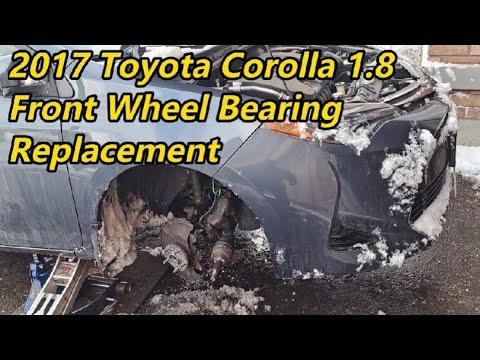







How to Replace Wheel Hub & Bearing Assemblies on a 2017 Toyota Corolla
Step-by-step DIY guide with tools, parts list, torque specs, safety tips, and cost savings
How to Replace Wheel Hub & Bearing Assemblies on a 2017 Toyota Corolla
Step-by-step DIY guide with tools, parts list, torque specs, safety tips, and cost savings


🔧 Corolla - Wheel Bearing Replacement
You’ll be replacing the wheel hub & bearing assemblies. On your Corolla, the bearings are not serviced separately; you swap the whole hub unit. This restores smooth, quiet wheel rotation and removes humming or growling noises.
Difficulty Level: Intermediate | Estimated Time: 2–3 hours per axle
⚠️ Safety & Precautions
- 🦺 Always support the car with jack stands; never work under a car supported only by a jack.
- 🧯 Chock (block) the wheels that stay on the ground so the car cannot roll.
- 🔥 Brake parts and the exhaust can be very hot after driving; let the car cool first.
- 🔌 You do not need to disconnect the battery for front wheel bearings, but avoid pulling or twisting ABS sensor wires.
- ⚡ If your ABS warning light is on before the repair, have codes checked; the hub includes the ABS tone ring.
🔧 Required Tools
You'll need the following tools for this repair:
- Floor jack (rated 3-ton minimum)
- Jack stands (rated 3-ton minimum, Qty: 2–4)
- Wheel chocks
- Breaker bar 1/2" drive
- Torque wrench 1/2" drive (up to 200 ft-lbs)
- Torque wrench 3/8" drive (up to 80 ft-lbs)
- Socket set metric 3/8" and 1/2" drive
- 21mm socket
- 17mm socket
- 19mm socket
- 22mm socket
- 30mm axle nut socket (6-point)
- Ratchet 3/8" drive
- Ratchet 1/2" drive
- Extensions 3/8" and 1/2" drive
- Combination wrench set metric
- Flathead screwdriver medium
- Needle-nose pliers
- Pry bar medium
- Hammer
- Rubber mallet
- Punch or drift (for unstaking axle nut)
- Wire brush small
- Penetrating oil spray
- Brake cleaner spray
- Bungee cord or wire hanger
- Allen/hex key set metric
- Torx bit set (for any ABS sensor bolts)
- Impact wrench (air or electric, specialty)
- Impact screwdriver (specialty)
- Scraper or gasket scraper
- Safety glasses
- Mechanic gloves
- Shop rags
- Anti-seize compound
🔩 Required Parts
HowToo sells all the parts you need for this repair:
- Front wheel hub & bearing assembly (left) - Qty: 1
- Front wheel hub & bearing assembly (right) - Qty: 1
- Front axle nut (new) - Qty: 2
- Rear wheel hub & bearing assembly (left) - Qty: 1
- Rear wheel hub & bearing assembly (right) - Qty: 1
- Rear axle nut (if equipped, new) - Qty: 2
- Replacement hub mounting bolts - Qty: 8 (front) + 8 (rear) if replacing
- Brake cleaner - Qty: 1 can
- Anti-seize compound - Qty: 1 small tube
- Penetrating oil - Qty: 1 can
📋 Before You Begin
- Park the Corolla on level ground, engage the parking brake, and place the transmission in P.
- Loosen (but do not remove) the wheel lug nuts with a 21mm socket before lifting the car.
- Set wheel chocks behind the tires that stay on the ground.
- Plan to replace wheel bearings in pairs on the same axle (both fronts or both rears) for even wear.
🔨 Step-by-Step Instructions
Follow these steps in order:
Step 1: Lift and Support the Corolla
- Use the 21mm socket and breaker bar to crack all lug nuts loose about one turn.
- Position the floor jack under the front center jacking point and raise the front of the car.
- Place jack stands under the pinch welds or frame points on both sides and gently lower the car onto them.
- Remove the front wheels completely with the 21mm socket.
Step 2: Remove Front Brake Caliper and Rotor
- Turn the steering wheel to give better access to the side you’re working on.
- Use a 14mm or 17mm socket (varies by hardware) and ratchet to remove the caliper slide bolts.
- Lift the caliper off the rotor and hang it from the strut spring with a bungee cord so the hose is not stretched.
- Use a 17mm or 19mm socket to remove the caliper bracket bolts from the knuckle. Torque on reassembly: 107 Nm (79 ft-lbs).
- Remove the caliper bracket and set it aside.
- If the rotor is stuck, use a rubber mallet to tap around the hat area until it loosens, then remove it.
Step 3: Unstake and Remove the Axle Nut
- The axle nut is staked (crimped) into a groove on the axle to keep it from loosening.
- Use a punch and hammer to carefully bend out the staked area so the nut can turn.
- Spray penetrating oil on the nut and axle threads.
- Use a 30mm axle nut socket and breaker bar (or impact wrench) to remove the axle nut completely.
Step 4: Disconnect ABS Sensor (If Needed)
- Follow the ABS sensor wire from the hub to its connector on the knuckle or strut.
- Use a flathead screwdriver to gently release plastic clips holding the wire.
- If there is a retaining bolt, remove it with the correct socket or Torx bit.
- Disconnect the electrical connector by pressing the tab and pulling it apart.
Step 5: Remove Hub & Bearing Assembly (Front)
- Turn the steering to fully expose the back of the steering knuckle.
- Use a 17mm or 19mm socket, extension, and ratchet to remove the four hub mounting bolts from the rear of the knuckle. Torque on reassembly: 113 Nm (83 ft-lbs).
- Spray penetrating oil around the hub where it meets the knuckle.
- Tap the back of the hub flange with a hammer or use a rubber mallet on the front to break it free. Work evenly around the hub.
- Pull the old hub and bearing assembly straight off the axle and out of the knuckle.
Step 6: Clean the Knuckle Mating Surface
- Use a wire brush to clean rust and debris from the hub mounting surface on the knuckle.
- Wipe with a rag and a bit of brake cleaner until the surface is clean and smooth.
- Apply a very thin film of anti-seize compound to the mating surface to help future removal. Do not get any on brake surfaces.
Step 7: Install New Front Hub & Bearing Assembly
- Align the new hub with the axle splines and the bolt holes in the knuckle.
- Slide the hub fully into place by hand.
- Install the four hub mounting bolts by hand, then tighten them evenly with a 17mm or 19mm socket and ratchet.
- Use the torque wrench to tighten the bolts to 113 Nm (83 ft-lbs) in a crisscross pattern.
- Reconnect the ABS sensor bolt, clips, and electrical connector using the appropriate socket or Torx bit.
Step 8: Install New Axle Nut and Reassemble Brakes
- Thread the new axle nut on by hand, then snug it with the 30mm socket and ratchet.
- Reinstall the brake rotor. Clean its surfaces with brake cleaner if necessary.
- Reinstall the caliper bracket using a 17mm or 19mm socket and tighten bolts to 107 Nm (79 ft-lbs) with a torque wrench.
- Reinstall the brake caliper using the appropriate socket for the slide pins. Torque caliper slide bolts to 34 Nm (25 ft-lbs).
Step 9: Pre-Torque Axle Nut
- Have a helper hold the brake pedal, or temporarily install the wheel and lower the car enough so the tire just touches the ground.
- Use the torque wrench and 30mm socket to tighten the axle nut to 216 Nm (159 ft-lbs).
- Use the punch and hammer to stake (indent) the edge of the axle nut into the axle groove to lock it.
Step 10: Reinstall Wheels and Lower Vehicle
- Install the wheels and hand-tighten lug nuts using the 21mm socket.
- Raise the car slightly with the floor jack, remove the jack stands, and lower the car to the ground.
- Use a torque wrench and 21mm socket to tighten lug nuts in a star pattern to 103 Nm (76 ft-lbs).
Step 11: Rear Hub & Bearing Overview (If You’re Doing Rears Too)
- The rear hubs on your Corolla XSE are also bolt-on units behind the rear brake rotors.
- The process is similar: remove wheel, remove caliper and rotor, unbolt hub from rear of the backing plate/knuckle, clean the surface, and install the new hub.
- Typical rear hub bolt torque: 113 Nm (83 ft-lbs); rear wheel lug nuts: 103 Nm (76 ft-lbs).
- If there is a rear axle nut, torque it to 216 Nm (159 ft-lbs) and stake it the same way as the front.
✅ After Repair
- Start the engine and pump the brake pedal a few times to seat the caliper pistons.
- Check that the ABS and brake warning lights go off normally.
- On a short test drive, listen for any grinding, clicking, or humming; it should be quieter than before.
- After the test drive, recheck wheel lug nut torque with the torque wrench.
💰 DIY vs Shop Cost
Shop Cost: $600–$900 for front or rear pair (parts + labor)
DIY Cost: $200–$350 per axle (parts only)
You Save: $400–$550 by doing it yourself!
Shop labor rates vary but typically run $100–$150/hour. This repair takes a shop approximately 2–3 hours per axle.
🎯 Ready to get started?
HowToo makes it easy: same-day/2-day shipping on every part, plus all the tools and specialty tools you need! Check out the parts and tools sections above to add everything to your cart.