









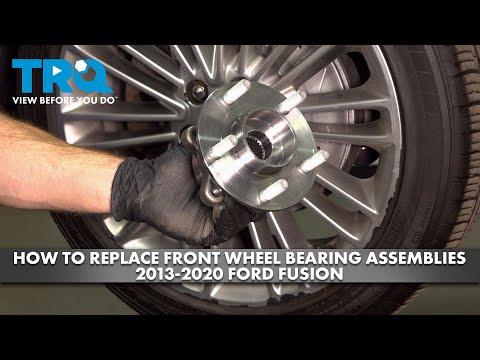







How to Replace Wheel Bearings (Hub Assembly) on a 2015 Ford Fusion
Step-by-step hub & bearing replacement with tools, parts list, safety tips, and torque specs
How to Replace Wheel Bearings (Hub Assembly) on a 2015 Ford Fusion
Step-by-step hub & bearing replacement with tools, parts list, safety tips, and torque specs


🔧 Fusion - Wheel Bearing Replacement
On your Fusion, the wheel bearing is part of a sealed hub-and-bearing assembly. Replacement is a remove-and-replace job (no bearing press), but rust and tight fasteners can make it challenging.
Difficulty Level: Advanced | Estimated Time: 2.5-5.0 hours (one corner)
⚠️ Safety & Precautions
- 🛑 Support the car with jack stands on solid points; never rely on a floor jack alone.
- 🧤 Wear safety glasses and mechanic gloves; rust scale can fall when the hub breaks loose.
- 🔥 Brakes get hot—let everything cool before touching the rotor/caliper.
- ⚡ Hybrid note: keep the car OFF and keep the key fob away from the car so it can’t wake up unexpectedly.
- 🧷 Do not let the brake caliper hang by the hose—support it with a hanger.
🔧 Required Tools
You'll need the following tools for this repair:
- Floor jack (rated 3-ton minimum)
- Jack stands (rated 3-ton minimum)
- Wheel chocks
- Safety glasses
- Mechanic gloves
- Breaker bar (1/2" drive)
- Torque wrench (20–250 ft-lbs range)
- Socket set (8mm–21mm, 1/2" drive)
- Wrench set (8mm–21mm)
- Axle nut socket (32mm, 1/2" drive)
- Ratchet (3/8" drive)
- Torx bit set (T30–T50)
- Pry bar (18")
- Hammer (2–3 lb)
- Wire brush
- Bungee cord
- Penetrating oil
- Hub puller/slide hammer kit (specialty)
🔩 Required Parts
HowToo sells all the parts you need for this repair:
- Front wheel hub & bearing assembly - Qty: 1
- Rear wheel hub & bearing assembly - Qty: 1
- Front axle nut (one-time-use) - Qty: 1
- Brake caliper bracket bolts - Qty: 2 (optional if specified one-time-use)
- Brake rotor retaining screw - Qty: 1 (optional if equipped)
- Brake cleaner - Qty: 1
- Anti-seize compound - Qty: 1
📋 Before You Begin
- Park on level ground. Turn the car OFF. Keep the key fob at least 15 feet away.
- Chock the wheels that will stay on the ground with wheel chocks.
- Loosen the wheel lug nuts slightly using a 19mm socket and breaker bar before lifting.
- If doing a rear hub: make sure the parking brake is released. If your Fusion has an electronic parking brake that won’t release, you may need a scan tool parking-brake service mode.
- Tip: Spray penetrating oil on hub bolts 10 minutes early.
🔨 Step-by-Step Instructions
Follow these steps in order:
Step 1: Lift and remove the wheel
- Use a floor jack to lift the corner you’re working on.
- Set the car down onto jack stands.
- Remove the lug nuts with a 19mm socket and remove the wheel.
Step 2 (Front): Remove the axle nut
- Remove any axle-nut cap (if present) using a small pry bar.
- Use a 32mm axle nut socket and breaker bar to remove the axle nut.
- Tip: Have a helper press the brake pedal.
Step 3: Remove the brake caliper and bracket
- Remove the caliper slide bolts using the correct socket/wrench (commonly 13mm).
- Lift the caliper off and hang it from the strut/spring with a bungee cord.
- Remove the caliper bracket bolts using a breaker bar and appropriate socket (commonly 15mm–18mm).
- Torque to 115 Nm (85 ft-lbs) when reinstalling (caliper bracket bolts).
Step 4: Remove the brake rotor
- If equipped with a rotor retaining screw, remove it with a Torx bit (commonly T30).
- Pull the rotor off. If stuck, tap the rotor hat with a hammer (avoid the wheel studs).
Step 5: Disconnect the wheel speed sensor (ABS) wiring
- Unclip the ABS wire from its holders using a trim tool or careful hand pressure.
- Disconnect the connector if needed (do not pull on the wire).
- Definition: The ABS sensor reads wheel speed for braking and stability control.
Step 6 (Front): Push the axle stub back slightly
- Thread the old axle nut on a few turns by hand to protect the threads.
- Use a hammer to tap the nut and push the axle inward slightly.
- Remove the nut again using the 32mm socket.
- Tip: If it won’t move, don’t mushroom the threads—use a puller.
Step 7: Remove the hub/bearing mounting bolts
- From the back side of the knuckle, remove the 3–4 hub bolts using a ratchet and appropriate socket (often 13mm–15mm).
- Use penetrating oil and a breaker bar if they’re stubborn.
- Torque to 90 Nm (66 ft-lbs) when reinstalling (hub-to-knuckle bolts).
Step 8: Remove the hub/bearing assembly
- Pull the hub straight out of the knuckle.
- If it’s rust-seized, use a hub puller/slide hammer kit (specialty) to pop it out.
- Clean the knuckle bore with a wire brush and wipe with brake cleaner.
Step 9: Install the new hub/bearing assembly
- Apply a very thin film of anti-seize compound to the knuckle bore (keep it off the brake surfaces).
- Set the new hub squarely in place by hand.
- Install hub bolts finger-tight, then tighten evenly using a ratchet.
- Torque to 90 Nm (66 ft-lbs) (hub-to-knuckle bolts).
- Reconnect and re-clip the ABS wiring by hand.
Step 10 (Front): Install a new axle nut
- Install the new axle nut by hand first to avoid cross-threading.
- Tighten using a torque wrench and 32mm socket: Torque to 300 Nm (221 ft-lbs).
- Tip: Axle nuts are often one-time-use—replace it.
Step 11: Reinstall rotor, bracket, and caliper
- Reinstall the rotor. If equipped, install the retaining screw with a Torx bit and snug it (do not over-tighten).
- Reinstall the caliper bracket using the correct socket.
- Torque to 115 Nm (85 ft-lbs) (caliper bracket bolts).
- Reinstall the caliper and tighten slide bolts using the correct socket/wrench.
- Torque to 35 Nm (26 ft-lbs) (caliper slide bolts).
Step 12: Reinstall wheel and lower the car
- Install the wheel and hand-tighten lug nuts.
- Lower the car using the floor jack.
- Tighten lug nuts in a star pattern with a torque wrench: Torque to 135 Nm (100 ft-lbs).
Assumption note: Torque values above are the common Fusion hub/brake specs; always match to your exact service info if any fastener/type differs.
✅ After Repair
- Before moving, pump the brake pedal 5–10 times until it feels firm.
- Start the car and confirm no ABS/traction warning lights stay on.
- Road test at low speed first. Listen for grinding/humming and check for pulling.
- Recheck lug nut torque with a torque wrench after 25–50 miles.
💰 DIY vs Shop Cost
Shop Cost: $450-$950 (parts + labor, per wheel)
DIY Cost: $120-$280 (parts only, per wheel)
You Save: $330-$670 by doing it yourself!
Shop labor rates vary but typically run $100-$150/hour. This repair takes a shop approximately 2.5-5.0 hours.
🎯 Ready to get started?
HowToo makes it easy: same-day/2-day shipping on every part, plus all the tools and specialty tools you need! Check out the parts and tools sections below to add everything to your cart.