









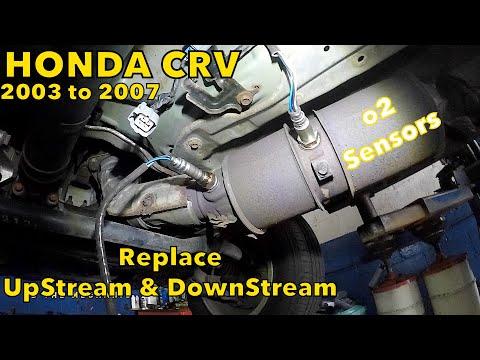







How to Replace Upstream & Downstream O2 Sensors on a 2007 Honda CR-V
Step-by-step instructions to identify B1S1 vs B1S2, required tools/parts, torque specs, and code-clearing tips
How to Replace Upstream & Downstream O2 Sensors on a 2007 Honda CR-V
Step-by-step instructions to identify B1S1 vs B1S2, required tools/parts, torque specs, and code-clearing tips


🔧 CR-V - Oxygen Sensor Replacement
Your CR-V has two exhaust sensors: an upstream Air/Fuel (A/F) ratio sensor (before the catalytic converter) and a downstream oxygen (O2) sensor (after the catalytic converter). Replacing the correct one restores proper fuel control (upstream) or catalyst monitoring (downstream) and can clear a check engine light.
Difficulty Level: Intermediate | Estimated Time: 0.5-1.5 hours
⚠️ Safety & Precautions
- ⚠️ Let the exhaust cool fully before touching sensors; they get extremely hot.
- ⚠️ Support the CR-V with jack stands on solid ground; never rely on a jack alone.
- ⚠️ Unplug the sensor connector before loosening the sensor to avoid twisting/damaging the harness.
- ⚠️ If you disconnect the battery, you may lose radio presets and idle learn may be needed.
🔧 Required Tools
You'll need the following tools for this repair:
- Safety glasses
- Nitrile gloves
- Wheel chocks
- Floor jack (rated 2-ton minimum)
- Jack stands (rated 2-ton minimum)
- 14mm socket
- 3/8" drive ratchet
- 3/8" drive extension set
- 22mm oxygen sensor socket (specialty)
- Torque wrench (10-80 ft-lbs range)
- Trim clip removal tool
- Flathead screwdriver
- Penetrating oil
- OBD2 scan tool (basic code reader)
🔩 Required Parts
HowToo sells all the parts you need for this repair:
- Upstream A/F ratio sensor (Bank 1 Sensor 1) - Qty: 1
- Downstream O2 sensor (Bank 1 Sensor 2) - Qty: 1
- Anti-seize compound (sensor-safe) - Qty: 1
📋 Before You Begin
- Park on level ground, shift to P, and set the parking brake.
- Chock the rear wheels with wheel chocks.
- If working underneath, raise the front with a floor jack and set it on jack stands.
- Spray penetrating oil around the sensor threads and let it soak 5–10 minutes.
- Tip: Warm (not hot) exhaust loosens easier.
🔨 Step-by-Step Instructions
Follow these steps in order:
Step 1: Identify which sensor you’re replacing
- The upstream A/F sensor (B1S1) is on the exhaust manifold at the front of the engine (top-side access).
- The downstream O2 sensor (B1S2) is after the catalytic converter (usually easiest from underneath).
- Use an OBD2 scan tool to confirm which code you have (example: P0134/P0171 often upstream; P0420 often downstream/catalyst-related).
Step 2: Disconnect the sensor electrical connector
- For top-side connectors, remove any plastic clips using a trim clip removal tool or flathead screwdriver.
- Press the connector lock tab by hand and unplug it. Tip: Don’t pull on the wires.
Step 3: Remove the sensor
- Slip the wire through the slot of the 22mm oxygen sensor socket (specialty).
- Use a 3/8" drive ratchet and extension to loosen and remove the sensor.
- If it’s stuck, apply more penetrating oil and try again after a few minutes.
Step 4: Prepare the new sensor
- Compare the old and new sensor: same connector, wire length, and thread size.
- If the new sensor threads are not pre-coated, apply a very light film of anti-seize compound (sensor-safe) to the threads only.
- Keep anti-seize off the sensor tip/holes.
Step 5: Install the new sensor
- Start threading the sensor in by hand to avoid cross-threading.
- Tighten with the 22mm oxygen sensor socket (specialty) and torque wrench.
- Torque to 44 Nm (33 ft-lbs).
Step 6: Reconnect and secure the harness
- Plug the connector back in until it clicks.
- Reinstall any wire clips/brackets you removed using a flathead screwdriver or by hand.
- Make sure the wire is routed away from the exhaust and moving parts.
Step 7: Reinstall any covers (if removed) and lower the vehicle
- If you removed a splash shield, reinstall bolts/clips using a 14mm socket (if equipped) and your ratchet.
- Lift slightly with the floor jack, remove jack stands, and lower the CR-V.
✅ After Repair
- Use your OBD2 scan tool to clear stored codes.
- Start the engine and listen for exhaust leaks (ticking sound) near the sensor area.
- Test drive 10–15 minutes, then recheck for codes.
- If the check engine light returns with the same code, inspect the connector pins and harness routing for damage.
💰 DIY vs Shop Cost
Shop Cost: $220-$450 (parts + labor)
DIY Cost: $60-$220 (parts only)
You Save: $160-$230 by doing it yourself!
Shop labor rates vary but typically run $100-$150/hour. This repair takes a shop approximately 0.7-1.2 hours.
🎯 Ready to get started?
HowToo makes it easy: same-day/2-day shipping on every part, plus all the tools and specialty tools you need! Check out the parts and tools sections below to add everything to your cart.