









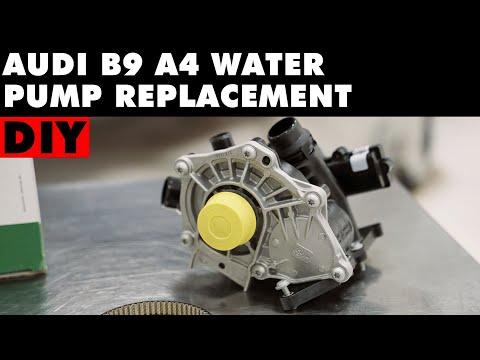







How to Replace the Water Pump & Thermostat Housing on a 2016 Audi A4 2.0T
Step-by-step DIY guide with tools, parts list, torque specs, coolant refill/bleeding, and safety tips
How to Replace the Water Pump & Thermostat Housing on a 2016 Audi A4 2.0T
Step-by-step DIY guide with tools, parts list, torque specs, coolant refill/bleeding, and safety tips


🔧 A4 - Water Pump Replacement
On your A4, the water pump (often serviced together with the thermostat housing) circulates coolant through the engine and radiator. When it leaks or the thermostat sticks, you can get coolant loss, overheating, or poor cabin heat.
Assumption: 2.0L turbo uses the water pump/thermostat module at the front of the engine behind the intake manifold.
Difficulty Level: Advanced | Estimated Time: 3-6 hours
⚠️ Safety & Precautions
- ⚠️ Work only on a fully cool engine; hot coolant can cause burns.
- ⚠️ Support the car with jack stands; never rely on a floor jack alone.
- ⚠️ Keep coolant off belts and pulleys; it can cause slipping.
- ⚠️ Coolant is toxic—keep away from kids/pets and clean spills immediately.
- ⚠️ Battery disconnect is recommended if you’ll unplug multiple sensors/actuators.
🔧 Required Tools
You'll need the following tools for this repair:
- Safety glasses
- Nitrile gloves
- Floor jack (rated 3-ton minimum)
- Jack stands (rated 3-ton minimum)
- Wheel chocks
- Drain pan (at least 10-quart)
- Funnel
- Trim clip remover
- Flathead screwdriver
- Pick tool
- Hose clamp pliers
- 3/8" drive ratchet
- 1/4" drive ratchet
- 3/8" drive torque wrench
- 1/4" drive torque wrench (inch-pound)
- Socket set: 8mm, 10mm, 13mm, 16mm
- Torx bit set: T25, T30
- Triple-square bit set: M10
- Allen bit set: 5mm, 6mm
- Serpentine belt tool (16mm)
- Magnetic pickup tool
- Shop towels
- Flashlight
- Cooling system vacuum fill tool (specialty)
🔩 Required Parts
HowToo sells all the parts you need for this repair:
- Water pump and thermostat housing assembly - Qty: 1
- Water pump/thermostat sealing O-rings/gaskets - Qty: 1 set
- Audi/VW coolant (G13 or OEM-approved equivalent) - Qty: 2-3 gallons (mixed 50/50 as required)
- Serpentine belt - Qty: 1 (recommended if coolant-soaked or cracked)
- Hose clamps - Qty: 2-6 (only if originals are weak/damaged)
📋 Before You Begin
- Park on level ground, set the parking brake, and chock the rear wheels.
- Let the engine cool completely (best: sit overnight).
- Plan for coolant capture: place a drain pan under the front of the engine.
- If using a vacuum fill tool: set it up now so refilling is easy later (it “sucks” coolant in and reduces air pockets).
- If disconnecting the battery: use a 10mm socket to remove the negative terminal and isolate it so it can’t spring back.
🔨 Step-by-Step Instructions
Follow these steps in order:
Step 1: Remove the lower splash shield
- Raise the front with a floor jack (rated 3-ton minimum) and support with jack stands (rated 3-ton minimum).
- Use a Torx T25 bit and trim clip remover to remove the fasteners and take off the lower engine cover.
Step 2: Drain the coolant
- Place a drain pan (at least 10-quart) under the radiator/engine area.
- Slowly loosen the coolant expansion tank cap to release any residual pressure.
- Use hose clamp pliers to release the lower radiator hose clamp (or the most accessible lower coolant hose) and carefully pull the hose off.
- Tip: Twist the hose to break it free.
Step 3: Remove the intake ducting for access
- Use a flathead screwdriver and 8mm socket to loosen hose clamps and remove the intake snorkel/ducting near the front of the engine.
- Use a Torx T30 bit to remove any intake airbox/duct screws if equipped.
Step 4: Remove the serpentine belt
- The serpentine belt is the outer accessory drive belt for the alternator/A/C.
- Use a serpentine belt tool (16mm) to rotate the belt tensioner and slide the belt off a smooth pulley.
- Inspect the belt. If it’s wet with coolant, glazed, or cracked, replace it.
Step 5: Create working room at the front of the engine
- Use a 10mm socket and 13mm socket to remove any small brackets or covers blocking access to the water pump/thermostat module.
- Use a flashlight to locate the pump housing and attached coolant hoses.
- Have shop towels ready—coolant will spill when hoses come off.
Step 6: Disconnect electrical connectors (if equipped on your housing)
- Use a pick tool to gently lift locking tabs, then unplug any connectors at the thermostat/heater control area.
- Tip: Don’t pull on wires—pull on the connector.
Step 7: Remove coolant hoses from the pump/thermostat housing
- Use hose clamp pliers to slide spring clamps back on each hose.
- Use a pick tool to break the seal if needed, then pull hoses off carefully.
- Catch remaining coolant in the drain pan.
Step 8: Unbolt and remove the water pump/thermostat housing
- Use a 10mm socket and Torx T30 bit (varies by fastener location) to remove the housing bolts.
- Remove bolts evenly, then pull the housing straight off.
- Use a magnetic pickup tool if a bolt drops into a tight spot.
- Torque on install: 10 Nm (89 in-lbs) for small housing bolts (typical M6). If your housing uses larger bolts, torque those to 20 Nm (15 ft-lbs).
Step 9: Clean the mating surface
- Use shop towels to wipe the engine mating surface clean.
- Do not gouge aluminum surfaces. Avoid using hard scrapers.
- Remove and discard old O-rings/gaskets.
Step 10: Install the new water pump/thermostat housing
- Lightly lubricate new O-rings with fresh coolant from your funnel.
- Position the new housing squarely and start all bolts by hand.
- Use a 1/4" drive torque wrench (inch-pound) or 3/8" drive torque wrench to tighten evenly.
- Torque to 10 Nm (89 in-lbs) for M6 bolts, and 20 Nm (15 ft-lbs) for M8 bolts (where equipped).
Step 11: Reconnect hoses and connectors
- Push hoses fully onto their fittings, then use hose clamp pliers to reinstall clamps in their original positions.
- Reconnect electrical connectors until they click.
- Use a flashlight to verify no hoses are kinked or rubbing.
Step 12: Reinstall the serpentine belt
- Route the belt exactly as before (take a photo earlier if helpful).
- Use the serpentine belt tool (16mm) to rotate the tensioner and slip the belt on.
- Double-check the belt is centered on every pulley.
Step 13: Refill and bleed the cooling system
- If using a cooling system vacuum fill tool (specialty), pull vacuum and refill with Audi/VW coolant (G13 or OEM-approved equivalent) per the tool instructions.
- If filling normally: use a funnel to slowly fill the expansion tank to the MAX line.
- Set the cabin heat to HOT and the fan to low (this helps coolant flow through the heater core).
- Start the engine and let it idle. Watch the coolant level and add as needed.
- When the radiator hose warms up and heat blows hot, shut the engine off and top off to MAX once it cools.
Step 14: Reinstall the lower splash shield and lower the car
- Use a Torx T25 bit and trim clip remover to reinstall the lower cover.
- Remove jack stands (rated 3-ton minimum) and lower the vehicle with the floor jack (rated 3-ton minimum).
✅ After Repair
- Let the engine reach normal temperature, then check for leaks around the housing and every hose connection.
- After the first short drive, re-check coolant level once fully cool and top off to MAX.
- If you have a warning light or overheating: stop driving and recheck for trapped air or a loose clamp.
- Inspect the serpentine belt area for any remaining coolant and clean it off with shop towels.
💰 DIY vs Shop Cost
Shop Cost: $900-$1,600 (parts + labor)
DIY Cost: $180-$450 (parts only)
You Save: $720-$1,150 by doing it yourself!
Shop labor rates vary but typically run $100-$150/hour. This repair takes a shop approximately 3-5 hours.
🎯 Ready to get started?
HowToo makes it easy: same-day/2-day shipping on every part, plus all the tools and specialty tools you need! Check out the parts and tools sections below to add everything to your cart.