















How to Replace the Water Pump on a 2021 Nissan Rogue 2.5L
Step-by-step DIY water pump replacement with tools, parts list, torque tips, coolant refill, and safety precautions
How to Replace the Water Pump on a 2021 Nissan Rogue 2.5L
Step-by-step DIY water pump replacement with tools, parts list, torque tips, coolant refill, and safety precautions


🔧 Rogue - Engine Water Pump Replacement
You’ll be removing the belt‑driven engine water pump on your Rogue and installing a new pump and gasket, then refilling and bleeding the cooling system. This job is tight and a bit complex on this engine because of limited space and the number of components around the pump.
Difficulty Level: Advanced (for a first-timer) | Estimated Time: 4–6 hours
⚠️ Safety & Precautions
- ⚠️ Coolant can be very hot and under pressure; always work on a fully cooled engine before opening the radiator cap or hoses.
- ⚠️ Antifreeze is poisonous to people and animals; avoid spills and clean any immediately.
- ⚠️ Support the vehicle on jack stands, never only on a jack, if you need to raise it.
- ⚠️ Disconnect the negative battery cable before working near the belt and alternator to avoid accidental cranking or short circuits.
- ⚠️ Keep tools and hands clear of the cooling fan area; the fan can run unexpectedly on some vehicles, even with the engine off, if the battery is connected.
- ⚠️ Wear eye protection when draining coolant and when working under the vehicle.
🔧 Required Tools
You'll need the following tools for this repair:
- 🛠️ Metric socket set (8mm–19mm)
- 🛠️ Metric combination wrench set (8mm–19mm)
- 🛠️ 3/8" drive ratchet
- 🛠️ 3/8" drive extensions (75mm–150mm)
- 🛠️ Torque wrench 3/8" drive (5–80 ft-lbs range)
- 🛠️ Flathead screwdriver (medium)
- 🛠️ Phillips screwdriver (medium)
- 🛠️ Trim clip removal tool
- 🛠️ Needle-nose pliers
- 🛠️ Belt tensioner tool or long-handled 3/8" breaker bar
- 🛠️ Floor jack (rated 3-ton minimum)
- 🛠️ Jack stands (rated 3-ton minimum)
- 🛠️ Drain pan (at least 10-liter capacity)
- 🛠️ Shop rags
- 🛠️ Plastic scraper
- 🛠️ Non-marring gasket scraper (plastic or brass)
- 🛠️ Torque-angle marker or paint pen
- 🛠️ Funnel with long spout
- 🛠️ Cooling system vacuum fill tool (specialty, recommended)
- 🛠️ OBD2 scan tool (specialty, optional but helpful)
- 🛠️ Work light or headlamp
- 🛠️ Mechanic’s gloves
- 🛠️ Safety glasses
🔩 Required Parts
HowToo sells all the parts you need for this repair:
- 🔩 Engine water pump (with housing) for 2.5L - Qty: 1
- 🔩 Water pump gasket or O-ring (as required by pump design) - Qty: 1
- 🔩 Serpentine drive belt - Qty: 1
- 🔩 Nissan-approved long-life coolant (blue, premix or concentrate) - Qty: ~2–3 gallons premix equivalent
- 🔩 Water pump mounting bolts (optional, recommended if corroded) - Qty: set
- 🔩 Thermostat with gasket (optional but recommended while drained) - Qty: 1
- 🔩 Radiator drain plug gasket or O-ring (if separate) - Qty: 1
- 🔩 Hose clamps (correct diameter for any damaged ones) - Qty: as needed
- 🔩 Silicone-free gasket sealer (only if specified by pump instructions) - Qty: 1 tube
- 🔩 Brake cleaner or parts cleaner spray - Qty: 1
- 🔩 Distilled water - Qty: 1–2 gallons (if using concentrate)
📋 Before You Begin
- Park the Rogue on level ground, select Park, and set the parking brake.
- Let the engine cool completely, ideally several hours, so the coolant is not hot.
- Open the hood and remove any engine cover by pulling it straight up if equipped.
- Disconnect the negative battery terminal using a 10mm socket and move the cable aside so it cannot spring back.
- Plan where you will pour the old coolant; prepare a sealed container for disposal at a recycling center or workshop.
- If you have a scan tool, make sure it is ready to read and clear any check engine or overheat codes after the repair.
🔨 Step-by-Step Instructions
Follow these steps in order:
Step 1: Raise and prepare the vehicle
- Use the floor jack to lift the front of the Rogue at the front jacking point behind the front crossmember.
- Place jack stands under the proper pinch weld or frame lift points on both sides, then slowly lower the vehicle onto the stands.
- Remove the front right wheel with a 19mm socket and ratchet if you need better access through the wheel well.
- Remove any lower engine splash shield or front under-cover panels using the appropriate 10mm socket and trim clip tool.
Step 2: Drain the coolant
- Place the drain pan under the radiator drain area.
- Slowly loosen the radiator cap by hand to relieve any remaining pressure.
- Open the radiator drain cock using your fingers or needle-nose pliers (if it has a small handle) and let coolant drain fully into the pan.
- If there is a block drain plug on the engine, you can use a socket and ratchet to open it for more complete draining, then close it once flow stops.
Step 3: Remove components blocking water pump access
- From the top and the wheel-well side, remove the right-side plastic inner fender splash panel using a trim clip tool and Phillips screwdriver to expose the belt and pulleys.
- Remove any additional air ducting or intake snorkel that blocks access using a 10mm socket and flathead screwdriver for hose clamps.
- Take photos as you go to remember routing.
Step 4: Release serpentine belt tension and remove belt
- Identify the belt tensioner pulley (spring-loaded pulley that keeps the belt tight).
- Insert your 3/8" breaker bar or the belt tensioner tool into the tensioner square hole or onto the correct bolt head.
- Rotate the tensioner in the direction that loosens the belt and slide the belt off one pulley with your other hand.
- Slowly let the tensioner return to its rest position.
- Remove the belt fully and note or photograph the belt routing for reinstallation.
Step 5: Inspect pulleys and surrounding area
- Spin nearby pulleys by hand to feel for roughness or noise; if any feel bad, plan to replace them.
- Check the water pump area for dried coolant trails or staining that may have confirmed the leak source.
Step 6: Remove water pump pulley (if separate)
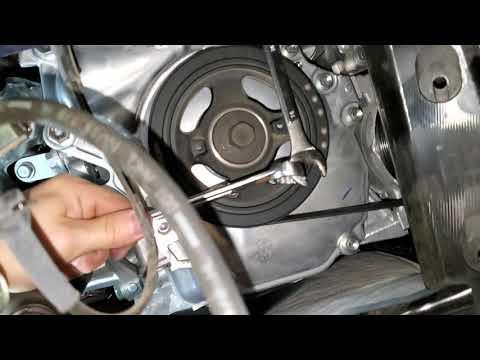
- If the water pump has an external pulley, hold the pulley in place with a wrench on the center nut or using a suitable holding tool.
- Use a socket and ratchet to loosen and remove the pulley bolts.
- Remove the pulley and set it aside where it will not be damaged.
Step 7: Remove the water pump
- Place rags and the drain pan under the pump area to catch any remaining coolant.
- Use a socket and ratchet to remove the water pump mounting bolts in a criss-cross pattern, a little at a time.
- Note the length and position of each bolt; some may be different lengths. You can use cardboard with labeled holes to keep track.
- Gently tap the pump housing with the handle of a ratchet to break it loose if it is stuck; do not pry aggressively against the engine block or cover.
- Pull the pump straight out; more coolant may spill, so keep the drain pan in place.
Step 8: Clean the gasket surface
- Use the plastic scraper or non-marring gasket scraper to carefully remove old gasket material from the engine mounting surface.
- Do not gouge or scratch the aluminum surface; work slowly.
- Spray a little parts cleaner on a rag and wipe the surface until it is clean and smooth.
- Any leftover gasket can cause leaks.
Step 9: Prepare the new water pump
- Compare the new pump to the old one to ensure the bolt holes and shape match.
- Install the new gasket or O-ring onto the pump as directed by its instructions.
- If Nissan specifies a small amount of sealant at certain corners, apply a thin bead of the recommended sealant using the gasket sealer tube. Do not over-apply.
Step 10: Install the new water pump
- Position the new pump against the engine, aligning bolt holes.
- Start all bolts by hand to avoid cross-threading.
- Use a socket and ratchet to snug the bolts evenly in a criss-cross pattern.
- Use the torque wrench to tighten the bolts to the factory torque specification in a criss-cross pattern. Torque to manufacturer spec (refer to service manual).
- Wipe away any squeezed-out sealant or coolant with a shop rag.
Step 11: Reinstall water pump pulley and belt
- Place the water pump pulley back onto the pump hub.
- Install the pulley bolts by hand, then tighten them with a socket and ratchet evenly around the circle. Torque to manufacturer spec (refer to service manual).
- Route the new serpentine belt following your photo or the belt routing sticker under the hood.
- Use the breaker bar or belt tensioner tool to rotate the tensioner and slip the belt onto the final pulley.
- Release the tensioner slowly and double-check that the belt is seated correctly in every pulley groove.
Step 12: Reinstall splash shields, wheel, and components
- Reinstall any splash shields and under-covers using the 10mm socket and trim clip tool.
- Reinstall the inner fender panel with its clips and screws using the Phillips screwdriver.
- Reinstall the right front wheel and tighten the lug nuts with a 19mm socket by hand, then snug them.
- Lower the vehicle off the jack stands using the floor jack; once on the ground, torque the lug nuts in a star pattern with the torque wrench to the wheel nut specification. Torque to manufacturer spec (refer to service manual).
Step 13: Refill the cooling system
- Make sure the radiator drain cock and any engine drain plugs are closed.
- If using a vacuum fill tool, follow its instructions and use your cooling system vacuum fill tool to draw in premixed coolant. This helps avoid air pockets.
- If filling normally, place the funnel in the radiator neck or reservoir and slowly pour in Nissan-approved coolant until full.
- Squeeze the upper radiator hose by hand several times to help burp air out.
Step 14: Bleed air and warm up the engine
- Reconnect the negative battery terminal with a 10mm socket.
- Start the engine and set the heater to maximum heat and the fan to low.
- Let the engine idle, watching the temperature gauge and checking for leaks at the water pump and hoses.
- As the thermostat opens, the coolant level may drop; add more coolant slowly using the funnel to keep the level up.
- Once the engine reaches normal operating temperature and the heater blows hot, turn off the engine and let it cool fully, then re-check coolant level and top off if needed.
Step 15: Final leak check and cleanup
- Inspect the water pump area, hose connections, and under the vehicle for any signs of leaking coolant.
- Check the belt again to make sure it is tracking correctly and not walking off any pulley.
- Pour old coolant from the drain pan into a sealed container and take it to a proper recycling or disposal location.
✅ After Repair
- On your next few drives, keep an eye on the temperature gauge; it should stay in the normal range.
- After the first long drive and full cool-down, re-check coolant level in the reservoir and top off with premixed coolant if it has dropped.
- Listen for any unusual belt noises such as squealing or chirping; if present, inspect belt routing and tensioner operation.
- If a check engine light or overheat warning appears, use your OBD2 scan tool to read codes and address any issues.
- Inspect the pump area and under the vehicle again after a day or two of driving to make sure everything remains dry.
💰 DIY vs Shop Cost
Shop Cost: $650–$1,000 (parts + labor)
DIY Cost: $180–$350 (parts + coolant + supplies)
You Save: $470–$650 by doing it yourself!
Shop labor rates vary but typically run $100–$150/hour. This repair takes a shop approximately 3–4 hours.
🎯 Ready to get started?
HowToo makes it easy: same-day/2-day shipping on every part, plus all the tools and specialty tools you need! Check out the parts and tools sections above to add everything to your cart.