









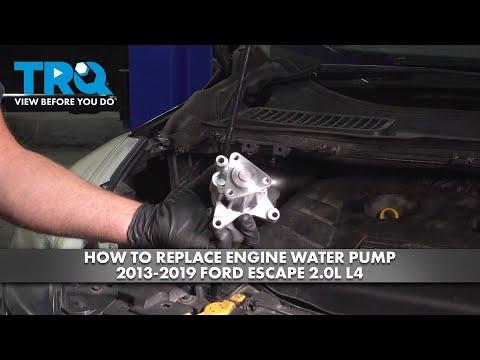







How to Replace the Water Pump on a 2019 Ford Escape 2.0L EcoBoost
Step-by-step DIY water pump replacement with tools, parts list, torque specs, safety tips, and cost savings breakdown
How to Replace the Water Pump on a 2019 Ford Escape 2.0L EcoBoost
Step-by-step DIY water pump replacement with tools, parts list, torque specs, safety tips, and cost savings breakdown


🔧 Escape - Water Pump Replacement
You’ll be removing the accessory drive belt, unbolting the water pump on the side of the engine, and installing a new pump with fresh coolant. This restores proper engine cooling and prevents overheating or coolant leaks.
Difficulty Level: Advanced | Estimated Time: 4–6 hours (first time)
⚠️ Safety & Precautions
- ⚠️ Let the engine cool completely. Hot coolant can cause severe burns if the system is opened while hot.
- ⚠️ Support the vehicle with jack stands if you lift it. Never rely only on a floor jack.
- ⚠️ You’ll be working near the accessory belt and engine mount on the right side of the engine bay. Keep hands and tools clear when the engine is running for bleeding.
- ⚠️ Coolant is toxic to people and animals. Catch all drained coolant and dispose of it properly.
- ⚠️ Disconnect the negative battery cable before working around the belt and starter area to avoid accidental cranking.
- ⚠️ On this Escape, don’t pry on the water pump or engine block sealing surface. Only use the bolt pads provided on the pump.
🔧 Required Tools
You'll need the following tools for this repair:
- 🛠️ Floor jack (rated 3-ton minimum)
- 🛠️ Jack stands (rated 3-ton minimum) - Qty: 2
- 🛠️ Wheel chocks
- 🛠️ Safety glasses
- 🛠️ Mechanic’s gloves
- 🛠️ Drain pan (at least 10-liter capacity)
- 🛠️ Shop rags or paper towels
- 🛠️ 3/8" drive ratchet
- 🛠️ 1/2" drive ratchet
- 🛠️ 3/8" drive torque wrench (5–80 ft-lbs range)
- 🛠️ 1/2" drive torque wrench (50–150 ft-lbs range)
- 🛠️ 10mm socket
- 🛠️ 13mm socket
- 🛠️ 15mm socket
- 🛠️ 18mm socket
- 🛠️ 8mm socket
- 🛠️ Short 3/8" drive extension
- 🛠️ Serpentine belt tool (flat, long-handle) (specialty)
- 🛠️ Flat-blade screwdriver (medium)
- 🛠️ Plastic trim clip remover (specialty)
- 🛠️ Pliers (standard slip-joint)
- 🛠️ Hose clamp pliers (specialty)
- 🛠️ Plastic scraper
- 🛠️ Pick tool (small) (specialty)
- 🛠️ Funnel (coolant-safe)
- 🛠️ Coolant hydrometer or refractometer (specialty)
- 🛠️ Shop light or headlamp
🔩 Required Parts
HowToo sells all the parts you need for this repair:
- 🔩 Engine water pump (2.0L EcoBoost, complete with housing) - Qty: 1
- 🔩 Water pump gasket or O-ring set - Qty: 1
- 🔩 Water pump mounting bolts (one-time-use, if specified) - Qty: 1 set
- 🔩 Serpentine drive belt - Qty: 1
- 🔩 Engine coolant (Motorcraft Orange or equivalent meeting Ford WSS-M97B44-D2) - Qty: ~7–8 liters premixed
- 🔩 Upper and lower radiator hose clamps (if original are weak) - Qty: 2–4
- 🔩 Degas bottle cap (coolant reservoir cap) (optional if old or cracked) - Qty: 1
- 🔩 Brake cleaner or coolant-safe surface cleaner - Qty: 1 can
- 🔩 Anti-seize compound (for pulley bolts, light use) - Qty: 1 small tube
📋 Before You Begin
- Park the Escape on level ground, select Park, set the parking brake, and chock the rear wheels.
- Let the engine cool for at least 1–2 hours until the upper radiator hose feels cold.
- Open the hood and locate the coolant reservoir (plastic tank on passenger side).
- Disconnect the negative battery cable using a 10mm socket and move the cable aside so it cannot spring back.
- Plan to lift the front right side of the vehicle to access the lower splash shield and belt area more easily.
🔨 Step-by-Step Instructions
Follow these steps in order:
Step 1: Lift and secure the vehicle
- Use the floor jack (3-ton) under the front right jacking point (pinch weld under the passenger door) and raise the vehicle enough to work underneath.
- Place jack stands under the proper support points and lower the Escape gently onto them using the floor jack.
- Place wheel chocks behind the rear wheels.
- Shake the vehicle slightly to confirm stability.
Step 2: Remove lower engine splash shield
- Position the drain pan under the front of the engine area.
- Use the 8mm socket and 3/8" ratchet to remove the screws holding the lower splash shield.
- Use the plastic trim clip remover to pop out any plastic clips.
- Lower the shield and set it aside.
Step 3: Drain the coolant
- Place the drain pan under the radiator drain area (lower passenger side) or under the lower radiator hose.
- Slowly loosen the coolant reservoir cap by hand to release pressure.
- If equipped with a drain plug, use the pliers or your hand to open it carefully and let coolant drain; if not, use the pliers or hose clamp pliers to release the clamp on the lower radiator hose and pull the hose off slightly to drain.
- Allow coolant to fully drain, then close the drain plug or reinstall the hose and clamp using the hose clamp pliers.
Step 4: Remove the right front wheel and inner splash panel (if needed for access)
- Use the floor jack to slightly lift the right side further if needed and remove the right front wheel using the appropriate lug wrench or 1/2" drive ratchet with correct socket (typically 19mm).
- Use the plastic trim clip remover and 8mm socket to remove the fasteners for the right inner fender liner to access the belt area.
- Pull the liner back or remove it fully and set it aside.
Step 5: Release the serpentine belt
- Locate the belt tensioner (spring-loaded pulley that keeps the belt tight).
- Install the serpentine belt tool or 15mm socket and 3/8" ratchet on the tensioner bolt.
- Rotate the tensioner in the direction that loosens the belt (usually clockwise viewed from the passenger side) and slip the belt off one of the upper pulleys using your other hand.
- Slowly release the tensioner back to rest.
- Remove the belt completely from all pulleys and note the belt routing. Take a clear picture for reference.
Step 6: Support the engine and remove the right engine mount (if required for access)
- Place a block of wood on top of the floor jack and position it under the oil pan to spread the load.
- Gently raise the jack until it just contacts and lightly supports the engine (do not lift the vehicle off the stands).
- Use the 15mm socket, 18mm socket, and 1/2" drive ratchet to remove the bolts and nuts attaching the right engine mount and bracket to the body and engine.
- Carefully lift the mount out and set it aside. Keep track of bolt locations.
Step 7: Remove any brackets or accessories blocking the water pump
- On the 2.0L EcoBoost, the water pump sits on the passenger side of the engine, driven by the accessory belt.
- Use the 10mm socket or 13mm socket with the 3/8" ratchet to remove any small brackets or covers that obstruct access to the pump and its bolts.
- Move hoses aside gently as needed. Use the hose clamp pliers to reposition small clamps if hoses need to be shifted.
Step 8: Disconnect hoses from the water pump
- Place the drain pan under the water pump area to catch any remaining coolant.
- Use the hose clamp pliers to compress and slide back the hose clamps on the water pump inlet and outlet hoses.
- Twist each hose gently by hand to break it loose, then pull it off the pump fittings. Use a flat-blade screwdriver very gently at the edge only if needed.
- Let any remaining coolant drain into the pan.
Step 9: Remove the water pump
- Locate all the water pump mounting bolts around the pump housing.
- Use the 10mm socket and 3/8" ratchet to loosen and remove the pump bolts in a criss-cross pattern.
- Carefully pull the pump straight away from the engine block. If stuck, tap lightly with your hand or a soft mallet—do not pry between metal surfaces.
- Remove the old gasket or O-ring using the plastic scraper and pick tool very gently.
- Clean the sealing surface on the engine with a lint-free rag and cleaner so it is smooth and free of residue.
Step 10: Install the new water pump
- Compare the new pump to the old one to confirm they match (same bolt holes and hose connections).
- Install the new gasket or O-ring on the new pump according to its design. Lightly lubricate O-rings with clean coolant using a rag if specified.
- Position the new pump onto the engine, aligning all bolt holes.
- Install all pump bolts finger-tight using the 10mm socket.
- Using the 3/8" torque wrench and 10mm socket, tighten the bolts evenly in a criss-cross pattern to 10 Nm (89 in-lbs).
Step 11: Reconnect hoses to the water pump
- Slide each hose fully onto its fitting on the new pump.
- Use the hose clamp pliers to move the clamps back into their original positions over the hose and fitting.
- Check each connection by pulling gently to be sure it’s secure.
Step 12: Reinstall brackets and the engine mount
- Reinstall any brackets or covers you removed earlier using the 10mm socket or 13mm socket, and tighten bolts snugly with the 3/8" torque wrench to 25 Nm (18 ft-lbs) unless otherwise marked.
- Reposition the engine slightly if needed using the floor jack under the oil pan (with wood block) to align the engine mount.
- Install the right engine mount and its bolts using the 15mm socket, 18mm socket, and 1/2" ratchet.
- Tighten the mount-to-body and mount-to-engine fasteners using the 1/2" drive torque wrench to 80 Nm (59 ft-lbs) for the smaller bolts and 115 Nm (85 ft-lbs) for the larger through-bolt, unless your mount hardware is labeled otherwise.
Step 13: Install the new serpentine belt
- Route the new belt around the pulleys according to the belt diagram under the hood or your earlier picture.
- Leave the belt off one easy-to-reach upper pulley.
- Use the serpentine belt tool or 15mm socket and 3/8" ratchet on the tensioner to rotate it and create slack.
- Slip the belt fully over the last pulley, then slowly release the tensioner.
- Visually check that the belt sits centered in all pulley grooves.
Step 14: Reinstall inner fender liner, wheel, and lower splash shield
- Reinstall the inner fender liner using the 8mm socket and plastic trim clip remover to refit screws and clips.
- Reinstall the right front wheel and hand-tighten the lug nuts.
- Lower the Escape carefully off the jack stands using the floor jack.
- Tighten the lug nuts in a star pattern with the 1/2" drive torque wrench to about 135 Nm (100 ft-lbs).
- Reinstall the lower engine splash shield using the 8mm socket and 3/8" ratchet and refit all clips.
Step 15: Refill and bleed the cooling system
- Ensure the radiator drain is closed and all hoses are connected.
- Use the funnel to slowly fill the coolant reservoir with the correct premixed coolant up to the “MAX” mark.
- Reconnect the negative battery cable with the 10mm socket and tighten snugly.
- Start the engine and let it idle. Turn the cabin heater to full hot with the fan on low.
- As the engine warms up, watch the coolant level in the reservoir and add more as it drops.
- Gently rev the engine to around 1500–2000 RPM a few times to help purge air.
- Once the engine reaches operating temperature and the heater blows hot, shut off the engine and let it cool completely.
- Recheck the coolant level after cooling and top off to the “MAX” mark if needed.
Step 16: Final leak checks
- With the engine running again, inspect around the new water pump, hose connections, and under the Escape for any signs of leaks.
- Look underneath with the shop light to check that everything is dry.
- Verify the temperature gauge on the dash stays in the normal range during a short test drive.
✅ After Repair
- Check coolant level again over the next few short drives and top off to the “MAX” mark if it drops slightly as remaining air works out.
- Inspect under the front of the Escape after parking for any fresh drips of coolant.
- Use the coolant hydrometer or refractometer to confirm proper coolant mixture (typically about 50/50) once the system is fully bled.
- Listen for any unusual belt noises; if you hear squealing, recheck belt routing and tensioner operation.
💰 DIY vs Shop Cost
Shop Cost: $650–$950 (parts + labor)
DIY Cost: $180–$320 (parts and coolant)
You Save: $330–$770 by doing it yourself!
Shop labor rates vary but typically run $100–$150/hour. This repair takes a shop approximately 3–4 hours.
🎯 Ready to get started?
HowToo makes it easy: same-day/2-day shipping on every part, plus all the tools and specialty tools you need! Check out the parts and tools sections above to add everything to your cart.