









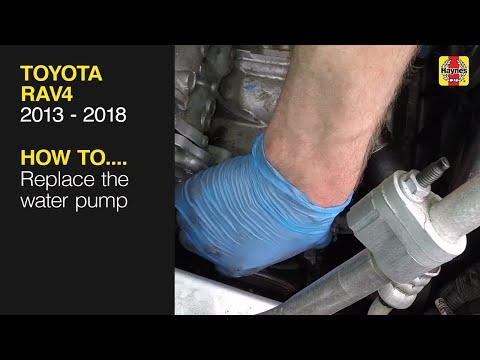




How to Replace the Water Pump on a 2009-2018 Toyota RAV4 2.5L (Engine: Inline 4 2.5L)
Step-by-step DIY water pump replacement with tools, torque specs, coolant refill, and safety tips for your 2018 RAV4
How to Replace the Water Pump on a 2009-2018 Toyota RAV4 2.5L (Engine: Inline 4 2.5L)
Step-by-step DIY water pump replacement with tools, torque specs, coolant refill, and safety tips for your 2018 RAV4 for 2009, 2010, 2011, 2012, 2013, 2014, 2015, 2016, 2017, 2018


RAV4 - Water Pump Replacement 🔧
I’ll give you a full, beginner-friendly guide for replacing the engine water pump on your 2018 RAV4 2.5L (2AR-FE), AWD, SE.
Note: This job is moderate difficulty. If you’re patient and careful, you can do it at home.
Safety First ⚠️
- 🛑 Engine cold only – Never open the cooling system on a hot engine. Hot coolant can cause serious burns.
- 🧤 Wear gloves and safety glasses.
- 🔌 Disconnect the negative battery cable (10 mm) to avoid accidental starts.
- 🧯 Keep coolant away from kids and pets – it is poisonous but sweet-tasting.
Tools & Supplies 🧰
- 🛠️ Basic tools
- 3/8" drive ratchet
- 1/4" drive ratchet (helpful in tight spots)
- Metric socket set: 8, 10, 12, 14 mm
- Metric combination wrenches: 10, 12, 14 mm
- Torque wrench (3/8" drive, range ~5–80 ft-lb) – tool that lets you tighten bolts to a specific torque.
- Serpentine belt tool or long-handled 14 mm wrench – to release belt tension.
- Flat-blade screwdriver or plastic trim tool – to help with hose clamps and clips.
- Needle-nose pliers – for spring hose clamps.
- 🧊 Cooling system items
- New water pump assembly (with gasket/O-ring) for 2.5L 2AR-FE.
- New Toyota Super Long Life Coolant (pink) – premixed 50/50. About 2–3 gallons to be safe.
- Optional: new serpentine belt (drive belt).
- Coolant drain pan (at least 2–3 gallon capacity).
- 🧽 Other
- Shop towels / rags.
- Plastic scraper – to clean gasket surfaces without scratching aluminum.
- Brake cleaner or similar – to clean surfaces (keep off belts and rubber).
Key Torque Specs 📏
- 🧷 Water pump mounting bolts: 8.0 N·m (71 in-lb)
- 🧷 Water pump pulley bolts (if removed): 21 N·m (15 ft-lb)
- 🧷 Engine undercover bolts: 7–9 N·m (62–80 in-lb) – snug, not crazy tight
- 🧷 Battery terminal nut: 5 N·m (44 in-lb)
Overview – Location 🧭
On your RAV4 2.5L, the water pump is mounted on the passenger side of the engine, driven by the serpentine belt. You’ll access it mostly from the right front wheel well and underneath.
Step 1 – Prepare the Vehicle 🚙
- 🧱 Park on a flat surface, set the parking brake, and put the shifter in P.
- 🔌 Disconnect the negative battery terminal (10 mm) and move the cable aside so it can’t spring back.
- 🪜 Raise the front of the vehicle with a jack and support it on jack stands under the proper pinch welds or frame points. Never rely on the jack alone.
- 🛞 Remove the right front wheel (21 mm lug nuts) for better access.
Step 2 – Remove Engine Under Cover & Splash Shield 🧩
- 🧷 Remove the front engine under cover:
- Remove the 10 mm bolts and plastic clips holding the cover under the engine.
- Set the cover aside.
- 🧷 Remove or loosen the right front inner fender splash shield:
- Remove the plastic clips and a few 10 mm bolts around the front of the wheel well.
- Fold the liner back to expose the side of the engine and belt area.
Step 3 – Drain Coolant 🧊
- 🪣 Place a drain pan under the radiator drain cock (bottom of radiator, usually on the passenger side).
- 🔧 Open the radiator cap slowly (engine cold!) to relieve any residual pressure.
- 🔧 Open the drain cock and let coolant drain. You don’t need to fully empty the system, but draining most of it reduces mess.
- 🔒 Close the drain cock once done. Do not overtighten; it’s plastic.
Step 4 – Remove Serpentine Belt 🪢
The serpentine belt drives the alternator, A/C, and water pump. The tensioner keeps it tight.
- 📸 Take a clear photo of the belt routing before removal, or use the routing diagram under the hood if present.
- 🔧 From the wheel well, locate the belt tensioner (pulley on a spring-loaded arm).
- 🔧 Use a 14 mm wrench or serpentine belt tool on the tensioner bolt and rotate it to relieve tension (usually clockwise on this engine).
- 🪢 While holding tension off, slip the belt off one of the upper pulleys (like the alternator), then slowly release the tensioner.
- 📦 Remove the belt completely if you’re replacing it. If reusing, set it aside in a clean area.
Step 5 – Access and Remove the Water Pump ⚙️
The water pump on the 2AR-FE is a small aluminum housing with a pulley, bolted to the engine block.
- 🧷 If your pump has a separate pulley with bolts:
- Use a 10 mm socket to remove the pulley bolts (there are usually 4).
- You may need to hold the pulley with a strap wrench or by hand with gloves.
- Remove the pulley and set aside.
- 🧷 Disconnect any hoses attached directly to the pump (if applicable on your layout):
- Use pliers to slide spring clamps back, then twist the hose gently to break it free.
- Expect some coolant to spill; keep the drain pan under the area.
- 🧷 Remove the water pump mounting bolts:
- There are several 10 mm bolts around the pump body.
- Loosen them in a crisscross pattern and remove them. Note their lengths and positions.
- 🧷 Gently pry the pump away from the engine block:
- Use a plastic or wooden tool if needed. Do not gouge the aluminum surface.
- More coolant will spill; keep the pan ready.
- 📦 Remove the pump and old gasket/O-ring.
Step 6 – Clean the Mating Surface 🧼
- 🧽 Use a plastic scraper to remove any remaining gasket material from the engine block.
- 🧽 Wipe the surface with a clean rag and a bit of brake cleaner until it’s clean and smooth.
- ⚠️ Do not scratch the aluminum or let debris fall into the coolant passages.
Step 7 – Install the New Water Pump 🆕
- 🧷 Install the new gasket or O-ring:
- If it’s a flat gasket, align it with the bolt holes on the pump.
- If it’s an O-ring style, lightly coat it with clean coolant and seat it in its groove.
- Do not use RTV sealant unless the pump manufacturer specifically says so.
- 🧷 Position the new pump on the engine and start all mounting bolts by hand to avoid cross-threading.
- 🔧 Snug the bolts evenly in a crisscross pattern.
- 🔩 Torque the water pump bolts to:
- 8.0 N·m (71 in-lb) – this is just past “snug,” do not overtighten.
- 🧷 Reconnect any hoses you removed and reinstall their clamps.
- 🧷 Reinstall the water pump pulley (if separate):
- Install the pulley and hand-thread the 10 mm bolts.
- Hold the pulley and torque the bolts to 21 N·m (15 ft-lb).
Step 8 – Reinstall the Serpentine Belt 🪢
- 📋 Route the belt according to your photo or the under-hood diagram.
- 🔧 Rotate the tensioner again with the 14 mm wrench/tool.
- 🪢 Slip the belt over the last pulley (usually an easy-to-reach smooth pulley).
- 👀 Double-check:
- Belt is centered on each pulley.
- Ribs are seated correctly in the grooves.
Step 9 – Reassemble Underbody Parts 🧩
- 🧷 Reposition the right inner fender liner and reinstall its clips and 10 mm bolts.
- 🧷 Reinstall the engine under cover with its bolts and clips (snug only).
- 🛞 Reinstall the right front wheel and torque lug nuts to about 76 ft-lb (103 N·m) in a star pattern.
- 🪜 Lower the vehicle back to the ground.
Step 10 – Refill and Bleed the Cooling System 💧
- 🧊 Make sure the radiator drain cock is closed.
- 🧴 Slowly fill the radiator with Toyota Super Long Life Coolant (pink) until full.
- 🧴 Fill the coolant reservoir to the FULL mark.
- 🔌 Reconnect the negative battery terminal and tighten the nut (about 5 N·m / 44 in-lb).
- 🚗 Start the engine and set:
- Heater to HOT.
- Fan on low to medium.
- ⏱ Let the engine idle and warm up:
- Watch the coolant level in the radiator (cap off) and top up as it drops.
- Squeeze the upper radiator hose gently to help push air out.
- 🌡 When the engine reaches operating temperature and the thermostat opens:
- You’ll feel the upper radiator hose get hot.
- Coolant level should stabilize.
- 🔒 Once no more bubbles appear and level is stable, install the radiator cap.
- 🧴 Recheck and adjust the reservoir level to the FULL mark.
Step 11 – Final Checks ✅
- 👀 Inspect around the water pump area for any leaks with the engine running.
- 👂 Listen for abnormal noises (squealing, grinding). The belt should run smoothly.
- 🚗 Take a short test drive, then let the engine cool completely and recheck:
- Coolant level in reservoir.
- Under the car for any drips.
Extra Tips 💡
- 🧰 Good time to replace the serpentine belt if it’s cracked or glazed.
- 🧪 Dispose of old coolant properly – most parts stores accept used coolant.
If you tell me whether you’re also changing the serpentine belt, I can add a simple belt-routing and inspection mini-guide for your RAV4.
HowToo makes it easy: below this answer you’ll see recommended water pump, gasket, coolant, and tools you can order with fast shipping. You can add them to your cart directly from the parts section. 🚚
Guide for Engine Water Pump replace for these Toyota vehicles
| Year Make Model | Sub Model | Engine | Body Style |
|---|---|---|---|
| 2018 Toyota RAV4 | - | Inline 4 2.5L | - |
| 2017 Toyota RAV4 | - | Inline 4 2.5L | - |
| 2016 Toyota RAV4 | - | Inline 4 2.5L | - |
| 2015 Toyota RAV4 | - | Inline 4 2.5L | - |
| 2014 Toyota RAV4 | - | Inline 4 2.5L | - |
| 2013 Toyota RAV4 | - | Inline 4 2.5L | - |
| 2012 Toyota RAV4 | - | Inline 4 2.5L | - |
| 2011 Toyota RAV4 | - | Inline 4 2.5L | - |
| 2010 Toyota RAV4 | - | Inline 4 2.5L | - |
| 2009 Toyota RAV4 | - | Inline 4 2.5L | - |