









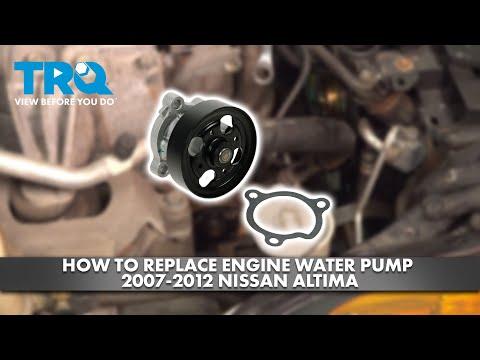







How to Replace the Water Pump on a 2008 Nissan Altima 2.5L (Timing Chain Driven)
Step-by-step instructions with tools, parts list, torque specs, timing cover tips, and coolant bleeding steps for 2008, 2009, 2010, 2011, 2012, 2013
How to Replace the Water Pump on a 2008 Nissan Altima 2.5L (Timing Chain Driven)
Step-by-step instructions with tools, parts list, torque specs, timing cover tips, and coolant bleeding steps for 2008, 2009, 2010, 2011, 2012, 2013


🔧 Altima - Water Pump Replacement
On your Altima’s 2.5L engine, the water pump sits behind the timing cover and is driven by the timing chain. Replacing it is a bigger job than most pumps because you must remove the right engine mount, front cover, and carefully manage timing components to avoid engine damage.
Difficulty Level: Advanced | Estimated Time: 6-10 hours
⚠️ Safety & Precautions
- ⚠️ Work on a cold engine; hot coolant can cause severe burns.
- ⚠️ Support the engine before removing the right-side engine mount.
- ⚠️ Keep the timing chain and guides organized; incorrect timing can cause no-start or engine damage.
- ⚠️ Use jack stands on solid, level ground—never rely on a jack alone.
- Disconnect the negative battery cable if you’ll be working near the starter/alternator wiring.
🔧 Required Tools
You'll need the following tools for this repair:
- Safety glasses
- Nitrile gloves
- Floor jack (rated 3-ton minimum)
- Jack stands (rated 3-ton minimum)
- Wheel chocks
- Drain pan (at least 10-quart)
- Funnel
- Torque wrench (10-200 ft-lbs range)
- 3/8" drive ratchet
- 1/2" drive breaker bar
- Socket set (8mm-19mm)
- Wrench set (10mm-19mm)
- Phillips screwdriver
- Flat trim tool
- Serpentine belt tool or 14mm wrench
- Harmonic balancer puller kit (specialty)
- Engine support bar (specialty)
- Gasket scraper or plastic razor blade
- Brake cleaner spray
- RTV sealant applicator nozzle
- Pliers (hose clamp)
🔩 Required Parts
HowToo sells all the parts you need for this repair:
- Water pump assembly (2.5L) - Qty: 1
- Water pump O-ring / seal - Qty: 1
- Engine coolant (Nissan-compatible long-life) - Qty: 2 gallons
- Timing cover RTV sealant (OEM-type) - Qty: 1
- Crankshaft front oil seal - Qty: 1
- Serpentine drive belt - Qty: 1
- Fresh hose clamps (assorted) - Qty: 1 set
📋 Before You Begin
- Park on level ground, set the parking brake, and chock the rear wheels.
- Raise the front of the car with a floor jack and support with jack stands.
- Let the engine cool fully before opening the cooling system.
- Take photos as you go—helps reassembly.
🔨 Step-by-Step Instructions
Follow these steps in order:
Step 1: Disconnect battery and drain coolant
- Use a 10mm socket to remove the negative battery terminal and set it aside.
- Place a drain pan (at least 10-quart) under the radiator drain.
- Open the radiator cap, then open the drain cock and drain coolant into the pan.
Step 2: Remove right front wheel and splash shields
- Use a 19mm socket to loosen lug nuts, then raise/support the car with a floor jack (rated 3-ton minimum) and jack stands (rated 3-ton minimum).
- Remove the wheel with a 19mm socket.
- Remove inner fender/splash shields using a Phillips screwdriver and flat trim tool.
Step 3: Remove the serpentine drive belt
- Use a serpentine belt tool or 14mm wrench on the belt tensioner and rotate to release tension.
- Slip the belt off and remove it from the engine bay.
Step 4: Support the engine and remove the right engine mount
- Install an engine support bar (specialty) across the strut towers and lightly tension it to hold the engine weight. (An engine support bar holds the engine from above while mounts are removed.)
- Use 14mm and 17mm sockets to remove the right engine mount fasteners and lift the mount out.
- Torque to 62 Nm (46 ft-lbs) for mount-to-body bolts and 80 Nm (59 ft-lbs) for mount-to-engine bracket bolts (during reassembly).
Step 5: Remove crankshaft pulley (harmonic balancer)
- Use a 1/2" drive breaker bar and the correct socket (typically 19mm socket) to loosen the crank bolt.
- Use a harmonic balancer puller kit (specialty) to pull the pulley off straight. (A puller removes press-fit pulleys without prying.)
- Torque to 175 Nm (129 ft-lbs) for the crank bolt during reassembly.
Step 6: Remove the front timing cover
- Remove any remaining brackets/fasteners blocking the cover using 10mm and 12mm sockets.
- Use a gasket scraper or plastic razor blade to carefully cut the RTV seam at the cover edges.
- Gently separate the cover without bending it; avoid gouging aluminum sealing surfaces.
- Torque to 12 Nm (9 ft-lbs) for timing cover bolts during reassembly (tighten evenly).
Step 7: Set engine to TDC and secure timing components
- Use a socket and ratchet on the crank to rotate the engine clockwise to Top Dead Center (TDC). (TDC is when cylinder #1 is at the top of its compression stroke.)
- Take clear photos of the timing chain alignment marks before disturbing anything.
- Do not rotate crank/cams independently.
Step 8: Remove timing chain tensioner and guide as needed
- Use a 10mm socket to remove the timing chain tensioner bolts.
- Remove the necessary guide(s) with a 10mm socket to create clearance for water pump removal.
- Torque to 10 Nm (7 ft-lbs) for tensioner bolts during reassembly.
Step 9: Remove the water pump
- Place the drain pan under the pump area—more coolant will spill.
- Use a 10mm socket to remove the water pump bolts.
- Pull the pump straight out; remove the old water pump O-ring / seal.
- Clean the mating surface using a gasket scraper or plastic razor blade and finish with brake cleaner spray on a rag.
- Torque to 12 Nm (9 ft-lbs) for water pump bolts during reassembly.
Step 10: Install the new water pump
- Lightly lubricate the new water pump O-ring / seal with fresh coolant.
- Install the pump squarely by hand, then start all bolts by hand to avoid cross-threading.
- Tighten evenly using a 10mm socket, then torque to 12 Nm (9 ft-lbs).
Step 11: Reassemble timing components and front cover
- Reinstall timing guide(s) and tensioner using a 10mm socket; torque to 10 Nm (7 ft-lbs).
- Install a new crankshaft front oil seal into the cover if removed, using a suitable driver and gentle taps.
- Apply an even bead of timing cover RTV sealant (OEM-type) to the cover’s sealing path.
- Install the cover and hand-start bolts, then tighten in stages with a 10mm socket; torque to 12 Nm (9 ft-lbs).
Step 12: Reinstall crank pulley, engine mount, belt, and shields
- Reinstall the crank pulley and crank bolt using a 19mm socket and torque wrench; torque to 175 Nm (129 ft-lbs).
- Reinstall the right engine mount with 14mm and 17mm sockets; torque to 62 Nm (46 ft-lbs) and 80 Nm (59 ft-lbs) as applicable.
- Install the new serpentine drive belt using a serpentine belt tool or 14mm wrench.
- Reinstall splash shields using a Phillips screwdriver and flat trim tool.
- Reinstall the wheel with a 19mm socket; torque to 113 Nm (83 ft-lbs).
Step 13: Refill and bleed the cooling system
- Close the radiator drain, then refill with engine coolant (Nissan-compatible long-life) using a funnel.
- Start the engine and let it warm up with the heater set to HOT.
- Watch coolant level and add as needed; check for leaks at the pump and cover.
✅ After Repair
- Verify no coolant leaks with the engine running and after a short test drive.
- Recheck coolant level after the engine cools; top off if needed.
- Listen for abnormal rattles near the timing cover area.
💰 DIY vs Shop Cost
Shop Cost: $900-$1,600 (parts + labor)
DIY Cost: $120-$280 (parts only)
You Save: $780-$1,320 by doing it yourself!
Shop labor rates vary but typically run $100-$150/hour. This repair takes a shop approximately 6-10 hours.
🎯 Ready to get started?
HowToo makes it easy: same-day/2-day shipping on every part, plus all the tools and specialty tools you need! Check out the parts and tools sections below to add everything to your cart.