









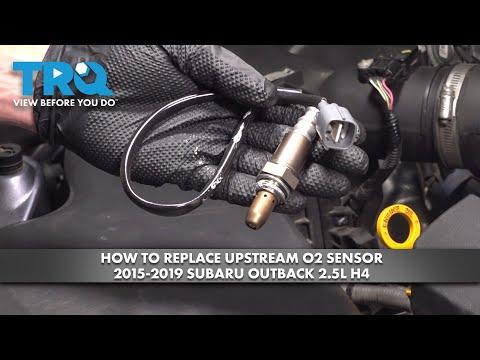







How to Replace the Upstream or Downstream O2 Sensor on a 2013-2019 Subaru Legacy (Engine: Flat 4 2.5L)
Step-by-step DIY guide with tools, parts, safety tips, sensor locations, and 30 ft-lb torque spec
How to Replace the Upstream or Downstream O2 Sensor on a 2013-2019 Subaru Legacy (Engine: Flat 4 2.5L)
Step-by-step DIY guide with tools, parts, safety tips, sensor locations, and 30 ft-lb torque spec for 2013, 2014, 2015, 2016, 2017, 2018, 2019


🔧 Legacy - Oxygen Sensor Replacement
Your Legacy has two exhaust oxygen sensors: the front Air/Fuel (A/F) sensor (upstream, before the catalytic converter) and the rear O2 sensor (downstream, after the catalytic converter). Replacing the correct one fixes check-engine lights, poor fuel economy, and drivability issues caused by a failed sensor.
Difficulty Level: Intermediate | Estimated Time: 1.0-2.0 hours
⚠️ Safety & Precautions
- Work on a fully cool exhaust; sensors can cause severe burns when hot.
- Support the car with jack stands on solid, level ground—never rely on a jack alone.
- Use safety glasses; rust and debris often fall when loosening the sensor.
- Do not pull on wiring; release the connector lock before separating.
- Battery disconnect is not strictly required, but it’s recommended before unplugging sensor connectors.
🔧 Required Tools
You'll need the following tools for this repair:
- Floor jack (rated 2-ton minimum)
- Jack stands (rated 2-ton minimum, pair)
- Wheel chocks
- Safety glasses
- Mechanic gloves
- 22mm oxygen sensor socket (slotted)
- 3/8" drive ratchet
- 3/8" drive extension set
- Breaker bar (3/8" or 1/2" drive)
- Torque wrench (10–80 ft-lbs range)
- 10mm socket
- 12mm socket
- Flat trim clip tool
- Penetrating oil spray
- OBD2 scan tool
🔩 Required Parts
HowToo sells all the parts you need for this repair:
- Front Air/Fuel ratio sensor (upstream) - Qty: 1
- Rear oxygen sensor (downstream) - Qty: 1
- High-temp anti-seize compound - Qty: 1
📋 Before You Begin
- Quick question #1: Are you replacing the front A/F sensor or the rear O2 sensor?
- Quick question #2: What code(s) are stored (example: P0130, P0137, P0420)?
- Park on level ground, shift to P, and set the parking brake.
- Let the exhaust cool completely (at least 1 hour after driving).
- If disconnecting the battery: use a 10mm socket to remove the negative terminal and isolate it so it can’t spring back.
🔨 Step-by-Step Instructions
Follow these steps in order:
Step 1: Raise and support the front of the car
- Place wheel chocks behind the rear wheels.
- Use a floor jack to lift the front of your Legacy at the front center jack point.
- Set it securely on jack stands at the front pinch welds or approved stand points.
Step 2: Remove the front under cover (splash shield) if it blocks access
- Use a 12mm socket to remove the bolts.
- Use a flat trim clip tool to pop out the plastic clips.
- Set the cover and hardware aside in a small pile so nothing gets lost.
Step 3: Locate the correct sensor
- Front A/F sensor (upstream): Installed in the exhaust manifold/collector area, before the catalytic converter.
- Rear O2 sensor (downstream): Installed after the catalytic converter, further back under the car.
- Follow the wire to its connector.
Step 4: Unplug the sensor connector
- Spray the connector area lightly with penetrating oil spray only if it’s dirty (avoid soaking the connector).
- Release the locking tab by hand (or gently with the flat trim clip tool), then separate the connector.
- Free any wiring clips so the harness can rotate with the sensor as you remove it.
Step 5: Loosen and remove the oxygen sensor
- Spray the sensor threads where it meets the exhaust with penetrating oil spray and wait 5–10 minutes.
- Place the 22mm oxygen sensor socket (slotted) over the sensor with the wire passing through the slot.
- Use a ratchet and extension to break it loose. If it’s very tight, switch to a breaker bar.
- Once loose, spin it out by hand and remove it.
Step 6: Install the new sensor
- Compare the new sensor to the old one (same connector and length).
- If the new sensor threads are not pre-coated: apply a tiny amount of high-temp anti-seize compound to the threads only (keep it off the tip).
- Thread the sensor in by hand first to avoid cross-threading.
- Tighten with the 22mm oxygen sensor socket (slotted) and torque wrench: Torque to 40 Nm (30 ft-lbs).
Step 7: Reconnect wiring and secure the harness
- Plug the connector back in until it clicks.
- Reinstall any harness clips so the wire is not touching the exhaust.
Step 8: Reinstall the under cover and lower the car
- Reinstall the under cover using the 12mm socket and the original clips.
- Lift slightly with the floor jack, remove jack stands, and lower the car.
Step 9: Clear codes and verify the fix
- If you disconnected the battery, reconnect it using a 10mm socket.
- Use an OBD2 scan tool to clear stored codes.
- Start the engine and check for exhaust leaks (loud ticking) around the sensor area.
✅ After Repair
- Test drive 10–15 minutes with mixed city/highway driving and confirm the check engine light stays off.
- Re-scan with your OBD2 scan tool and confirm no codes return.
- If you still have a code like P0420, the issue may be catalytic converter efficiency rather than the sensor.
💰 DIY vs Shop Cost
Shop Cost: ₹8,000-₹18,000 (parts + labor)
DIY Cost: ₹3,500-₹12,000 (parts only)
You Save: ₹4,500-₹6,000 by doing it yourself!
Shop labor rates vary but typically run ₹1,200-₹2,500/hour. This repair takes a shop approximately 1.0-2.0 hours.
🎯 Ready to get started?
HowToo makes it easy: same-day/2-day shipping on every part, plus all the tools and specialty tools you need! Check out the parts and tools sections below to add everything to your cart.
Guide for Oxygen Sensor replace for these Subaru vehicles
| Year Make Model | Sub Model | Engine | Body Style |
|---|---|---|---|
| 2019 Subaru Legacy | - | Flat 4 2.5L | - |
| 2019 Subaru Legacy | - | Flat 6 3.6L | - |
| 2018 Subaru Legacy | - | Flat 4 2.5L | - |
| 2018 Subaru Legacy | - | Flat 6 3.6L | - |
| 2017 Subaru Legacy | - | Flat 4 2.5L | - |
| 2017 Subaru Legacy | - | Flat 6 3.6L | - |
| 2016 Subaru Legacy | - | Flat 4 2.5L | - |
| 2016 Subaru Legacy | - | Flat 6 3.6L | - |
| 2015 Subaru Legacy | - | Flat 4 2.5L | - |
| 2015 Subaru Legacy | - | Flat 6 3.6L | - |
| 2014 Subaru Legacy | - | Flat 4 2.5L | - |
| 2014 Subaru Legacy | - | Flat 6 3.6L | - |
| 2013 Subaru Legacy | - | Flat 4 2.5L | - |
| 2013 Subaru Legacy | - | Flat 6 3.6L | - |