









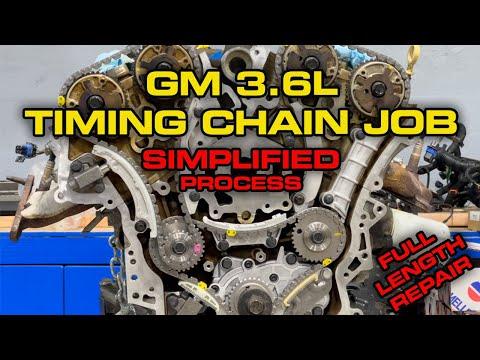







How to Replace the Timing Chain on a 2018 Chevrolet Camaro 3.6L V6 (Step-by-Step Guide)
Tools, parts list, safety tips, cam/crank locking procedure, and critical timing verification steps
How to Replace the Timing Chain on a 2018 Chevrolet Camaro 3.6L V6 (Step-by-Step Guide)
Tools, parts list, safety tips, cam/crank locking procedure, and critical timing verification steps


🔧 Camaro - Timing Chain Replacement
Your Camaro’s 3.6L uses timing chains (not a belt) to keep the crankshaft and camshafts synchronized. Replacing the chains is a major job because you have to open the front of the engine and precisely re-time the cams—one small mistake can cause severe engine damage.
Difficulty Level: Advanced | Estimated Time: 10-18 hours
⚠️ Safety & Precautions
- ⚠️ Let the engine cool fully before opening the cooling system.
- ⚠️ Disconnect the battery negative cable to prevent accidental cranking.
- ⚠️ Support the engine safely if an engine mount must be removed.
- ⚠️ Do not rotate the crank/cams with the chains removed unless the OEM procedure allows it.
- ⚠️ Keep the work area surgically clean—dirt in the front cover can ruin the engine.
🔧 Required Tools
You'll need the following tools for this repair:
- Safety glasses
- Nitrile gloves
- Wheel chocks
- Floor jack (rated 3-ton minimum)
- Jack stands (rated 3-ton minimum)
- Engine support bar
- Drain pan (10-liter minimum)
- Funnel
- Socket set (8mm-24mm)
- Deep socket set (10mm-18mm)
- Breaker bar (1/2-inch drive)
- Torque wrench (10-200 Nm range)
- Torque angle gauge
- Torx bit set (T20-T50)
- E-Torx socket set (E8-E18)
- Hex bit socket set (4mm-10mm)
- Pry bar set
- Trim clip removal tool
- Serpentine belt tool (long handle)
- Harmonic balancer puller kit
- Harmonic balancer installer kit
- Camshaft holding/locking tool kit (specialty)
- Crankshaft holding tool (specialty)
- Feeler pick set
- Plastic gasket scraper
- Shop towels
- Brake cleaner spray
- RTV sealant applicator nozzle
🔩 Required Parts
HowToo sells all the parts you need for this repair:
- Timing chain kit (primary chain + secondary chains + guides + tensioners) - Qty: 1
- Front cover gasket set - Qty: 1
- Front crankshaft seal - Qty: 1
- Valve cover gaskets - Qty: 2
- Harmonic balancer bolt (single-use torque-to-yield) - Qty: 1
- Engine oil (dexos-approved, correct viscosity for your Camaro) - Qty: 6 quarts
- Oil filter - Qty: 1
- Coolant (DEX-COOL compatible) - Qty: 2-3 gallons premix
- RTV sealant (GM-style engine sealant) - Qty: 1
📋 Before You Begin
- Park your Camaro on level ground, set the parking brake, and chock the rear wheels.
- Disconnect the negative battery cable using a 10mm socket.
- Raise the front of the car with a floor jack and support it with jack stands.
- Drain the coolant into a drain pan (hot coolant can burn).
- Plan to label every connector and bolt.
🔨 Step-by-Step Instructions
Follow these steps in order:
Step 1: Confirm you have GM torque specs and the correct specialty tools
- This job uses multiple torque-to-yield fasteners and critical torque sequences.
- Before turning a wrench, confirm you have a torque spec source for your Camaro and the camshaft holding/locking tool kit (specialty) plus the crankshaft holding tool (specialty).
- If you do not have the torque specs, do not proceed past disassembly—reassembly without exact specs can cause oil leaks, loose balancer, or catastrophic timing slip.
Step 2: Remove underbody shields and gain front access
- Remove the lower splash shield using a socket set (8mm-10mm) and a trim clip removal tool.
- Set hardware aside in labeled bags (example: “shield bolts”).
Step 3: Drain fluids (coolant and engine oil)
- Open the coolant drain and catch coolant with a drain pan.
- Drain engine oil using the correct drain plug socket from your socket set (8mm-24mm) and catch it with a drain pan.
Step 4: Remove the serpentine belt and front accessories
- Relieve belt tension using a serpentine belt tool (long handle) and remove the belt.
- Remove required front accessories/brackets (as applicable) using a socket set (8mm-24mm) and E-Torx socket set (E8-E18).
- Take photos before unplugging anything.
Step 5: Support the engine and remove any obstructing mount/bracket
- Install and tension an engine support bar so the engine is safely supported from above.
- Remove the obstructing mount/bracket hardware using a socket set (8mm-24mm).
- Torque to OEM spec during reassembly (mount fasteners are safety-critical).
Step 6: Remove the harmonic balancer (crank pulley)
- Hold the crank with the crankshaft holding tool (specialty).
- Remove the balancer bolt using a breaker bar (1/2-inch drive) and the correct socket from your socket set (8mm-24mm).
- Remove the balancer using a harmonic balancer puller kit.
- Important: Plan to install a new balancer bolt (torque-to-yield).
Step 7: Remove valve covers (to access cam timing features)
- Disconnect ignition/PCV/vent connections as needed.
- Remove valve cover bolts with a socket set (8mm-24mm) or E-Torx socket set (E8-E18) (whichever your fasteners use).
- Lift covers carefully and keep debris out of the valvetrain.
Step 8: Remove the front cover
- Remove front cover bolts using a socket set (8mm-24mm) and E-Torx socket set (E8-E18).
- Gently separate the cover using a pry bar set (only at designated pry points).
- Clean gasket surfaces with a plastic gasket scraper and brake cleaner spray.
Step 9: Set the engine to the correct timing position and lock it
- Rotate the engine by hand (never with the starter) using a socket from your socket set (8mm-24mm) on the crank.
- Install the camshaft holding/locking tool kit (specialty) and keep the crank held with the crankshaft holding tool (specialty).
- Stop here if your locking tools do not fit correctly—that means the engine is not at the correct timing position.
Step 10: Remove tensioners, guides, and chains
- Remove timing chain tensioners using the correct bit from your socket set (8mm-24mm), Torx bit set (T20-T50), or E-Torx socket set (E8-E18) depending on fasteners.
- Remove timing guides using the same tool sets as above.
- Remove the chains and keep track of which chain goes where (primary vs secondary).
Step 11: Install new chains, guides, and tensioners (critical timing step)
- Install new guides and hand-start all fasteners to avoid cross-threading.
- Align the chain colored links with the correct crank/cam sprocket timing marks (exact mark locations vary by setup).
- Install and set (pin/release) tensioners per the instructions included with your timing kit.
- Torque all timing fasteners to OEM spec using a torque wrench (10-200 Nm range).
- Do not “eyeball” timing marks.
Step 12: Verify timing by hand-rotating the engine
- Remove locking tools, then rotate the crank slowly by hand two full revolutions using a socket from your socket set (8mm-24mm).
- Re-check that timing marks/positions return correctly (per your OEM procedure).
- If anything binds or feels “hard stop,” do not force it—recheck timing.
Step 13: Reinstall the front cover with correct sealant placement
- Install the new front cover gasket.
- Apply RTV only where the OEM procedure calls for it (commonly at joints where covers meet).
- Install the cover and torque bolts in sequence with a torque wrench (10-200 Nm range).
- Torque to OEM spec (bolt lengths can vary by hole).
Step 14: Reinstall harmonic balancer with a new bolt
- Press/install the balancer using a harmonic balancer installer kit (do not hammer it on).
- Install a new balancer bolt and tighten using a torque wrench (10-200 Nm range) and torque angle gauge.
- Torque to OEM spec + angle (this is torque-to-yield).
Step 15: Reassemble accessories, belt, valve covers, and refill fluids
- Install valve covers with new gaskets and tighten evenly using a torque wrench (10-200 Nm range).
- Reinstall brackets/accessories using a socket set (8mm-24mm) and E-Torx socket set (E8-E18).
- Reinstall the belt using a serpentine belt tool (long handle).
- Refill engine oil using a funnel.
- Refill coolant and bleed air per the OEM process.
✅ After Repair
- Start the engine and let it idle; listen for abnormal chain rattle and watch for oil/coolant leaks.
- Verify oil pressure warning stays off and the temperature rises normally.
- Top off coolant after the first full heat cycle (cool down completely first).
- If the check engine light comes on, scan codes before driving further.
- Some GM setups may require a crank/cam correlation relearn with a GM-capable scan tool after timing work; follow the OEM service procedure if applicable.
💰 DIY vs Shop Cost
Shop Cost: ₹80,000-₹180,000 (parts + labor)
DIY Cost: ₹25,000-₹70,000 (parts only)
You Save: ₹55,000-₹110,000 by doing it yourself!
Shop labor rates vary but typically run ₹1,500-₹3,500/hour. This repair takes a shop approximately 10-18 hours.
🎯 Ready to get started?
HowToo makes it easy: same-day/2-day shipping on every part, plus all the tools and specialty tools you need! Check out the parts and tools sections below to add everything to your cart.
Two quick questions so I can finish this with correct, exact torque specs and the right variant steps:
- 🧰 Do you have a GM-capable scan tool and the cam/crank locking tool kit listed above?
- 🔊 Why are you replacing the chains (rattle on cold start, metal in oil, check-engine codes)?