









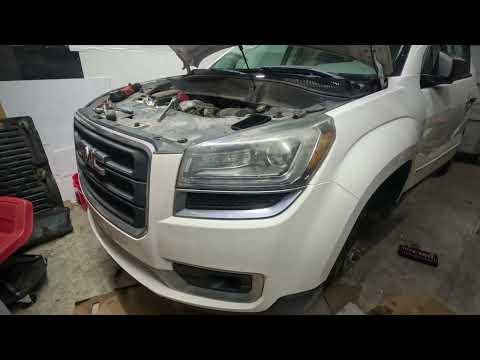







How to Replace the Timing Chain on a 2016 GMC Acadia 3.6L V6 (Not a Timing Belt)
Step-by-step timing chain replacement guide with required tools, parts list, safety tips, and timing setup notes
How to Replace the Timing Chain on a 2016 GMC Acadia 3.6L V6 (Not a Timing Belt)
Step-by-step timing chain replacement guide with required tools, parts list, safety tips, and timing setup notes


🔧 Acadia - Timing Chain Replacement
Your Acadia’s 3.6L V6 uses a timing chain, not a timing belt. Replacing the timing chain is a major engine-timing job that requires holding the camshafts/crankshaft in the correct positions so the engine stays in sync.
Difficulty Level: Advanced | Estimated Time: 8-14 hours
Assumption: Stock 3.6L V6 (timing-chain engine).
⚠️ Safety & Precautions
- ⚠️ Work on a cool engine; hot coolant/oil can burn.
- ⚠️ Disconnect the negative battery cable to prevent accidental cranking.
- ⚠️ Support the engine before removing the right-side engine mount.
- ⚠️ Keep fingers clear when releasing chain tensioners.
- ⚠️ If timing is set wrong, the engine can be severely damaged—double-check all timing marks.
🔧 Required Tools
You'll need the following tools for this repair:
- Safety glasses
- Nitrile gloves
- Wheel chocks
- Floor jack (rated 3-ton minimum)
- Jack stands (rated 3-ton minimum)
- Engine support bar (specialty)
- Drain pan (at least 10-quart)
- Metric socket set (8mm-24mm)
- 1/4" drive ratchet
- 3/8" drive ratchet
- 1/2" drive breaker bar
- Torque wrench (10-200 ft-lbs range)
- Torx bit set (T20-T50)
- E-Torx socket set (E8-E14)
- Serpentine belt tool (specialty)
- Harmonic balancer puller kit (specialty)
- Crankshaft pulley holding tool (specialty)
- Camshaft locking tool kit for GM 3.6L (specialty)
- Trim clip removal tool
- Plastic scraper
- Brake cleaner spray
- Shop rags
- Funnel
🔩 Required Parts
HowToo sells all the parts you need for this repair:
- Timing chain kit (chains, guides, tensioners) - Qty: 1
- Front timing cover gasket set - Qty: 1
- Front crankshaft seal - Qty: 1
- Valve cover gasket set (if removed for access) - Qty: 1
- Crankshaft pulley bolt (torque-to-yield style) - Qty: 1
- Engine oil (dexos-approved 5W-30 full synthetic) - Qty: 6 quarts
- Oil filter - Qty: 1
- Coolant (DEX-COOL compatible) - Qty: 2-3 gallons premix
- RTV silicone gasket maker (timing cover sealing) - Qty: 1
- Serpentine belt (recommended while apart) - Qty: 1
📋 Before You Begin
- Park on level ground, set the parking brake, and chock the rear wheels.
- Disconnect the battery using a 10mm socket on the negative terminal.
- Raise the front with a floor jack and support with jack stands under proper lift points.
- Plan for cleanliness: timing cover sealing surfaces must be oil-free for RTV to seal.
- Cam locking tools “hold timing” while you work.
🔨 Step-by-Step Instructions
Follow these steps in order:
Step 1: Disconnect battery and prep the work area
- Use a 10mm socket to remove the negative battery cable and isolate it.
- Put a drain pan under the engine.
Step 2: Drain coolant and engine oil
- Drain coolant into a drain pan (open radiator drain if equipped; otherwise remove the lower hose with hose clamp pliers if you have them, or carefully with a flat screwdriver if it’s a worm clamp).
- Drain engine oil using a 15mm socket for the drain plug (common size) and remove the oil filter with an oil filter wrench if needed.
- Label the drain pans so you don’t mix fluids.
Step 3: Remove right front wheel and splash shields
- Use a 19mm socket to remove the lug nuts and remove the wheel.
- Remove fender liner/splash shield fasteners using a trim clip removal tool and 7mm/10mm sockets as needed.
Step 4: Remove the serpentine belt and front accessory components
- Relieve belt tension with a serpentine belt tool and slip the belt off.
- Remove any components blocking the front cover (varies by packaging): use metric sockets and E-Torx sockets for brackets/fasteners.
- Take photos before removing brackets.
Step 5: Support the engine and remove the right engine mount
- Install an engine support bar (specialty) across the strut towers and gently take the engine’s weight.
- Remove the right engine mount fasteners using metric sockets and torque wrench for reassembly.
- Torque to OEM specification on reassembly (mount fastener torque varies by fastener/location).
Step 6: Remove the crankshaft pulley (harmonic balancer)
- Hold the crank pulley using a crankshaft pulley holding tool (specialty).
- Remove the crank bolt with a 1/2" breaker bar and correct socket (commonly 24mm on many GM applications).
- Use a harmonic balancer puller kit (specialty) to pull the balancer off.
- Do not pry against the timing cover.
Step 7: Remove the front timing cover
- Remove perimeter bolts using metric sockets and E-Torx sockets where applicable.
- Carefully separate the cover using a plastic scraper (avoid gouging aluminum).
- Clean the mating surfaces with brake cleaner spray and shop rags.
Step 8: Set cylinder #1 to TDC and lock the engine timing
- Rotate the engine by hand using a breaker bar on the crank bolt (temporarily reinstall if needed) until timing marks align.
- Install the camshaft locking tool kit for GM 3.6L (specialty). (A cam locking tool holds camshafts so they can’t rotate.)
- Do not rotate the crank/cams independently once the chain is off.
Step 9: Remove timing chain tensioners, guides, and chains
- Relieve/remove tensioners using metric sockets.
- Remove chain guides with metric sockets or Torx bits depending on fasteners.
- Remove the primary chain and any secondary chains (if equipped) carefully by hand.
- Keep bolts grouped by location.
Step 10: Install new chains, guides, and tensioners (time the engine)
- Install new guides using metric sockets; Torque to OEM specification.
- Route the new chain(s) following the colored link(s) to the timing marks on the sprockets (your kit instructions will show the marked links).
- Install the new tensioners using metric sockets; Torque to OEM specification.
- Release tensioners per the kit design (some use a retaining pin you pull).
Step 11: Verify timing by hand-rotating the engine
- Remove the cam locking tools only when instructed by the tool kit procedure.
- Rotate the crankshaft by hand two full turns using a breaker bar.
- Re-check that timing marks align correctly; if not, stop and correct before proceeding.
- If it binds, stop immediately.
Step 12: Reinstall front cover with new seals and RTV
- Install a new front crankshaft seal in the cover (use a suitable driver from a harmonic balancer puller kit or seal driver piece).
- Apply RTV silicone gasket maker at the OEM-specified junction points (commonly where the cover meets the oil pan and cylinder head seams).
- Install the timing cover and hand-start all bolts; tighten using a torque wrench in an even pattern.
- Torque to OEM specification (cover bolt torque varies by bolt size/location).
Step 13: Reinstall crank pulley and replace the crank bolt
- Reinstall the harmonic balancer (use the proper installer method if required by your puller kit).
- Install a new crankshaft pulley bolt using a torque wrench and the crankshaft pulley holding tool (specialty).
- Torque to OEM specification (often a multi-step torque + angle procedure on torque-to-yield bolts).
Step 14: Reassemble accessories, mount, belt, and shields
- Reinstall brackets/accessories using metric sockets and E-Torx sockets; Torque to OEM specification.
- Reinstall the right engine mount using metric sockets and a torque wrench; Torque to OEM specification.
- Install the serpentine belt using a serpentine belt tool and confirm correct routing.
- Reinstall splash shields and the wheel using trim clip removal tool and a 19mm socket; Torque to OEM specification for lug nuts.
Step 15: Refill fluids and reconnect battery
- Install a new oil filter by hand and refill with 5W-30 dexos-approved oil using a funnel.
- Refill coolant with DEX-COOL compatible coolant using a funnel.
- Reconnect the battery negative cable using a 10mm socket.
✅ After Repair
- Start the engine and let it idle; verify smooth idle and no warning lights.
- Check for oil leaks at the timing cover and crank seal area.
- Check coolant level after warm-up and top off as needed; confirm the heater blows hot (helps confirm coolant circulation).
- Test drive gently, then re-check for leaks and re-check fluid levels.
💰 DIY vs Shop Cost
Shop Cost: $1,800-$3,500 (parts + labor)
DIY Cost: $350-$900 (parts only)
You Save: $1,450-$2,600 by doing it yourself!
Shop labor rates vary but typically run $100-$150/hour. This repair takes a shop approximately 8-14 hours.
🎯 Ready to get started?
HowToo makes it easy: same-day/2-day shipping on every part, plus all the tools and specialty tools you need! Check out the parts and tools sections below to add everything to your cart.