









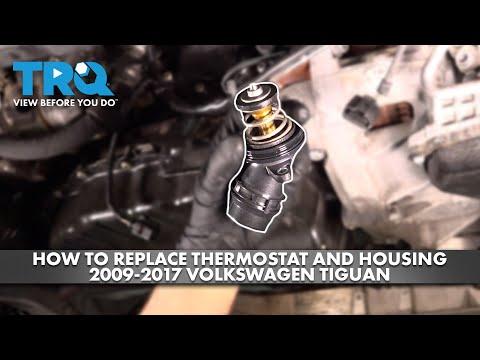







How to Replace the Thermostat/Water Pump Housing on a 2018 Volkswagen Tiguan 2.0T
Step-by-step DIY guide with required tools, parts list, torque specs, and coolant refill/bleeding tips for 2018, 2021
How to Replace the Thermostat/Water Pump Housing on a 2018 Volkswagen Tiguan 2.0T
Step-by-step DIY guide with required tools, parts list, torque specs, and coolant refill/bleeding tips for 2018, 2021


🔧 Tiguan - Thermostat Replacement
On your Tiguan’s 2.0T engine, the thermostat is typically built into the water pump/thermostat housing module, so replacement usually means swapping that complete housing (not just a small “standalone” thermostat). This job sits under the intake manifold, so access is the main challenge, plus you must drain/refill coolant correctly to avoid overheating.
Difficulty Level: Advanced | Estimated Time: 4-7 hours
⚠️ Safety & Precautions
- ⚠️ Work only on a fully cold engine; hot coolant can cause severe burns.
- ⚠️ Support the vehicle securely; never rely on a jack alone.
- ⚠️ Keep coolant off belts and electrical connectors; clean spills immediately.
- ⚠️ Disconnect the battery negative terminal before unplugging many engine connectors.
- ⚠️ Use only VW-spec coolant (pink/purple VW coolant); mixing types can sludge the system.
🔧 Required Tools
You'll need the following tools for this repair:
- Floor jack (rated 3-ton minimum)
- Jack stands (rated 3-ton minimum)
- Wheel chocks
- Safety glasses
- Nitrile gloves
- Drain pan (at least 10-quart)
- Funnel
- Trim clip removal tool
- Flathead screwdriver
- Pick tool
- Hose clamp pliers
- Ratchet (3/8")
- Extension set (3/8")
- Torque wrench (5–60 Nm range)
- 10mm socket
- 13mm socket
- 16mm socket
- Torx T20 bit
- Torx T25 bit
- Torx T30 bit
- 6mm hex bit
- Serpentine belt tool (16mm)
- OBD2 scan tool with VW cooling system output tests (specialty)
- Cooling system vacuum fill tool (specialty)
🔩 Required Parts
HowToo sells all the parts you need for this repair:
- Water pump / thermostat housing assembly (integrated thermostat) - Qty: 1
- Intake manifold gasket - Qty: 1
- Throttle body gasket/O-ring - Qty: 1
- Coolant (VW-spec pink/purple) - Qty: 2-3 gallons (mixed 50/50 if concentrate)
- Coolant hose O-rings/seals (as applicable) - Qty: 1 set
- Serpentine belt - Qty: 1 (recommended if contaminated or cracked)
📋 Before You Begin
- Park on level ground, set the parking brake, and let the engine go fully cold.
- Open the hood and remove the engine cover (pull straight up by hand).
- Disconnect the battery negative terminal using a 10mm socket and isolate the cable.
- Place a drain pan under the front of the engine bay area where coolant will drain.
- A vacuum fill tool makes bleeding much easier.
🔨 Step-by-Step Instructions
Follow these steps in order:
Step 1: Relieve coolant pressure
- Slowly loosen the coolant expansion tank cap by hand to release any residual pressure, then reinstall it loosely.
Step 2: Raise and secure the vehicle
- Lift the front using a floor jack (rated 3-ton minimum) and support with jack stands (rated 3-ton minimum).
- Use wheel chocks at the rear wheels.
Step 3: Remove the lower engine splash shield (if equipped)
- Remove fasteners with a Torx T25 bit and a ratchet (3/8").
- Use a trim clip removal tool for any push-clips.
Step 4: Drain the coolant
- Position the drain pan under the radiator drain area or lower radiator hose area.
- If draining from a hose connection, release the clamp with hose clamp pliers and carefully work the hose free using a pick tool.
- Let coolant drain fully, then temporarily refit the hose and clamp.
Step 5: Remove the intake ducting to access the intake manifold
- Loosen the intake hose clamps using a flathead screwdriver (or the correct bit if your clamps are screw-type).
- Unclip/remove the air ducting and set aside.
Step 6: Remove the throttle body (to clear the manifold)
- Unplug the throttle body connector by hand; use a pick tool gently if the lock tab is stubborn.
- Remove throttle body bolts using a Torx T30 bit and ratchet (3/8").
- Remove the throttle body and discard the old throttle body gasket/O-ring.
- On reassembly: Torque to 10 Nm (7 ft-lbs).
- Don’t pry on the throttle plate.
Step 7: Remove the intake manifold
- Unplug any manifold sensors/actuators and move the harness aside.
- Release any attached vacuum/EVAP lines using hose clamp pliers and a pick tool.
- Remove intake manifold fasteners using a 10mm socket and extension set (3/8").
- Remove the manifold and discard the old intake manifold gasket.
- On reassembly: Torque to 9 Nm (80 in-lbs).
Step 8: Move the serpentine belt out of the way (if it blocks access)
- Rotate the belt tensioner using a serpentine belt tool (16mm) and slide the belt off the relevant pulley.
- Inspect the belt; replace if cracked, glazed, or coolant-soaked.
Step 9: Remove coolant hoses from the thermostat/water pump housing
- Place rags and the drain pan under the housing area for spills.
- Release spring clamps with hose clamp pliers.
- Twist hoses gently to break the seal, then pull off; use a pick tool carefully if stuck.
- Remove and replace any coolant hose O-rings/seals that come off with the housing.
Step 10: Unplug electrical connectors at the housing
- Unplug connectors by hand; use a pick tool only to lift lock tabs.
- Pull on the connector, not the wires.
Step 11: Remove the thermostat/water pump housing assembly
- Remove mounting bolts using a 10mm socket with extension set (3/8").
- Remove the housing from the engine and catch remaining coolant in the drain pan.
- Clean the mating surface using a clean rag; do not gouge aluminum.
Step 12: Install the new housing assembly
- Ensure new seals/O-rings are seated on the new unit (do not reuse old flattened seals).
- Position the housing and hand-start all bolts to avoid cross-threading.
- Tighten bolts evenly using a torque wrench (5–60 Nm range): Torque to 10 Nm (7 ft-lbs), then turn an additional 90° (angle-tighten).
Step 13: Reconnect hoses and wiring
- Reinstall hoses fully seated, then secure clamps using hose clamp pliers.
- Reconnect all electrical connectors until they click.
Step 14: Reinstall intake manifold and throttle body
- Install a new intake manifold gasket, then reinstall the manifold using a 10mm socket.
- Torque to 9 Nm (80 in-lbs).
- Install the throttle body with a new throttle body gasket/O-ring using a Torx T30 bit.
- Torque to 10 Nm (7 ft-lbs).
Step 15: Reinstall belt, intake ducting, and splash shield
- Route and reinstall the belt using the serpentine belt tool (16mm).
- Reinstall intake ducting and tighten clamps with a flathead screwdriver.
- Reinstall the lower splash shield using a Torx T25 bit.
Step 16: Refill and bleed the cooling system
- Lower the vehicle safely.
- Refill the expansion tank using a funnel with the correct VW-spec coolant (50/50 mix if concentrate).
- Best method: use a cooling system vacuum fill tool (specialty) to pull vacuum and refill without air pockets.
- If using a scan tool: run cooling system bleed/output tests with an OBD2 scan tool with VW cooling system output tests (specialty) (this commands pumps/valves to help purge air).
- Without scan tool: start engine, set cabin heat to max temp and low fan, let it idle, and top off as the level drops. Watch temperature closely.
✅ After Repair
- Bring the engine to operating temp and confirm the heater blows hot air (a sign coolant is circulating).
- Check for leaks around the new housing and all hose connections with a flashlight.
- Shut off, let cool completely, then recheck coolant level and top off to the correct mark.
- If you had a check-engine light related to coolant temp, clear codes using an OBD2 scan tool and verify they don’t return.
- Over the next 2-3 drives, recheck level each morning when cold.
💰 DIY vs Shop Cost
Shop Cost: $900-$1,600 (parts + labor)
DIY Cost: $250-$650 (parts only)
You Save: $650-$950 by doing it yourself!
Shop labor rates vary but typically run $100-$150/hour. This repair takes a shop approximately 4-7 hours.
🎯 Ready to get started?
HowToo makes it easy: same-day/2-day shipping on every part, plus all the tools and specialty tools you need! Check out the parts and tools sections below to add everything to your cart.